Grade Level: Elementary School (Grades 3–5)
Claude Monet (1840–1926) was a French painter who is considered by many in the art world the leader of Impressionism, an artistic movement that took place predominantly in the 1860s to 1880s. Impressionists were interested in capturing the immediate visual feeling of a scene, often applying quick and distinctive brushstrokes to thecanvas to depict changing light and atmosphere.
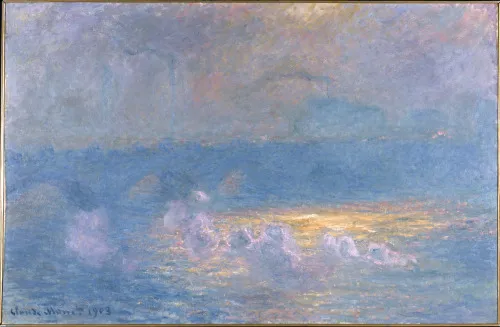
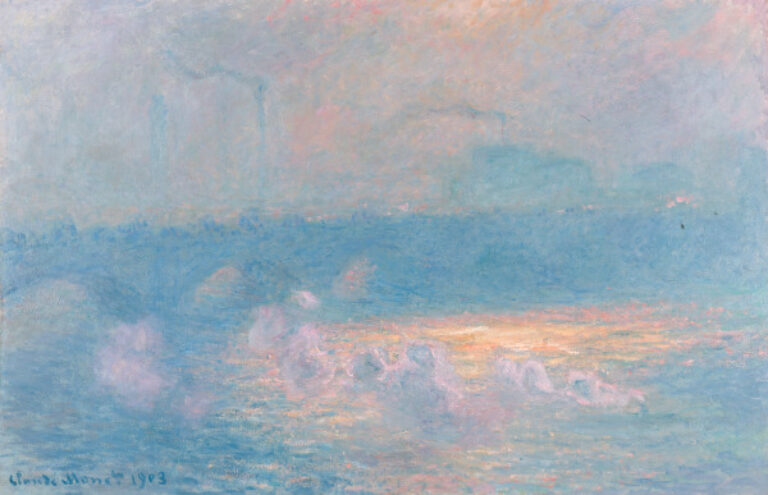
In Waterloo Bridge, Sunlight Effect with Smoke, the ghostly shape of a bridge appears in a blue haze swirling with color. Wisps in the background suggest towering smokestacks as bleary yellow sunlight glitters on the water of the River Thames.
In diary entries and letters, the artist explained how he was inspired by the specific kind of light he saw in London. Though the word “smog”—a type of air pollution formed by chemical reactions between pollutants and sunlight—was not used until
the early 20th century, the impact of this pollution was clearly visible to the artist. In 1900, Claude described it as “fog,” writing: “I am working very hard, although this morning I really thought the weather had changed completely; when I got up, I was terrified to see that there was no fog, not even a wisp of mist: I was prostrate, and could just see all my paintings done for, but gradually the fires [of residential homes, factories, and businesses filled with coal] were lit and the smoke and haze came back.”
Like many Impressionist artists, Claude often painted outdoors. He observed the colors produced by smog and natural light with wonder. In a letter to his daughter, he wrote: “You wouldn’t believe the amazing effects I have seen in the nearly two
months that I have been constantly looking at the River Thames… The fog assumes all sorts of colors; there are black, brown, yellow, green, purple fogs.” In this painting, Claude incorporated the brilliant colors produced by pollutants that he wrote so
passionately about.
Activities
- En plein air, or “in the open air” is a central feature of French Impressionism. Take students outside with artmaking materials, such as markers, colored pencils, or watercolors. Encourage them to capture their environment as they see it in
the moment. When complete, have students share their work and their experience of en plein air making. Compare their thoughts with Claude’s musings to see if there is any overlap. Does this experience change how they engage with his work? - NOTE: Adult supervision is required for this activity. Show students how smogis created by demonstrating “Smog in a Jar.” It will require one glass jar, aluminum foil, 1–2 ice cubes, a match, and a small piece of paper. See instructions below or
watch here.- Twist a piece of paper to create a thin strip.
- Light one end of the piece of paper and drop it in a glass jar.
- Cover the mouth of the jar with aluminum foil.
- Place ice cubes on the aluminum foil.
The reaction of smoke from the burning paper and cool air in the jar will combine to form smog. After the demonstration, ask students to reflect on the activity. For a deeper dive, visit airnow.gov to see more data on the air quality of your school community.