Rain, rain go away! While some people may not look forward to rainy weather, rainstorms play an important part in maintaining a steady food source and a healthy climate. For the ancient Zapotec, who originated in Oaxaca, Mexico, in 500 BCE, the rain god Cocijo (co-SEE-ho) held an important role by providing rain that allowed crops to thrive, ensuring the community was well-fed.
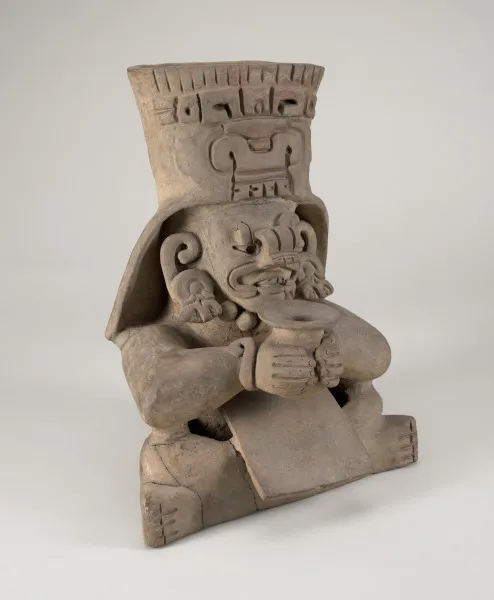
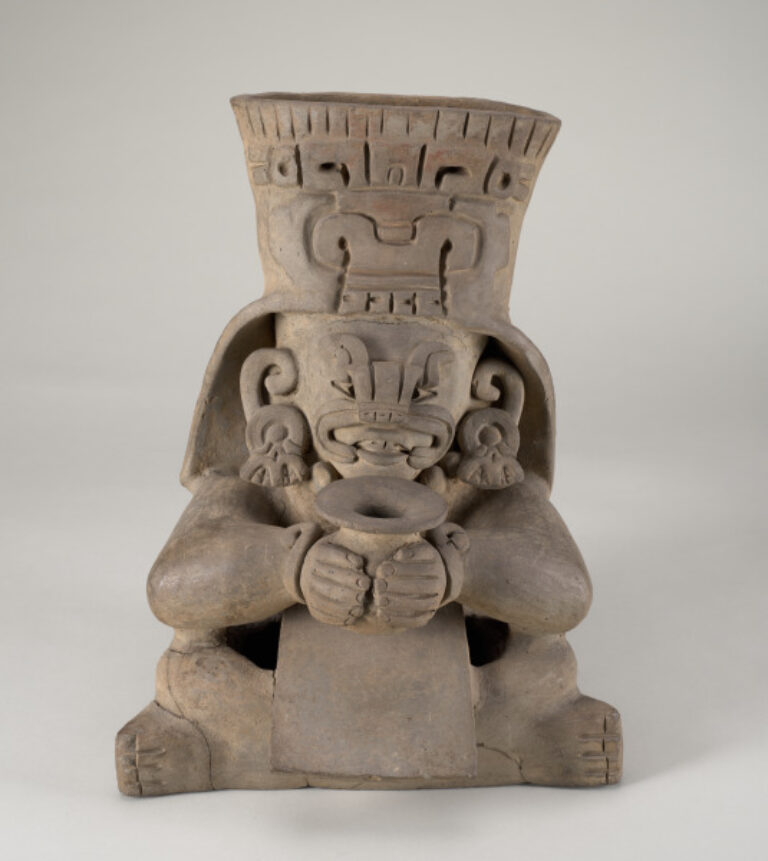
In this clay burial vessel, a figure sits cross-legged with his elbows on his knees, holding a water cup called an olla (OY-ya) between his hands. On his head rests a large headdress adorned with a Zapotec symbol identifying him as Cocijo, the god of lightning and rain. He wears an elaborate mask, which covers his nose and curves around the lines of his mouth. Large, ornate earrings hang from his ears, and a hood hangs down from the back of the headdress, curving around the tops of his ears. Vessels like this were included in ancient Zapotec burial chambers to demonstrate the continuation of life’s cycle after death.
Cocijo’s message, which is about getting the food and water we need to live and the cyclical nature of life and death, is still an important part of Zapotec culture today.
Classroom Activities
The ancient Zapotec people worshipped many gods dedicated to natural elements like rain, lightning, bodies of water, and more.
To delve deeper into how rain forms and its impact on life on Earth, ask students to research the water cycle. Then, invite students to write and illustrate a narrative from the perspective of a water molecule going through the water cycle. Encourage students to include details about where, when, and how their water molecule traveled. For a short introduction to the water cycle, students can watch this short video from the U.K. Weather Office. For inspiration for their water molecule narratives, students can read The Magic School Bus at the Waterworks by Joanna Cole.
The Zapotec god of rain, Cocijo, has similarities to the Aztec god of rain, Tlaloc. To investigate other similarities and differences between these cultures, have students break into groups and choose one of these cultures to research. They can focus on their chosen culture’s spiritual beliefs or other ways of life. Ask each group to create a poster with images and words explaining their research, then have each group present to the class. To get started, students can watch this video on Zapotec history and culture, and explore another Art-to-Go on an Aztec Water Deity Figure.