Grade Level: Elementary School (Grades 3–5)
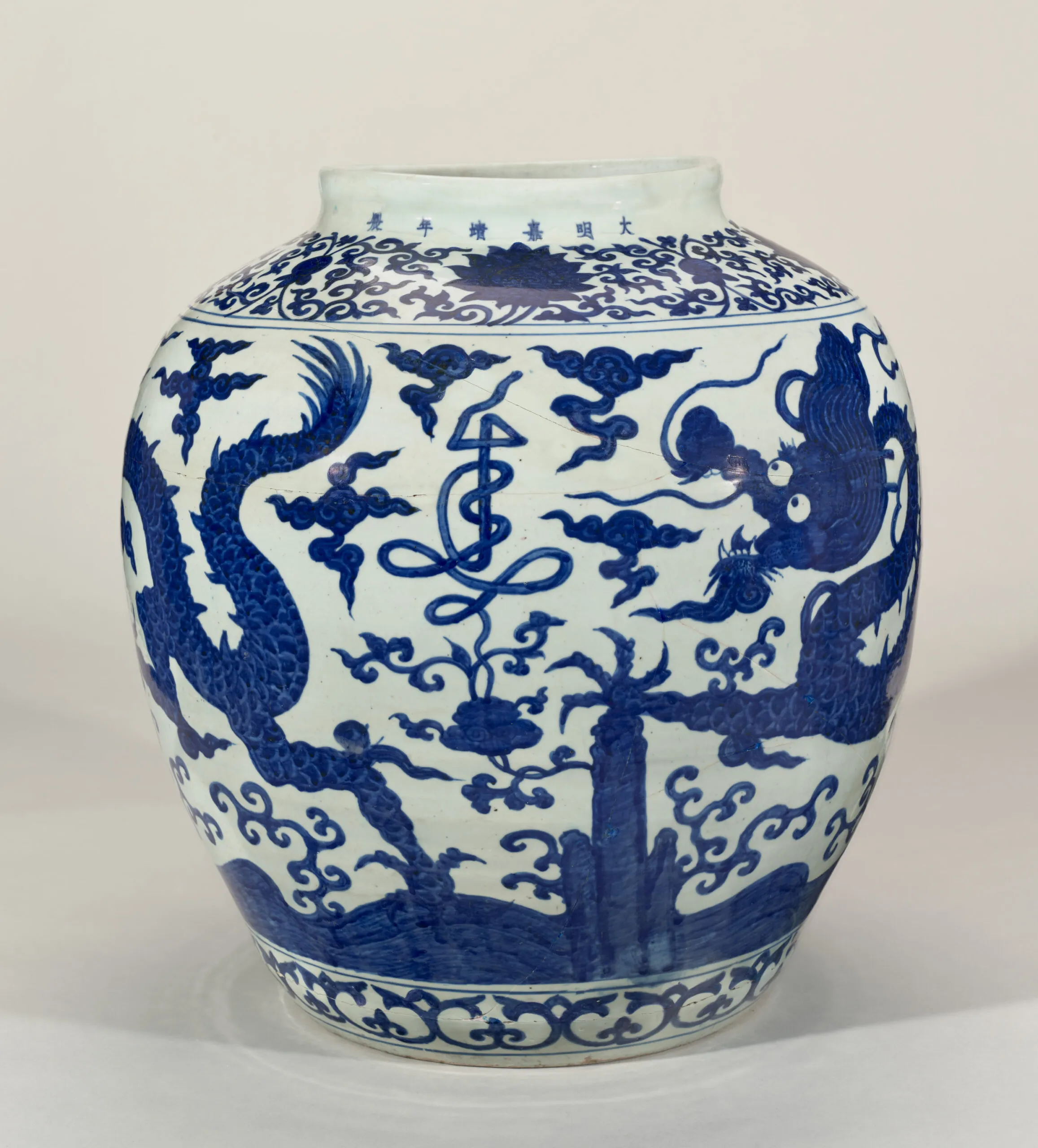
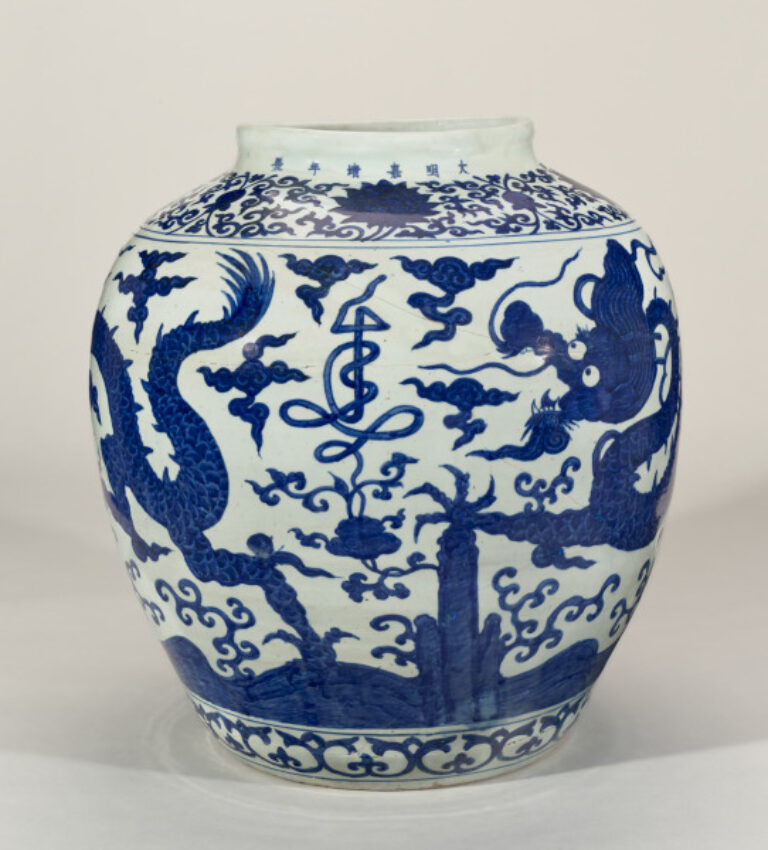
In Large Jar Decorated with Dragons, a brilliant blue dragon twists across a white surface. This kind of pattern is typical of ceramics made during China’s Ming Dynasty (1368–1644 CE). During this period, artists often used elements from the natural world like flowers, vines, fruits, and landscapes to decorate pottery. Mythical creatures, especially dragons, were also a popular subject.
In Chinese legends, dragons live in lakes, rivers, mountains, and the sky. They are hybrid animals constructed from the parts of nine different creatures, nine being a lucky number in Chinese numerology and philosophy. Though this vase is from the 1500s, dragons had been an important symbol for hundreds of years. Han Dynasty scholar Wang Fu (82–167 CE) described the creatures this way: “…His antlers resemble those of a stag, his head that of a camel, his eyes those of a demon, his neck that of a snake, his belly that of a clam sea monster, his scales those of a carp, his claws those of an eagle, his soles those of a tiger, his ears those of a cow.” Each element of a dragon’s appearance has a symbolic meaning, such as authority and strength (horns), protection (scales), and power (claws). Even though this dragon soars through the clouds, its body is fluid and graceful. This motion highlights the important connection between dragons and water. In folklore, dragons control rivers and rain, and they can even shapeshift to look like humans. Because of these powerful abilities, there are legends of the children of dragons and humans becoming emperors, tying these creatures to the long imperial history of China.
Activities
- Part one: Dragons are symbolic creatures. Define and discuss symbols with students and brainstorm examples as a class. Have students brainstorm an idea, theme, or action they would like to represent with a symbolic creature of their own. Remind students that dragons are comprised of the parts of many other animals, and their symbolic
creatures can also follow that model. Give students the option to draw or write about their creature. - Part two: A national emblem, the dragon is celebrated across China through Dragon Dances during different festivals. Once students have
completed their symbolic animal creations, ask them to imagine how their creature might move. Have them try to make that movement with their bodies. Invite students to come up with a short dance associated with their symbolic creature and take turns performing, either for the class or in small groups. To conclude, ask students how it felt to move like their symbolic creature.