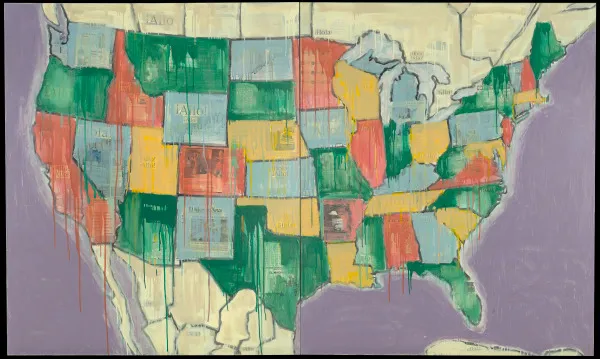
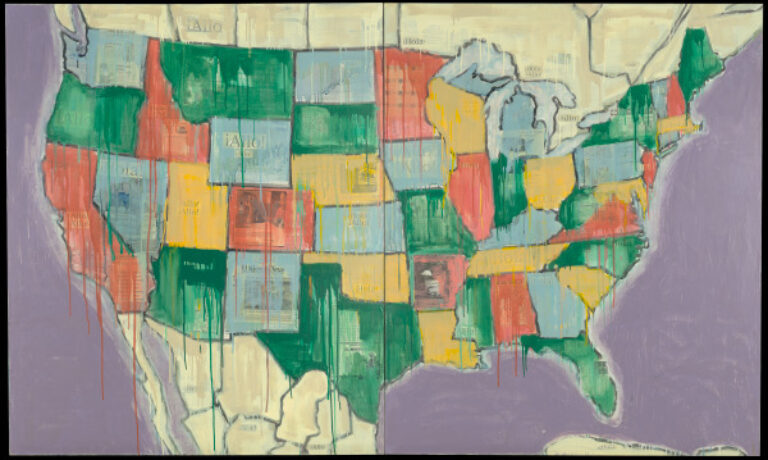
In Echo Map I, created by artist, educator, and political activist Jaune Quick-to-See Smith (1940–2025), a map of the continental United States emerges, dripping with paint. Look closer. Here, state names are replaced with the Spanish and French words for “hello” amongst newspaper clippings. Like ghosts, the words fade in and out, transforming this map into a representation of erasure and invisibility.
Jaune’s painting Echo Map I encourages us to think critically: what do maps represent? Often, they are educational tools to show the territory of a nation, making borders tangible and concrete. Perhaps what remains unspoken is how national maps like this one ignore what existed before these boundary lines were drawn. For Jaune, these visuals reinforced historical and cultural tragedy. When Christopher Columbus sailed the ocean blue in 1492, he began the global transfer of plants, animals, food, and disease across the Atlantic Ocean. New illnesses and the brutality of European colonizers had devastating impacts on Native American populations. This aspect of American history is lacking in many maps of the United States, but Jaune used maps as a means of exploring land ownership and loss. She has been quoted to say, “A map is not empty for me, it’s not an icon of this incredible country…it’s about real land—stolen land, polluted land.”
Jaune began her series of U.S. map paintings in 1992 to respond to the United States’ quincentennial (500th annual) celebrations of Columbus landing in the Bahamas. Of Metis and Shoshone ancestry, Jaune was also an enrolled member of the Confederated Salish and Kootenai Nation. She dedicated her life and work to political and environmental activism, both in her subject matter and in her use of materials. Jaune often critiqued the pollution generated by artmaking. In 1991, she created the Nomad Art Manifesto, which calls for art that is:
- Made with biodegradable materials.
- Recyclable.
- Foldable and easily stored on a bookshelf.
- Non-wasteful and geographically mobile.
- Does not require framing.
- Convenient for countries undergoing disbanding or reformation.
Classroom Activities
- Jaune Quick-to-See Smith made map paintings to represent stolen Native land. Work together with students to identify and research the Native land your school occupies. From the results, choose a specific Indigenous group for continued fact-finding. As students gather information about the Native people in the area and their lifestyle, have them write a fact down on a card to contribute to a group display. Showcase the display either in the classroom or in the hallway of your school.
- Drawing inspiration from the Nomad Art Manifesto and Jaune’s passion for environmentalism, have students bring in recyclable materials from home to make an artwork. Encourage students to work in groups of four or five and share materials as a community. When complete, set up artworks around the classroom like a gallery and have students compare each other’s work and artistic process.