
Grade Level: High School
What was it like for working-class women in 19th-century Paris? During the Industrial Revolution (c. 1760–c. 1840), small factories and mills populated the cities and rural areas across France. This expansion of job opportunities paved the way for a new class of laborers: one that included women. As women began to work outside of the household, they gained not only greater independence but also increased visibility in public life. The laundress in particular garnered more attention than others.
Parisian laundresses could be seen across the city, washing and ironing in shops open to the street or carrying heavy baskets of clothing back and forth to the river. Often wearing just their undershirts and lighter garments, their image
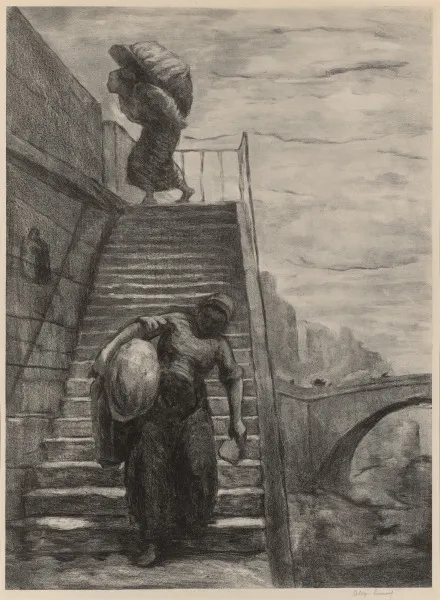
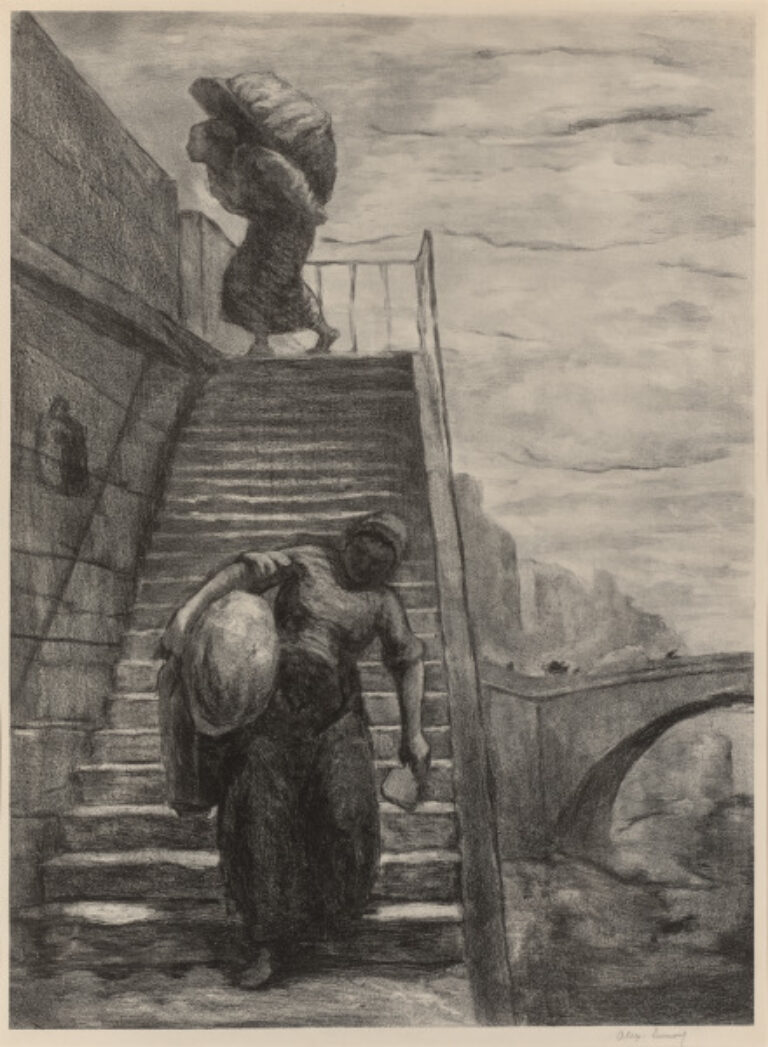
became widespread in popular culture as the women became muses for many artists. Alexandre Lunois (1863–1916) was no exception, reinterpreting an earlier painting by Honoré Daumier (1808–1879) titled Les laveuses du quai d’Anjou (Les blanchisseuses—Les laveuses sur l’escalier).
Though the original painting was in color, Alexandre’s Laundresses is a black-and-white lithograph. This composition hints at the more austere side of the profession. An extremely hazardous and dangerous job, the work exposed laundresses to respiratory illnesses and contagious diseases like cholera. Poor ventilation in the workplace and constant humidity led to mold growth and mold-related health problems. Due to this difficult labor, long working hours, and poor pay (by 1892, the legal working day for a woman was 10–11 hours, earning only 50-75% of what her working-class male counterpart earned), their job was among the most grueling in the city. Laundresses often supplemented their income with sex work to make ends meet.
An Impressionist-era work, Laundresses is one of many artworks showcasing this modern working woman. These women did not adhere to feminine and “proper” expectations, so their profession was seen as questionable and uncouth by the upper
class. They were disregarded, spurned, and susceptible to alcoholism and disease. Today, we may take for granted something as ordinary as a washing machine or laundromat, but one look at Alexandre’s laundresses—hunched contorted, and
shadowed—reminds us of the small privileges and conveniences of modern life.
Activities
- Laundresses may be uncommon in our own communities, though it is still possible to find a laundry or dry-cleaning service. What is another 19th-century occupation made obsolete by modern technology? Or how has it adapted with the times?
Have students research an occupation for presentation to the class. Bonus points if they come dressed in historical costume! - Show students Les laveuses du quai d’Anjou (Les blanchisseuses—Les laveuses sur l’escalier) by Honoré Daumier. Compare/contrast with Alexandre’s work. How do they think Honoré felt about the laundress profession based on his painting? What about the laundresses themselves? Consider the tone of the work. Ask students to think of a chore or activity they might find grueling or dreary. Once they’ve made their choice, have them create an artwork about it using any medium they choose. When complete, ask students if the experience changed their viewpoint and why. Share as a class.