Jacob More
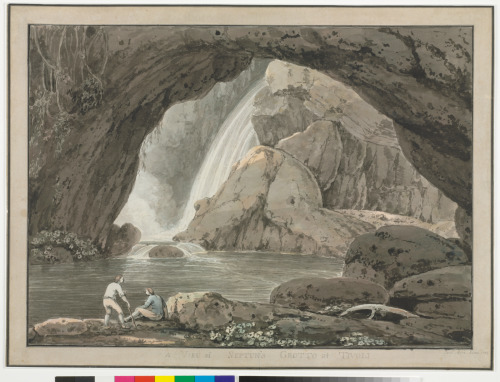
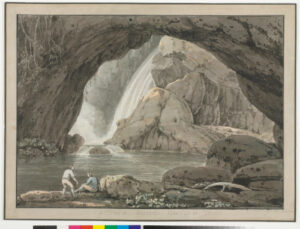
A View of the Cascade of Neptune’s Grotto at Tivoli
1777
Scroll
Jacob More
A View of the Cascade of Neptune’s Grotto at Tivoli
1777
Physical Qualities
Pen and black ink and watercolor on paper, Sheet: 410 x 550 mm. (16 1/8 x 21 5/8 in.)
Credit Line
Purchased as the gift of Rhoda Oakley, Baltimore
Object Number
2012.234
The setting of this watercolor is Neptune’s Grotto, a powerful waterfall not far from Rome, in the picturesque town of Tivoli. Tourists have flocked to Tivoli’s Villa d’Este gardens, Neptune’s Grotto, and the Grand Cascade waterfall for centuries. These sites were popular subjects for British artists of the late eighteenth and early nineteenth centuries, and would have been collected by travelers during the era of the Grand Tour (trips taken to the Continent to complete one’s classical education). At the same time, British audiences were well versed in the concepts of the picturesque and sublime, which inform these types of images. The theory of the sublime, introduced by Edmund Burke in 1757, proposed that a confrontation with the power of nature could produce a heightened emotional state of “magnificent horror” in the viewer. The theory of the picturesque, ardently put forth by the Reverend William Gilpin in 1786, suggested that artists and public alike should commune with nature by seeking out aesthetically-pleasing views. Jacob More’s watercolor of the grotto takes viewers inside the slippery cave along with the foreground figures who listen to the waterfall and glimpse daylight beyond. The idea of emerging from a dark cave into daylight as water pounds the rocks would have been understood by contemporary audiences as producing the proper effect of the sublime.
The Baltimore Museum of Art by purchase, 2012; Martyn Gregory, London; Sotheby's sale L01181, 4 July 2001, lot 191.
Inscribed: on mount, across bottom in black ink: "A VIEU of NEPTUN'S GROTTO at TIVOLI"; on mount, lower right in black ink: "Jacob More, Rome 1778"