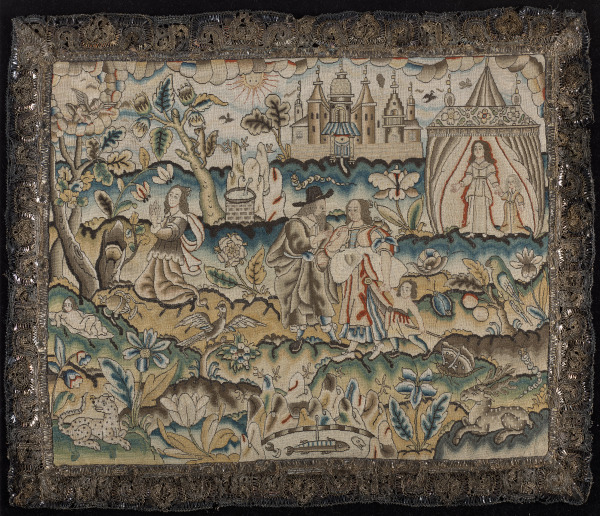
Abraham Banishing Hagar and Ishmael
1649
Scroll
Abraham Banishing Hagar and Ishmael
1649
Physical Qualities
Linen canvas ground, silk embroidery threads, metallic bobbin lace, silk backing, 17 1/4 x 20 1/4 in. (43.8 x 51.4 cm.)
Credit Line
Purchase with exchange funds from Gift of Mrs. A. Taylor Bragonier; Gift of Mrs. H.P. Bray; Gift of Mrs. Charles Collier; Gift of Mrs. Symington Dorsey; Gift of Mrs. J. Edward Duker; Gift of Maria Lovell Eaton and Mrs. Charles R. Weld, from the Estate of Mary M. Eaton; Gift of Mr. and Mrs. Manuel L. Hendler; Gift of Mrs. Gerald W. Johnson; Gift of Mrs. F.A. Korff; Gift of Ruth Young Lachman; Gift of Eleanor B. Leitch; Gift of Sara B. Lipscomb; Gift of Cornelius Ruxton Love, Jr.; Gift of Henry A. Ludwig; Gift of Fanny Lyon; Gift of Mrs. Florence Milliken; Gift of Mrs. Frank Primrose; Gift of Mrs. Jesse Rider; Gift of Mrs. Ralph K. Robertson; Gift of Mrs. C. Rogulih; Gift of Mrs. Dudley Shoemaker; and Gift of Louisa Gilmore Riach Wade
Object Number
1998.528
In 17th century England women of the gentry class were well schooled in the needle arts. With large houses to furnish they often turned their embroidery skills toward the production of domestic articles such as book covers, pillows, boxes, and cushions to add warmth, comfort, and color to their homes and to advertise their economic status. Biblical stories frequently provided the subject matter. This cushion cover is a rare surviving example of exceptional quality and condition.
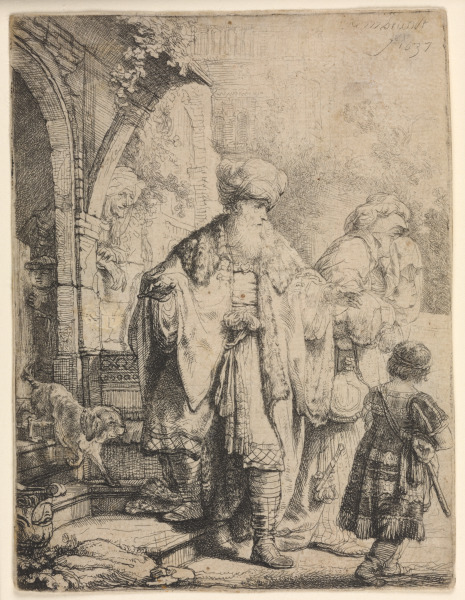
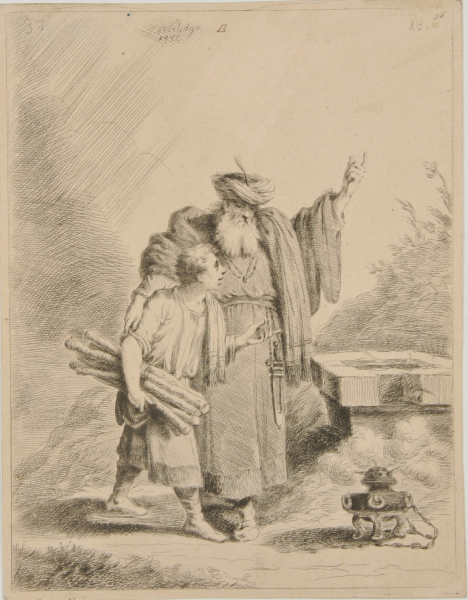
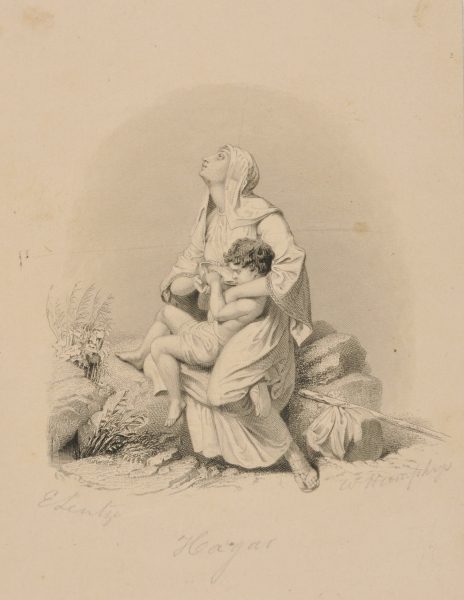
The cover depicts the biblical tale of Hagar, the handmaiden of Abraham's seemingly barren wife Sarah, who at Sarah's insistence bore Abraham a son, Ishmael. After Sarah herself gave birth to a son, Isaac, she required that Abraham send Hagar and Ishmael away in order to secure her son's position as Abraham's sole heir. The needlework portrays Abraham bidding farewell to Hagar and Ishmael as Sarah and Isaac look on from a tent. In a secondary scene Hagar prays in the wilderness, as she and Ishmael are about to perish from thirst. An angel appears to show her a source of water and promise deliverance. As was often the case in needlework, the design was derived from a printed source, in this instance an engraving in Gerard de Jode's Thesaurus Sacrarum Historiarum Veteris Testamenti published in Antwerp in 1585, an important source of inspiration for numerous embroideries of the period. The foreground is filled with motifs typical of 17th century English needlework, including numerous plants and animals with symbolic significance rendered with characteristic disregard to scale.
Although a professional draftsman may have drawn the design of this cushion cover, the embroidery was most likely performed by a female member of the household schooled in the needle arts, perhaps a high-born teenaged girl or the lady of the manor. The cover is an extraordinary example of tent stitch embroidery, a popular form of needlework in the 17th century in which the object is created almost entirely in "tent" or half-cross stitches on a plain-woven linen ground or canvas. The excellence of this embroidery is shown in the exquisite fineness of the stitching, the skill exhibited in the use of multicolored silk threads for shading, and the fluidity of line achieved. An original silver and gold metallic bobbin lace provides an elegant and expensive finish.
Baltimore Museum of Art by purchase, 1998; Cora Ginsburg LLC, New York, NY.
'Cora Ginsburg, Costume,Textiles, Needlework' (advertisement for items for sale), New York, N.Y., [September] 1998, n.p., ill. in color.
A. Jones, 'In the Spotlight: Recent Assessions,' "BMA Today," July/August 1999.
Yvonne Hackenbroch, English and Other Needlework Tapestries and Textiles in the Irwin Untermyer Collection, Cambridge, Mass.: The Harvard University Press for The Metropolitan Museum of Art, 1960, pp. xxviii-xxxii, illus. In. fig.24, illustrations pl. 31, fig. 48 (needlework of similar style), pl. 32, fig. 51 (needlework of the same subject), pl. 42, fig. 66 (needlework of the same subject), pl. 48, fig. 73 (needlework which includes this as well as other themes), 'Note: and Comments' pp. 19, 20, 27-28.
Liz Arthur, Embroidery 1600-1700 at the Burrell Collection, London: John Murray in association with Glasgow Museums, 1995, pp.80-81, pls. 55-56 (Illustration from Thesaurus Sacrarum Historiarum Veteris Testamenti and needlework of same subject); also p. 38, pl. 19 (pink cushion w/similar metallic lace), p. 41, pl. 22 (cushion w/ metallic lace); pp. 76-77, fig. 50-51 fountain, etc.
Liz Arthur, Embroidery 1600-1700 at the Burrell Collection, London: John Murray in association with Glasgow Museums, 1995, pp.80-81, pls. 55-56 (Illustration from Thesaurus Sacrarum Historiarum Veteris Testamenti and needlework of same subject); also p. 38, pl. 19 (pink cushion w/similar metallic lace), p. 41, pl. 22 (cushion w/ metallic lace); pp. 76-77, fig. 50-51 fountain, etc.
Inscribed: None