

Public Domain

Amish Bars

Amish, 1889-1939

Scroll

Amish Bars

Amish, 1889-1939

Physical Qualities Wool, cotton backing, 78 x 76 1/2 in. (198.1 x 194.3 cm.)
Credit Line Gift of Dena S. Katzenberg, Baltimore
Object Number 1981.158
The "Bars" pattern is one of the earliest and most popular of quilt designs employed by the Amish of Lancaster County, Pennsylvania. Although its central medallion format was already out of style by the time the Amish adopted the pattern in the late 19th century, the design appealed to their conservatism and their desire not to conform to the tastes of the "English" culture outside of their community. Other characteristics of this quilt also point to its Lancaster County origin, including its square shape, relatively small size, (approximately 76" square), wide outside borders, large corner blocks, wide binding, and printed cotton backing. The quilt top is composed of fine, lightweight wool--the preferred fabric of the Lancaster County Amish prior to 1940. Unlike the cotton and synthetic fabrics used in later decades, wool absorbed dye well, producing deep saturated colors. The wide borders of their quilts provided the Amish women of Lancaster County with the perfect space in which to exercise their considerable quilting skills, reputedly the best to be found anywhere among their sect. This quilt exhibits a remarkable twenty-four stitches to the inch (counting top and bottom stitches).
Baltimore Museum of Art by gift, 1981; Dena S. Katzenberg
Exhibited in the Jean and Allan Berman Textile Gallery, The Baltimore Museum of Art, March 15, 2004-August 29, 2004.
Explore the Collection Further

TEXTILES
Double-Sided Sampler / Bars Quilt
1929–1939
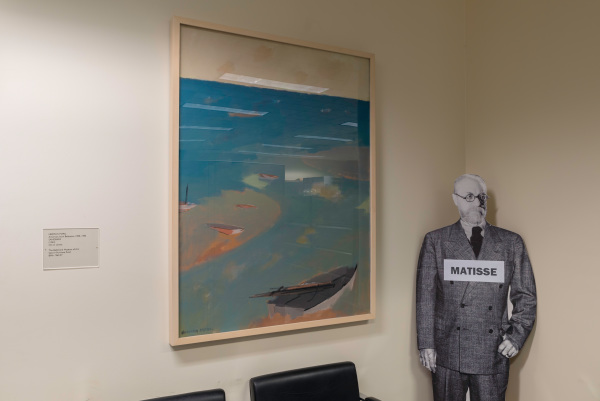
Herman Maril
Sandbars
1962
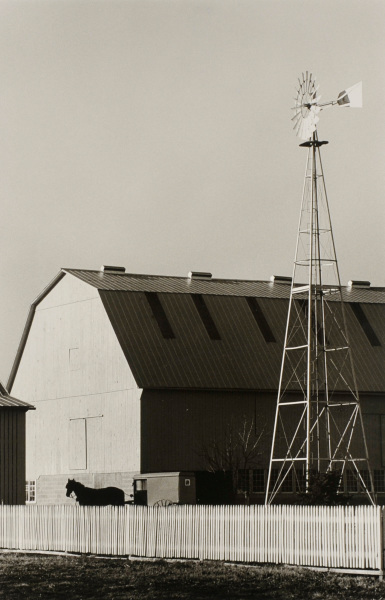
Peggy Fox
Amish Farmer, St. Mary's County.
1979