Dogon
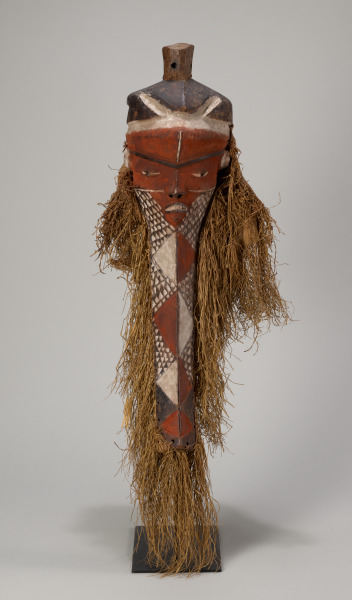
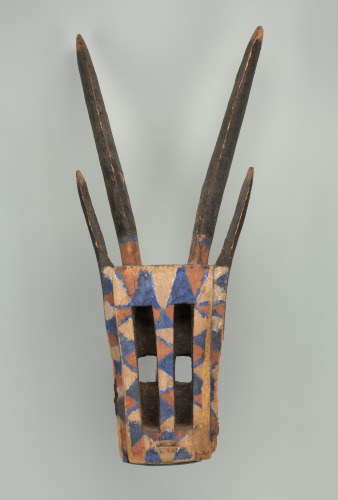
Antelope Mask (Walu)
Dogon, 1932-1966
Scroll
Dogon
Antelope Mask (Walu)
Dogon, 1932-1966
Physical Qualities
Wood, pigment, kaolin, plant fibers, 40 1/2 x 17 x 9 in. (102.9 x 43.2 x 22.9 cm.)
Credit Line
Gift of Gilbert and Jean Jackson, Potomac, Maryland
Object Number
2010.314
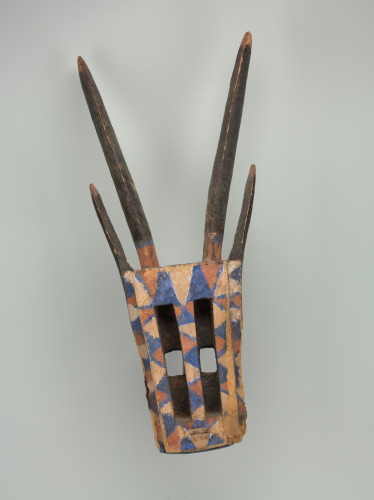
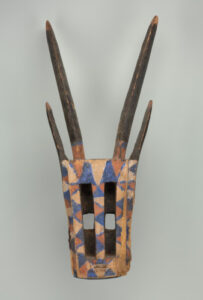
Antelope mask of the Walu type; of notably large and dynamic design; the flat, rectangular 'face' expanding slightly upward in width, a line carried into the unusually long outward-flaring horns and ears; typically deep vertical 'eye' grooves with square openings on the inner slanted surface; unusually fine painted triangular designs in natural red, blue and ocher pigments; the horns and ears, of triangular section, lightly incised; remains of fiber-cord netting in suspension holes around back rim; impressive signs of age and wear including 'pin holes' from infestation in front edge; heavily desiccated wood.
- Description per David Ackley from appraisal documentation of March 15, 2011
GROUP LABEL: for African Reinstallation, Modern Masquerade, April 2015:
"When a loved one dies, we feel that heaven and earth should weep with us. These masks represent different elements of the Dogon universe that are danced during a communal memorial event called the dama. The dama celebrates those who have died since the previous event and includes masks that represent the entire Dogon world, from animals to 20th-century European colonial officials to contemporary American tourists. Although the dama was developed as a day-long memorial, now it is also performed in an abbreviated form for tour groups, demonstrating that long-held beliefs and new avenues of expression can coexist.
The wooden masks all are based on a rectangular, abstracted face. On the antelope mask, the artist used only two planes—one for the eyes and cheeks and one for the forehead, chin, nose, and mouth. Antelope horns crown the top. The artist who carved the bird mask applied similarly restricted geometry. He placed a strong, projecting nose in the center of the mask, providing an organizing axis for the remaining features.
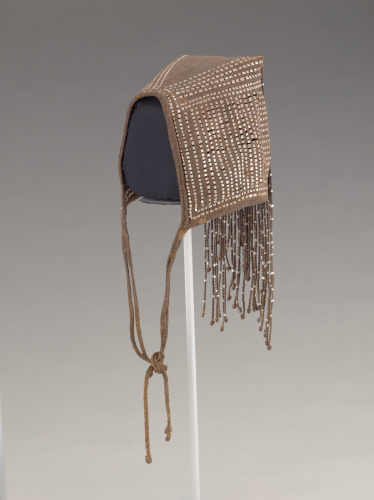
Even in the soft Bede costume, you can see how Dogon artists adapted a common style to serve their individual expressive goals. The beaded fiber mask and vest represent a Fulbe woman, who might trade with her Dogon neighbors in the marketplace. This costume also uses abstraction: the face is described through a simple division between the eyes and other features. The crest on the top is a common traditional hairstyle for Fulbe women, one you can also see on the D’mba headdress behind you, in the center of the gallery."- Kathryn Gunsch (label for 1995.109, 2003.342.1-2, 2010.314)
The Baltimore Museum of Art by gift, 2010; Gilbert and Jean Jackson, Washington, D.C., by purchase; Irene and Wilbert Petty Collection
African Reinstallation
Morgan State College. "The Irene and Wilbert Petty Collection of Traditional African Art," exhibition catalogue, November 13-December 10, 1971. Entry number 58 on page 6 or 88 on page 8.