Bakewell, Pears & Co.
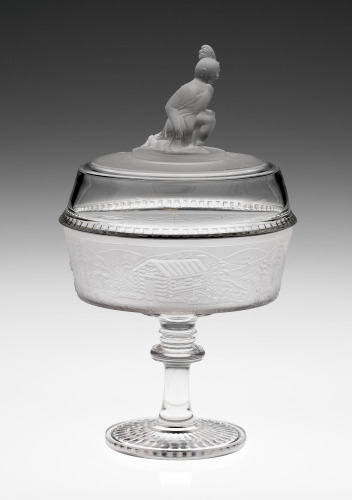
“Argus” Covered Compote
1849-1879
Scroll
Bakewell, Pears & Co.
“Argus” Covered Compote
1849-1879
Physical Qualities
Glass, Overall: 17 3/4 × 9 3/8 × 9 3/8 in. (45.1 × 23.8 × 23.8 cm.)
Credit Line
Friends of the American Wing Fund
Object Number
1998.516
An Englishman named Benjamin Bakewell found Pittsburgh's best known glass factory in 1808. The company produced glass items ranging from windows, bottles, lamps, and apothecary equipment to housewares such as this covered compote, a type of footed bowl that was often used to serve stewed fruit or other sweets. To make this piece, workers poured molten glass into metal molds and applied pressure, quickly creating handsome but reasonable priced glass objects for a wide consumer base. The "Argus" in the title refers to a mythic Greek giant with a hundred eyes - not unlike the circular patters that cover the surface of the compote.
New label copy from American Wing Rotation, after 2020
Baltimore Museum of Art by purchase, 1998; W.M Schwind Jr. Antiques, Yarmouth, ME
AMW Reinstallation 2014
American Wing Rotations 2020
American Wing Rotations 2021
American Wing Rotations 2022
American Wing Rotations 2023
American Wing Rotations 2024
American Wing Rotations 2025
Berry Tracey et al. "19th-Century America, Furniture and Other Decorative Arts." The Metropolitan Museum of Art & New York Graphic Society Ltd., 1970, fig.
Spillman, Jane Shadel and Frantz, Suzanne K.. "Masterpieces of American Glass: The Corning Museum of Glass." New York, Crown Publishers, Inc. 1990, p. 35, no. 55. (example of a different compote in the Argus pattern)
Palmer, Arlene. "Artistry and Innovation in Pittsburgh Glass, 1808-1882." Frick Art & Historical Center, 2004, p. 186, fig. 103.
Spillman, Jane Shadel and Frantz, Suzanne K.. "Masterpieces of American Glass: The Corning Museum of Glass." New York, Crown Publishers, Inc. 1990, p. 35, no. 55. (example of a different compote in the Argus pattern)
Palmer, Arlene. "Artistry and Innovation in Pittsburgh Glass, 1808-1882." Frick Art & Historical Center, 2004, p. 186, fig. 103.
Inscribed: None
Markings: None


 On View at the BMA