Edgar Degas
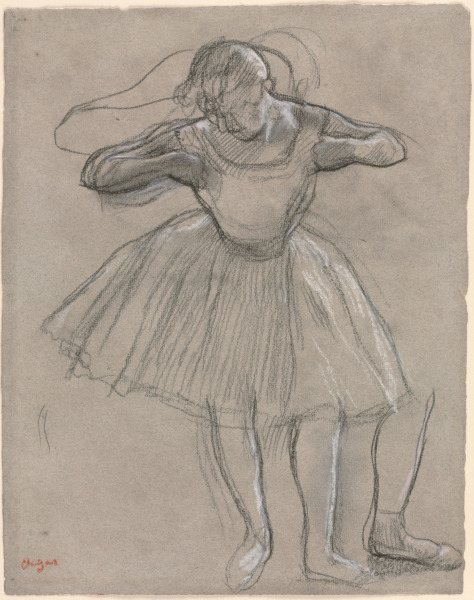
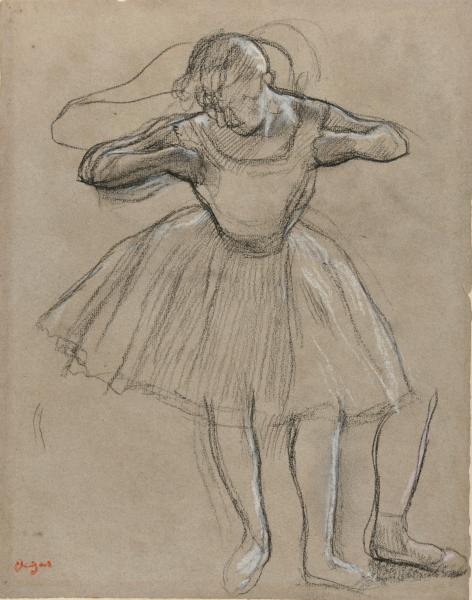
Ballet Dancer Standing
1885-1889
Scroll
Edgar Degas
Ballet Dancer Standing
1885-1889
Physical Qualities
Conté crayon with stumping, heightened with white chalk and pastel, on blue-gray paper, Sheet: 303 x 238 mm. (11 15/16 x 9 3/8 in.)
Credit Line
The Cone Collection, formed by Dr. Claribel Cone and Miss Etta Cone of Baltimore, Maryland
Object Number
1950.12.659
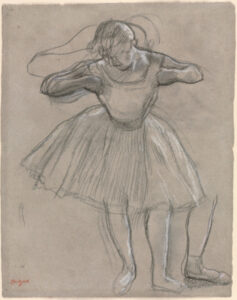
Edgar Degas's fascination with the ballet began in the 186os. At that time, he began to visit the Parisian theaters frequently, sometimes arranging to go backstage and often paying dancers to pose for him. Over the years, he developed a special knowledge of the dance and captured with great accuracy the conventions and movements of classical ballet. Degas often focused on the young, aspiring ballerinas at the Paris Opera, whose grueling training sessions he recorded in a variety of drawings. This work is from a series of four studies that he made of dancers adjusting their costumes that was ultimately used to provide the secondary figures in the paintings Danseuses niontant un escalier (Musee d'Orsay) and Danseuses au foyer (The Detroit Institute of Arts).'
The four drawings are closely related in subject and technique. One work in particular, sold most recently at Sotheby's, London, in 1998, is extremely similar in composition to the Baltimore version, with the addition on the page of sketches for the placement of the dancer's legs as well as a detailed drawing of the dancer's face. The figure in the drawing at the Rhode Island School of Design is the closest in composition to the painting in the Musee d'Orsay, with the head and body tilting toward the right, whereas the Baltimore version and its close companion have figures that tilt toward the left.
In the present drawing, Degas catches a young dancer in an awkward and unconventional pose as she adjusts her bodice during a quiet moment, seemingly unaware that the artist has captured her image on paper. Unlike many of his more finished, independent drawings, Degas here uses the conte crayon to work out the composition for a larger project. The head and right arm were initially higher on the page, and her legs have changed position, as evidenced by the third leg that is adjacent to her full skirt. The use of a dark paper highlighted with white chalk and pink pastel illuminates the figure and provides an indication of the light source coming from the right side. Degas seems to have focused most of his attention on accurately depicting the dancer's head, neck, and arms.
Etta Cone purchased this work from Pa Durand-Ruel in 1922. This year marked the return of the Cone sisters to Paris after many years and was also the start of a large buying campaign after almost fifteen years of not acquiring any art of significance. The sisters emerged from World War I with much more money to spend because of the success of the family's textile business during the war, and a desire to add extensively to their already impressive collection. Their admiration for and commitment to collecting works by Henri Matisse continued in this postwar period, as did a new impetus to acquire works by the nineteenth-century forerunners of the modern movement who could provide an artistic and historic foundation and context for their favorite painter.
The Baltimore Museum of Art by bequest, 1950; Etta Cone (1870-1949), Baltimore, by purchase 1922; Durand-Ruel, Paris, 1918; 2nd Degas Sale, Galerie Georges Petit, Paris, Dec. 11-13, 1918, p. 121, no. 218a (1,700 francs for two drawings); collection of the artist.
The Essence of Line: French Drawings from Ingres to Degas
2011-09-19 00:00:00
2011-09-19 00:00:00
Degas Dancers: Eye and Camera
"The Baltimore Museum of Art: Celebrating a Museum," The Baltimore Museum of Art, 2014, p. 183.
Fisher, Jay McKean, et al. The Essence of Line: French drawings from Ingres to Degas. University Park, PA: Pennsylvania State University Press, 2005, p. 190-91, ill.
The Baltimore Museum of Art, 'Newsletter of the Print and Drawing Society of the Baltimore Museum of Art,' Sept. 1998, Vol. XV, No.3, p. 1, ill.
The International Review published by The Drawing Society, Vol. XVII, No.1, May - June 1995, p.4, ill.
Ted Rose, Discovering Drawing, Worcester, Mass.: Davis Publication, 1995, ill. p. 207. Brenda Richardson, The Cone Collection of the Baltimore Museum of Art, 1985, p. 173.
Baltimore Museum of Art, Paintings, Sculpture and Drawings in the Cone Collection, 1967, p. 72, no. 177, ill. p. 61.
'The Contents', The Baltimore Museum of Art: The Cone Wing (1957), p. 8.
Lilian Browse, Degas Dancers, Boston: Boston Book and Art Shop, 1949, p. 399, plate no. 193.
Carlson, Victor, and Carol Hynning Smith. Master Drawings and Watercolors of the Nineteenth and Twentieth Centuries: The Baltimore Museum of Art. New York, NY: The American Federation of Arts, 1979, pp. 51, ill.
Paul André Lemoisne, Degas et son oeuvre, Paris: Paul Brame et C. M. de Hauke, 1946, vol. III.
Inscribed: RECTO: LL, red stamp, 'degas' (Lugt 658); VERSO: LL, red stamp, 'Atelier Ed. Degas' (Lugt 657); LL, blue crayon, [illegible].