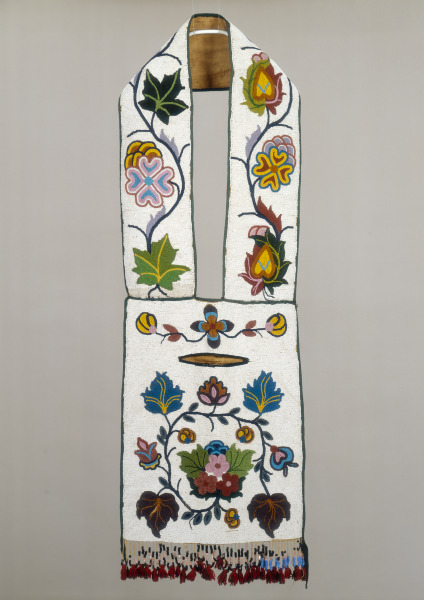
Anishinaabe (Chippewa, Ojibwe)
Bandolier Bag
Anishinabe (Chippewa/Ojibwe), 1867-1899
Scroll
Anishinaabe (Chippewa, Ojibwe)
Bandolier Bag
Anishinabe (Chippewa/Ojibwe), 1867-1899
Physical Qualities
Glass beads, cloth, yarn, string, 14 3/16 x 18 1/2 x 13/16 in. (36 x 47 x 2 cm.)
Credit Line
Gift of Ruth M. Bernstein, Baltimore
Object Number
1974.10
Bandolier bags developed in the Great Lakes region around 1850 and reached the height of their popularity between 1890 and 1930. The vast number of beads and the time and labor employed in their creation endowed them with great value. They were worn by both men and women as symbols of wealth and prestige. In trade with the Plains Indians a bandolier bag was equal in value to a horse.
Field photo:
Reverend Frank Pequette or Pedwaywaygishig, Minnesota, Objibwe (c. 1909-1912). Courtesy of the Minnesota Historical Society