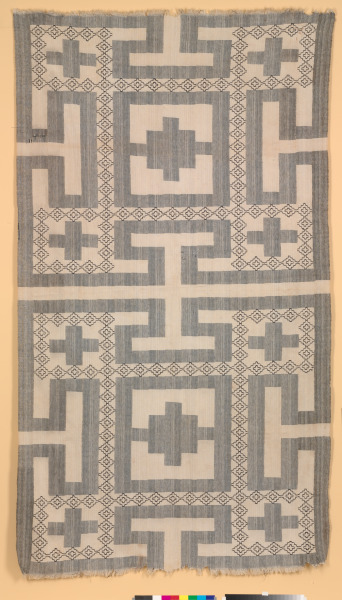
Gola and Mende
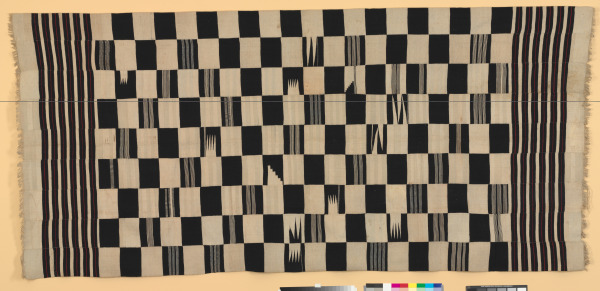
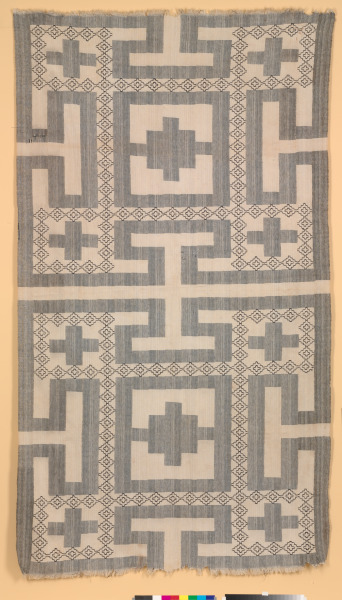
Blanket/Furnishing Cloth (Kpokpo)
Gola or Mende, 1900-1927
Scroll
Physical Qualities
Cotton, Overall: 170 x 252 cm. (66 15/16 x 99 3/16 in.)
Credit Line
Purchase with exchange funds from Gift of Edith Black, Potomac, Maryland, in Memory of Jack Black; Gift of Robert and Mary Cumming, Baltimore; Gift of Joseph B. France, Washington, D.C.; Gift of Mr. and Mrs. Manuel L. Hendler; Gift of Gilbert and Jean Jackson, Washington, D.C.; Gift of Mr. and Mrs. Howard A. Jackson, Massapequa, New York; Gift of Norman Jackson, New York; and Gift of the Jamosil Foundation, Alexandria, Virginia
Object Number
1998.480
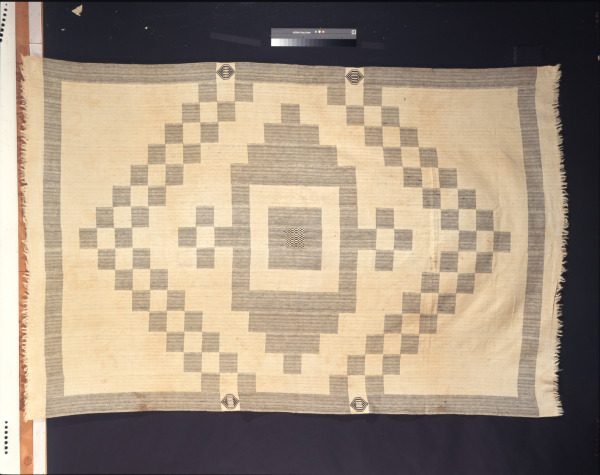
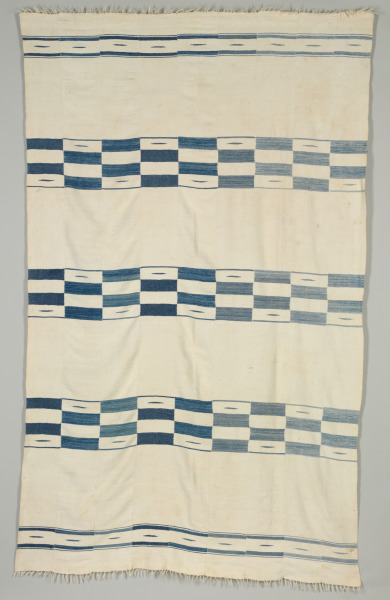
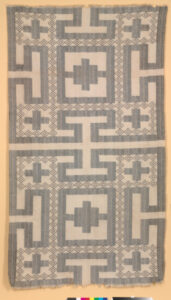
These two furnishing blankets originate from neighborhing areas and are made from strip-woven cloth. Furnishing fabrics were created to decorate and provide comfort and warmth in the home, and also to serve as space dividers within domestic structures. Despite their similar use of indigo or black and white threads, the blankets achieve strikingly divergent effects based on the contrast of light and dark motifs. The dramatic checkered cloth (kpokpo) reveals a weft-dominant weave accented by tapestry-woven and inlaid colored, triangular, and zigzag designs. The more understated example (kpokpo jawi) incorporates supplementary weft designs and painstakingly embroidered details to render its overall cruciform patterning. Like all of the textiles in this section, the cloths are composed of handspun threads that create subtle textural designs, even among un-dyed threads.
The Baltimore Museum of Art by purchase, 1998; Bruce Bussell, Alexandria, Virginia, 1998; collected in Liberia between 1926-1929 by his parents, Pauline Bussell and Conrad Turner Bussell who was Liberia's Supervisor of Customs and financial advisor to President Charles Dunbar Burgess King
Hand Held: Personal Arts from Africa
Frederick John Lamp, "See the Music Hear the Dance: Rethinking African Art at the Baltimore Museum of Art." New York: Prestel, 2003, p.178, ill.
Inscribed: Old masking tape label with number written: L75-16-18.