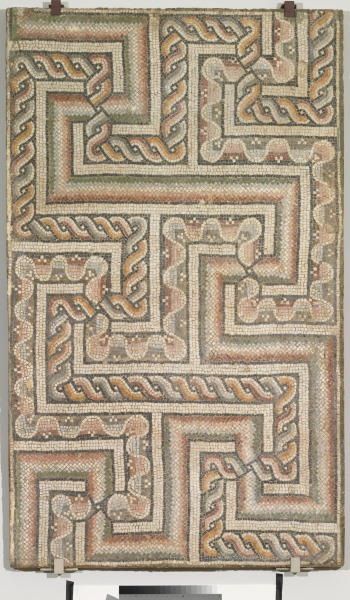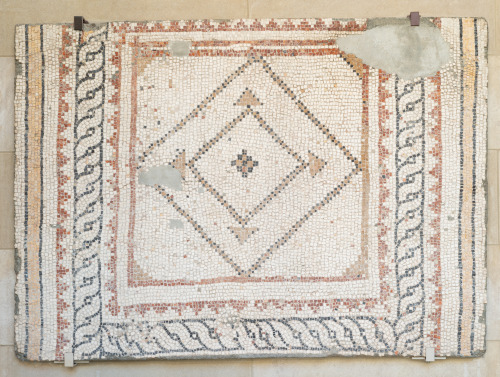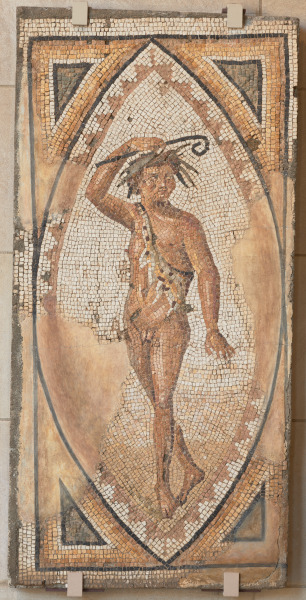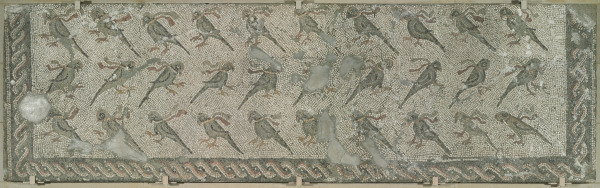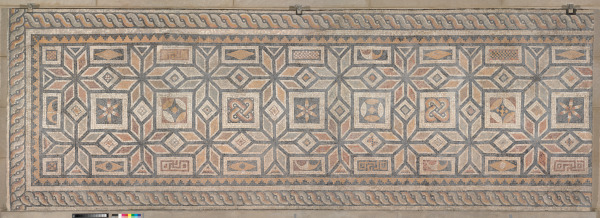
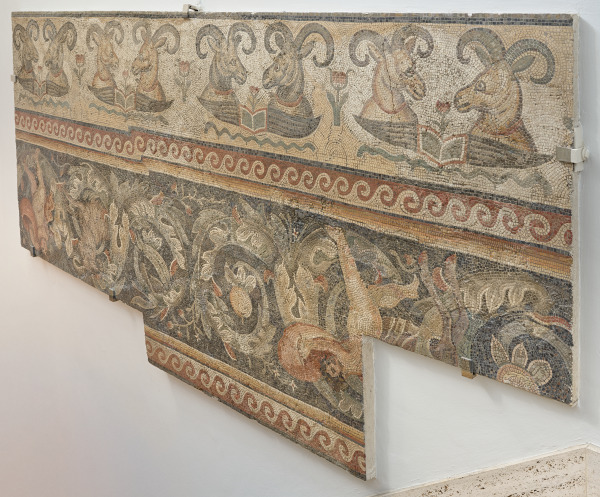
Border fragment of floor mosaic depicting rams’ heads over open wings
475-533
Scroll
Border fragment of floor mosaic depicting rams’ heads over open wings
475-533
Physical Qualities
Stone and lime mortar, 55 x 113 in. (139.7 x 287.1 cm.)
Credit Line
Antioch Subscription Fund
Object Number
1937.130
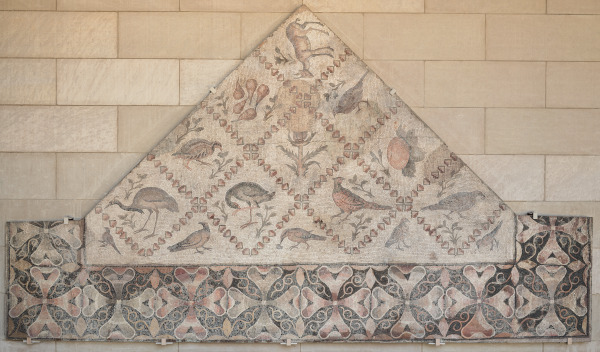
In 1933, a peasant discovered this mosaic border while digging a well in front of his house. Scholars immediately realized that he had uncovered important evidence of ancient Antioch's dual orientation toward East and West. The rams' heads in the upper band are symbols of Persian royalty and suggest Antioch's tie to the East. Each pair of heads rests on a set of open wings from which a ribbon flutters. Wings and ribbons were attributes of the royal crown of Persia during the Sasanian dynasty (226-641 A.D.) The rams' red collars indicate that they inhabited the royal hunting park.
The luxuriant vines and acanthus leaves of the lower border derive from Roman ornament. Erotes (cupids) in red capes can be found amidst the foliage. They have been placed to face the outside of the border so they appear upside-down.
Cone Wing Rotations 2021
Cone Wing Rotations 2022
Cone Wing Rotations 2023
Cone Wing Rotations 2024
Cone Wing Rotations 2025
C. R. Morey, Museum Quarterly II, BMA, 1937-1938, no. 4, p. 4.
"Antioch-on-the Orontes, II, The Excavations, 1932-1936," Princeton: Princeton University Press, 1938, no. 60, p. 188, pl. 45.
C.R. Morey, "The Mosaics of Antioch," Longmans, Green & Co., 1938, pp. 43-44, pl. XXIV.
Doro Levi, "Antioch Mosaic Pavements," Princeton: Princeton University Press, 1947, vol. I, pp. 478-480, vol. II, pl. CXXXIII-b.
R. Stead, "Pavements from a Fabled City," "Pharos," Museum of Fine Arts, St. Petersburg, Florida, Fall/Winter 1964, pp. 5-8.
 On View at the BMA