Unidentified
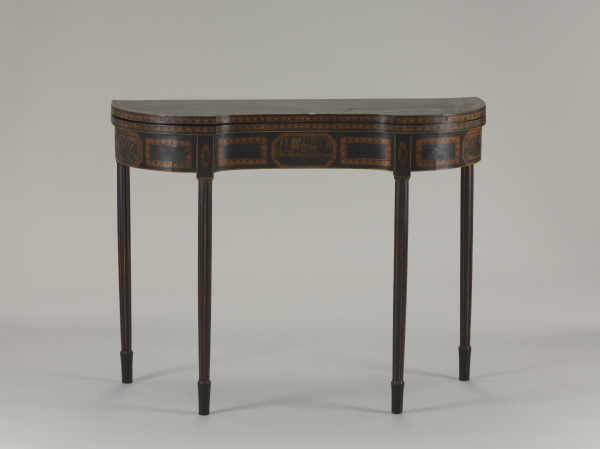
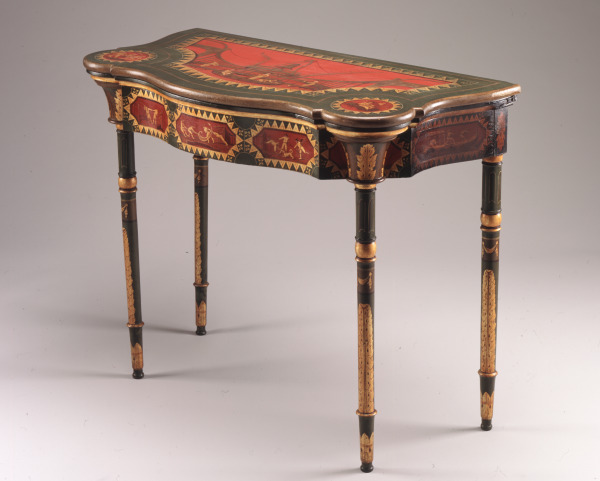
Card Table
1789-1809
Scroll
Unidentified
Card Table
1789-1809
Physical Qualities
Mahogany; boxwood inlay; tulip poplar and cherry secondary woods, 29 1/4 x 35 3/4 x 17 1/2 in. (74.3 x 90.8 x 44.5 cm.)
Credit Line
Bequest of Angelica Yonge Pearre, Baltimore
Object Number
1998.296
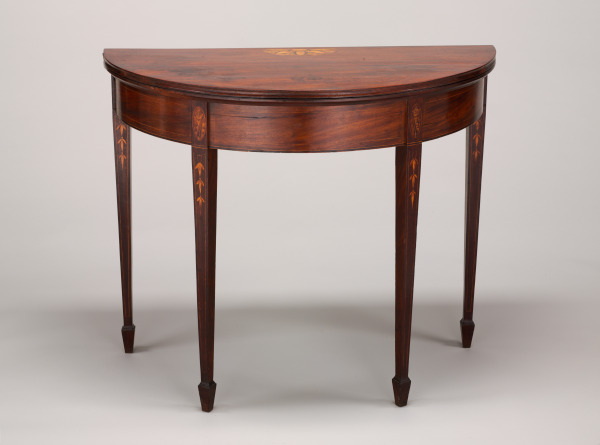
By 1800, the demilune or half round card table was a form much favored in Baltimore. The top folds out to form a circular surface for gaming; it rests on the two back gate legs that swing out to support it. When not in use, the folded table stood neatly against a wall. Card tables were often created in pairs according to early advertisements and inventories. They would have been used in symmetrically arranged drawing rooms and parlors. When folded, the tabletop features a powerfully composed shell set in a semicircle. Thin lines of boxwood stringing on the reeded tabletop edge reiterate the graceful half moon shape, and also enhance the apron and legs. Ovoid floral shells top each leg. Descending bell flowers, a popular motif in Baltimore, adorn both the sides and fronts of all four legs. Luxuriously worked, this fine card table is one of a number of such Baltimore-made examples in the BMA collection.
The Baltimore Museum of Art by bequest, 1998; Mrs. Sifford Pearre, Baltimore, Maryland
Pearre Gallery Reconfiguration & Reinstallation
American Wing Rotations 2020
American Wing Rotations 2021
American Wing Rotations 2022
American Wing Rotations 2023
American Wing Rotations 2024
American Wing Rotations 2025
BMA, 'Baltimore Furniture: 1760-1810,' 1947, figs. 2, 4, 5, 14, pp. 26, 28, 31, 41. Luke Vincent Lockwood, 'Colonial Furniture in America,' vol. II, fig. 774, p. 230.
Maker
Unidentified
2000-01-01 00:00:00–2000-01-01 00:00:00
 On View at the BMA