








Pottier & Stymus
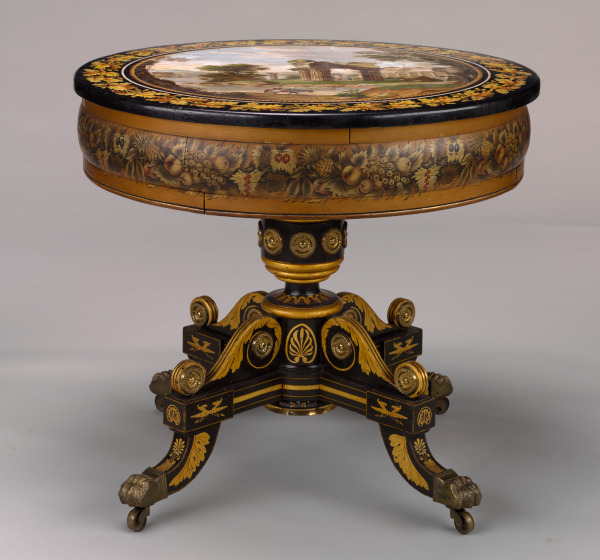
Center Table
1859-1874
Physical Qualities
Mahogany, rosewood, polychrome, gilt, marble, bronze, 29 3/4 x 45 3/4 x 32 5/8 in. (75.6 x 116.2 x 82.9 cm.)
Credit Line
Purchase with exchange funds from Bequest of Philip B. Perlman
Object Number
2001.37
The intrepid Antarctic explorer Admiral Richard Byrd (1888-1957) briefly owned this table. Covering broad territory, it orchestrates eclectic forms and motifs drawn from different times and places. Centered by a vaguely neoclassical urn, and glittering with incised gilt, a toothy four-part stretcher simultaneously celebrates Moorish architecture and American machine power. Pairs of legs attest to “Egyptomania,” an international design movement that followed Napoleon Bonaparte’s Egyptian campaign of 1798. “Egyptomania” received fresh impetus from the opening of the Suez Canal (1869), and the premier of Giuseppe Verdi’s opera Aida (1871). By 1881, when New Yorkers embellished Central Park with “Cleopatra’s Needle,” an ancient Egyptian obelisk, the firm of Pottier and Stymus had become one of the city’s leading decorators, renowned for furniture in the Egyptian taste.
The Baltimore Museum of Art by purchase, 2001; Judith Hollander by purchase, New York; Admiral Richard Byrd gifted to mistress (name unknown)
David Park Curry, The Baltimore Museum of Art, "PAINT! Japanned, Ebonised, Grained, and Polychromed Furniture," December 2006-November 2012.
Inscribed: Bronzes marked: 'P and S'

 On View at the BMA