
Helen Heineman and Julius Schrader
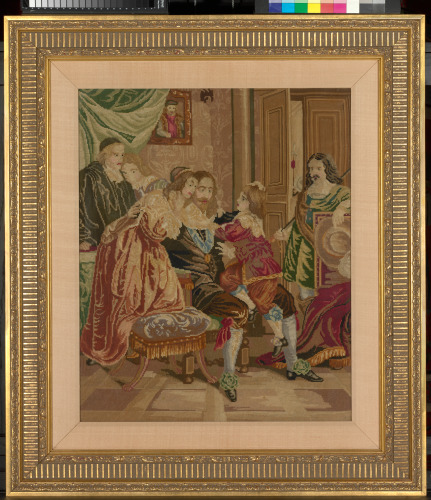
Charles I Says Farewell to His Family
1895-1896
Scroll
Physical Qualities
Cotton ground, wool, silk, and chenille embroidery threads, beads, 33 3/8 × 29 1/8 × 1 3/4 in. (84.8 × 74 × 4.4 cm.)
Credit Line
Gift of Harold and Lynn Rosenbush Davidov, Baltimore
Object Number
2012.581
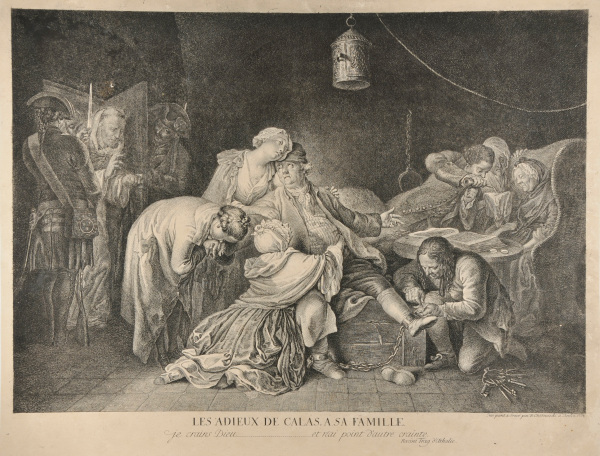
Large needlepoint picture of Berlin wool work depicting King Charles I bidding farewell to his youngest children, Princess Elizabeth and Prince Henry. The king is seated, the princess is to his right leaning toward him to comfort him and Prince Henry is climbing onto his leg on the other side. The children are bidding him goodbye before his impending execution for treason (in 1649). A cleric is standing behind the king to his right comforting a young workman who is leaning on his shoulder. Another aristocratically dressed gentleman stands to the king's left by the wall. The scene is set in an elaborate interior with paneled walls, carpet, drawn curtains, a painting on the wall (possibly Henry VIII), and upholstered furniture. A door is open in back of the king to the hallway where it appears a halberd or other staff is being held by an unseen guard outside of the door.
The ground is unbleached cotton Penelope canvas with 16 double warps per inch across the width and 16 double wefts slightly separated (30 wefts per inch) throughout the height. The embroidery is worked in numerous colors of untwisted wool thread, with some use of silk threads for highlights and some chenille threads of unknown fiber used to create the hair of the individuals and the beard of the subject of the portrait on the wall. Seventeen crossed stitches to the inch are worked in both directions. (Not fine enough for petit point). The eyes of all the individuals, including the person in the painting, are composed of single seed beads of either dark blue or black.
The needlework is mounted on a wooded stretcher. The original holes used to mount the work are found in the portion folded over to the back of the current stretcher. Approximately 1/2" of embroidery has been lost on all sides in order to reframe the work. This stretcher is set into an elaborate gilded decorator frame with an inner frame covered in soft gold colored fabric that covers a small portion of the needlework on all sides.
The Baltimore Museum of Art by gift, 2012; Lynn Rosenbush Davidov, (great niece of maker) by inheritance; Alice Sinsheimer Rosenbush (niece of maker) by inheritance; Miss Helen Heineman (maker). Miss Heineman was born and raised in Baltimore and lived there her entire life (per donor).
Pamela Clabburn, The Needleworker's Dictionary, New York: William Morrow & Company, Inc., 1976, pp. 29-30, p. 202.
Margaret Vincent, The Ladies' Work Table: Domestic Needlework in Nineteenth-Century America, London: University Press of New England, 1988, p.30 (a different version).
Margaret Vincent, The Ladies' Work Table: Domestic Needlework in Nineteenth-Century America, London: University Press of New England, 1988, p.30 (a different version).