
Paul Sandby
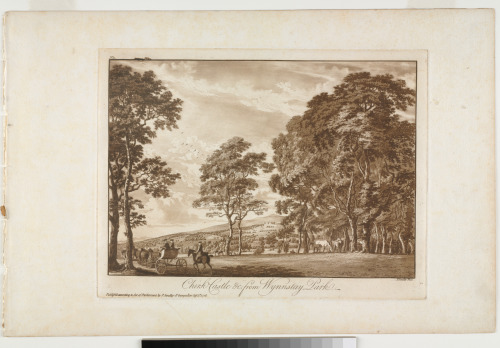
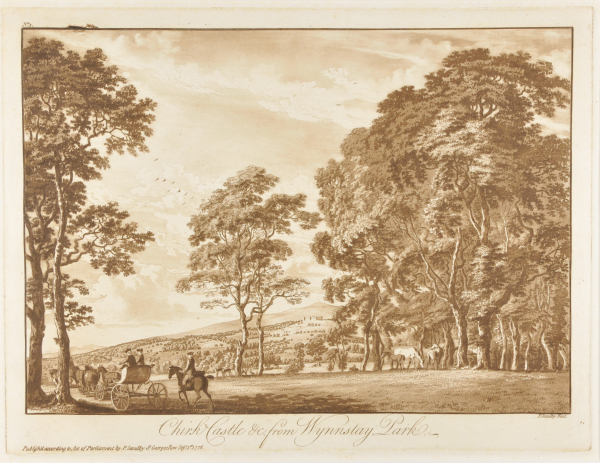
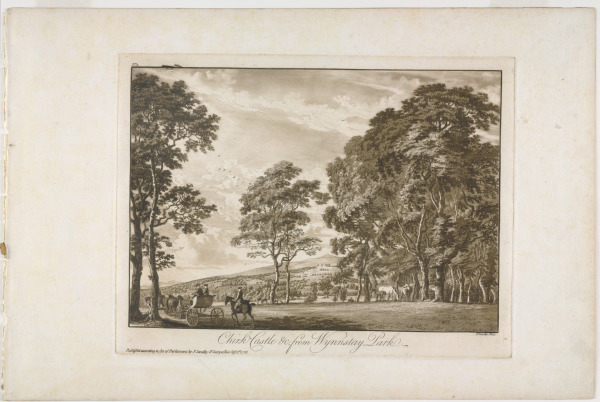
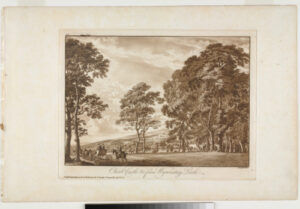
Chirk Castle &c. from Wynnstay Park
1775
Scroll
Paul Sandby
Chirk Castle &c. from Wynnstay Park
1775
Physical Qualities
Etching, softground and liftground etching with aquatint and burnishing, printed in brown, Sheet: 309 x 465 mm. (12 3/16 x 18 5/16 in.)
Plate: 236 x 312 mm. (9 5/16 x 12 5/16 in.)
Credit Line
Purchased as the gift of Rhoda Oakley, Baltimore
Object Number
2008.66
Sandby was the first English artist to use the aquatint technique to reproduce wash-like passages in prints. First developed around 1650 by the Dutch artist Jan van de Velde II, aquatint was marginalized until the 1760s when Frenchman Jean-Baptiste Le Prince perfected the process and published a how-to guide. The aquatint process involves sprinkling a fine resin powder on a copper plate, which is heated so that the resin melts onto the plate forming an uneven surface. The plate is then submerged in acid,
which etches the uncovered areas surrounding each droplet, and leaves a fine network of pockmarks that resembles broad areas of wash when printed.
Sandby further developed the liftground technique by combining resin with “rectified spirits of wine” and brushing it over the entire etching plate. He then used a sugar solution to brush on the design. After the whole plate was covered with varnish, it was submerged
in warm water. The sugar-solution-painted areas dissolved and lifted away, revealing the portions of the plate to be aquatinted.
The Baltimore Museum of Art by purchase, 2008; Susan Schulman
Taking in the View: English Watercolors and Prints
Inscribed: In plate, at upper left: "No. 3"; in plate, at lower center: "Chirk Castle &c. from Wynnstay Park."; in plate, at lower right: "P. Sandby Fect."; in plate, at bottom left: "Publish'd according to Act of Parliament by P. Sandby St. Georges Row, Sept. 1st. 1776."
Markings: None