
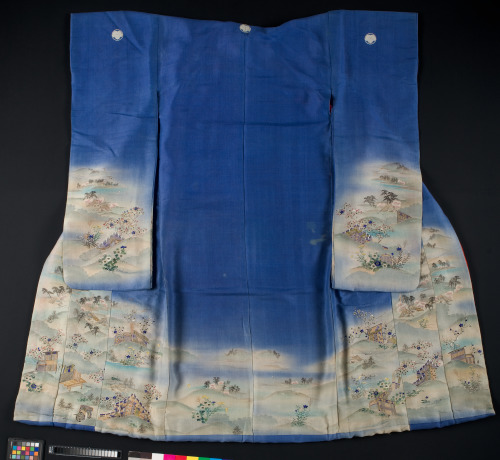
Chuburisode Depicting Matsukaze (Breeze Through the Pines) Theme
1866-1899

Scroll

Chuburisode Depicting Matsukaze (Breeze Through the Pines) Theme
1866-1899
Physical Qualities
Silk, dye, pigments, metal-leafed paper strips, metal-leafed paper strips wrapped around silk or cotton thread core, silk embroidery threads, silk lining, 62 x 50 in. (157.5 x 127 cm.)
Credit Line
Gift of Mrs. T. Meredith Hunter
Object Number
1955.155
(Anita Jones and Ann Marie Moeller, The Baltimore Museum of Art, Baltimore, MD, "Kimono and Obi: Romantic Echoes from Japan's Golden Age," July 10, 2016 - January 15, 2017. Wall label text.)
Chuburisode Depicting Matsukaze Theme
1868–1912, Meiji Era
Japan
Silk, dye, pigments, metal-leafed paper strips;metal-leafed paper strips wrapped around silk or cotton thread core, silk embroidery thread, silk lining
Gift of Mrs. T. Meredith Hunter, BMA 1955.155
The yuzen design on this chuburisode (a kimono with medium-long sleeves for a young unmarried woman) refers to the exile of the celebrated Heian poet Ariwara-no-Yukihira (818–893) to the remote Bay of Suma. The story of Ariwara and the Suma
women who loved him is told in the famous play, Matsukaze. Ariwara falls in love with two sisters who carried briny sea water to boiling huts to make salt. These huts, with smoke rising from the fires beneath their cauldrons, appear on this chuburisode.
Scattered throughout the landscape are images of the Heian court life that Ariwara had left behind. Decorated curtains used as backdrops for Heian court dance performances are suspended between stakes topped by orbs. A Heian noble’s cart (gosho-guruma) stands to the lower right of a Heian palace veranda shrouded by clouds. The subtlety of the allusions to the Heian poet and the Noh play suggest the sophisticated sensibilities of the owner.
[Photo Caption:]
Detail. Two water buckets resting in front of a hut represent the ever toiling sisters of Suma beloved of the exiled Ariwara-no-Yukihira. This scene is found on the opposite side of the kimono as it is displayed here.
[Photo Caption:]
Detail. A Heian palace veranda shrouded by clouds alludes to Ariwara’s life among
the nobility prior to his exile.
[Techniques:]
Yuzen (paste resist outline dyeing), Nui (embroidery), Koma-nui (couching), Kaki-e (hand painting)
The Baltimore Museum of Art by gift, ex. collection Mrs. T. Meredith Hunter
Kimono and Obi: Romantic Echoes from Japan's Golden Age
http://www.the-noh.com/en/plays/data/program_043.html 3-5-2018. (Story and title of Noh play).
Inscribed: No inscriptions, but three kamon (Japanese crests) featuring three ivy leaves within a circle