
Fante (Akan)
Cloth of the Great (Akunitan)
Fante, 1933-1966
Scroll
Fante (Akan)
Cloth of the Great (Akunitan)
Fante, 1933-1966
Physical Qualities
Wool, cotton, metallic thread, synthetic fibers, velvet, synthetic fur, 71 5/8 x 118 1/8 in. (182 x 300 cm.)
Credit Line
Gift of Ambassador Dawn M. Liberi, Washington, D.C.
Object Number
1998.378
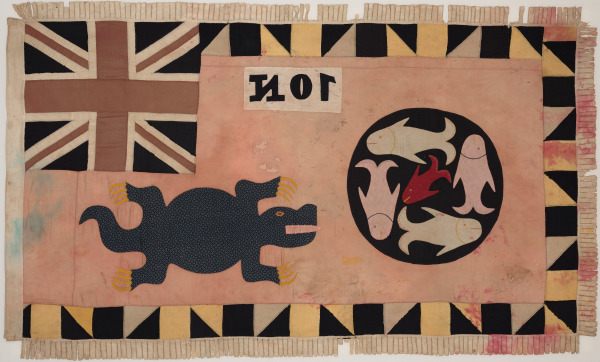
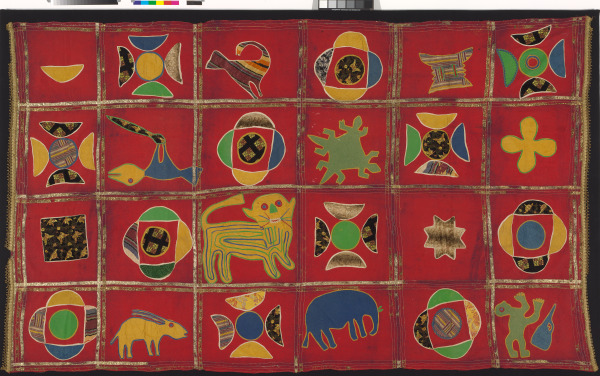
This textile “helps bring together old and new, local and imported items and ideas,” according to art historian Rowland Abiodun. Akunitan means “cloth of the great”
in Twi, and this work was likely created for a high-ranking Ghanaian man to wear on ceremonial occasions. Symbols suggest power: the stool in the upper right references the thrones used by traditional leaders in this area, while the eye-catching gold thread alludes to the region’s extensive gold deposits. Meanwhile, appliqué—a technique in
which patches of fabric are sewn onto a base cloth—has historically been associated with the leaders from the neighboring Kingdom of Dahomey (c. 1600–1904), and the
wool base cloth itself was likely imported from England.
The Baltimore Museum of Art by gift, 1998; Purchased by donor at Cape Coast.
African Gallery Rotations 2023