
Beatrice Glow
Colonial Desires
2021
Scroll
Beatrice Glow
Colonial Desires
2021
Physical Qualities
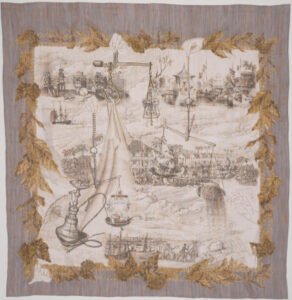
Inkjet print on polyester yoryu, embroidered with gold leaf thread, Overall: 50 × 54 in. (127 × 137.2 cm.)
Image: 1270 × 1270 mm. (50 × 50 in.)
Credit Line
Jane and Worth B. Daniels, Jr. Fund
Object Number
2022.198
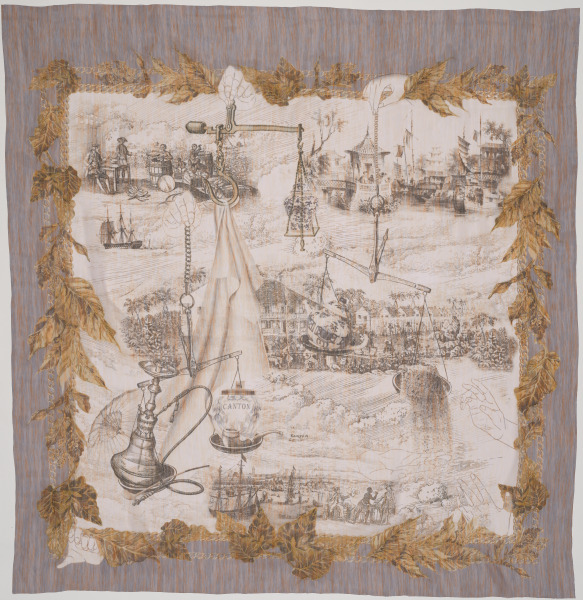
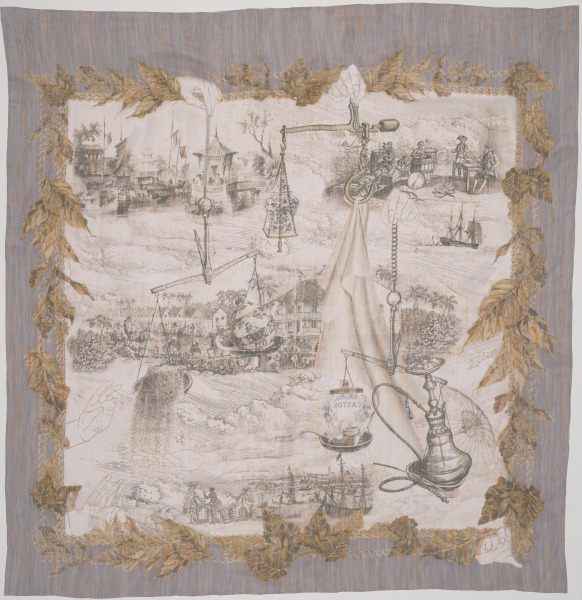
The scarf at right by Beatrice Glow, an American contemporary artist of Taiwanese descent, hangs like a ship’s sail. Glow’s images narrate how trade, enslavement, and exploitation are intertwined in Maryland’s tobacco industry. Using historic sources, Glow mapped the tobacco trade from plantations in the United States to Chinese ports. Colonial Desires is based on the events of merchant and enslaver Captain John O’Donnell’s (1749–1805) return to Baltimore from China in 1785. When O’Donnell arrived in Baltimore harbor, he abruptly sold his ship and used the money to purchase a plantation that he named Canton, now the location of Baltimore’s Canton neighborhood. In doing so, he stranded a crew of Chinese and South Asian sailors in the colonies against their will. Through a smoky montage of this history, Glow’s scarf signals the exploitative effect of Chesapeake trade on a global scale.
The Baltimore Museum of Art by purchase, 2022; the artist
Beatrice Glow: Once the Smoke Clears
American Wing Rotations 2023
American Wing Rotations 2024
Explore the Collection Further