Commemorative of the Great Exhibition 1851

William Underwood

Commemorative of the Great Exhibition 1851

1850
Scroll

William Underwood

Commemorative of the Great Exhibition 1851

1850

Physical Qualities Wool, 72 x 65 in. (182.9 x 165.1 cm.)
Credit Line Purchased as the gift of Joseph A. Holtzman and Carl Skoggard
Object Number 2008.142
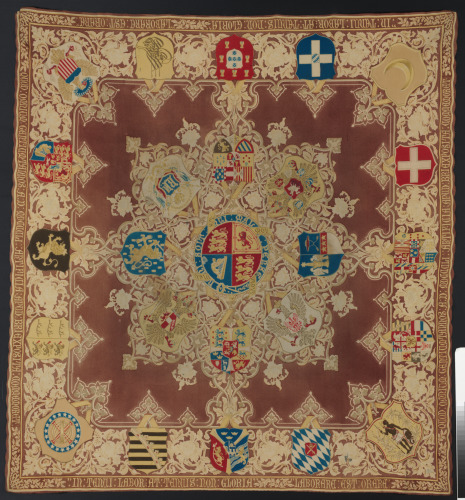
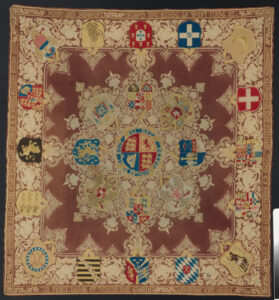
Large square woolen tablecloth or table cover commemorating the Great Exhibition of 1851. The ground is plainwoven with a very slight knap. The design is block printed using 223 blocks and copper plates (per the description in the official catalogue of the exhibition). The Arms of Great Britain are positioned in the center sourrounded by shields carrying the arms of other nations participating in the exhibition. The British arms consist of the seal of the Knights of the Garter with motto "Honi soit qui mal y pense" [trans. "Evil be to those who think it"] and the motto of the monarchy "Dieu et mon droit" [trans. "God and my right". Surrounding the British arms are the arms of the nations of Europe, including those of France, Russia, Spain, the Papal States, and others. Further out around the border of the table cover are the shields of nations such as Sweden, Greece, Portugal, Turkey, and others. In the four corners are the shields representing the four continents America, Asia (a crescent), Africa (a black man), and Europe (symbol of Europe). The shields are surrounded with strap-work in neo-gothic design, with trefoil crockets, and a floral rinceaux. Around the outermost border three phrases are written in Gothic block letters and repeated: "IN:TENUI :LABOR: AT:TENUIS: NON: GLORIA" [English translation: "The labor is on a slight (trivial) theme, but the glory is not slight." "LABORARE: EST: ORARE" [English translation: "To work is to pray." from the Motto of the Benedictine Order, "QUOD: OMNIUM: GENTIUMTANNOS:A:D: MDCCCLI: ARTIFICIA:APUD: BRIEXPOSITA: COMMEMORET" [translation is: "To commemorate the works (of industry) of all nations at the (British) exposition in the year 1851". A mistake in the Latin is shown in that there needs to be a space after "gentium" and "tannos" means nothing. "Apud Biexposita" [Translated "the Exposition in Britain,"] "at the British Exposition."[Alternate translation: Take the "bri"- from "briexposita" and the "tannos" from the "gentiumtannos" and the phrase "apud Britannos," meanings "in Britain," (TRANSLATION by: Sister Therese Marie Dougherty, SSND, Ph.D., Professor of Classics, College of Notre Dame of Maryland) The ground was originally a deep maroon, but has faded to a brown color. The coats of arms were printed in a indigo blue (now more Prussian blue but still vivid), an intense red, yellows (faded to lighter shade yellow), and tan or beige with dark brown outlines and markings. The table cover has a cut edge on all sides, in some places cut in a scallop and in others straight. The edges remain unhemmed and unfinished.
Baltimore Museum of Art by purchase, 2008; Meg Andrews, London, England by purchase; undisclosed party.
"In a New Light/News of the Campaign for The Baltimore Museum of Art," BMA, Fall 2009, ill.
Great Exhibition of the Works of Industry of all Nations, 1851, Official Descriptive and Illustrated Catalogue, Vol. 2 (London, Royal Commission, 1851), Section III, Manufacturers, Class 18, p. 554, cat. 22, illus. Plate 37. Accessed on Googlebooks.

The Morning Chronicle, October 1, 1851. [Mentioned this tablecover within a review of the exhibition.]

The Morning Chronical, October 7, 1851. Advertisement describing table cover.

Advertising flyer for William Underwood illustrating this same tablecover.

Inscribed: Printed along two borders and repeated on the other 2 borders in large Gothic lettering: "'IN TENUI LABOR AT TENUIS NON GLORIA'" [Note: there are quote marks at beginning and end.] English translation: "The labor is on a slight (trivial) theme, but the glory is not slight." [This comes from Vergil's Georgics, Book 4, which has to do with beekeeping and describes the work of the bees, who are tiny.] "'LABORARE EST ORARE'" [Note: there are quote marks at the beginning and end.] English Translation: "To work is to pray." [This is the motto of the Benedictine Order] "QUOD OMNIUM GENTIUMTANNOS: ARTIFICIA: MDCCCLI "APUD BRIEXPOSITA COMMEMORET" [Note: no quotes] English translation: Could mean: at the Exposition in Britain, at the British Exposition. Abbreviations are used all the time in this type of Latin.] [There needs to be a space after gentium. [There does not appear to be one on the cover. a.e.j.]; tannos means nothing and when I look at the photo I'm not sure that is the correct spelling. But can't come up with a suggestion.] English translation: "To commemorate the works (of industry) of all nations at the (British?) exposition in the year 1851." The Latin is in three parts: a quotation from Vergil about work, the motto of the Benedictines having to do with work, and the notice of the time and place. The above translations of the Latin and interpretations are from: Sister Therese Marie Dougherty, SSND, Ph.D. Professor of Classics College of Notre Dame of Maryland 4701 N. Charles Street Baltimore, MD 21210 Phone: 410-532-5559 Fax: 410-532-5794) Other inscriptions: Printed in center as part of Great Britain's coat of arms: "HONI SOIT QUI MAL [Y] PENSE" [Left out syllable? Dishonor to those who think it] "DIEU ET MON DROIT" [God and my right] Printed on the shield of France: "LIBERTE, EGALITE, FRATERNITE" [Liberty, Equality, Fraternity]
Manufacturer

William Underwood

2000–2000

English, dates unknown
Meet William →

Explore the Collection Further

BY SAME ARTIST
TEXTILES
Unknown Artist, John Harris, and others
The Flying Dutchman and Voltigeur: Running the Great Match at York on the 13th of May 1851 for 1000 Sovereigns a Side
1850–1855
George Baxter
The Gems of the Great Exhibition No. 1
1823–1866
George Baxter
The Gems of the Great Exhibition No. 3
1823–1866
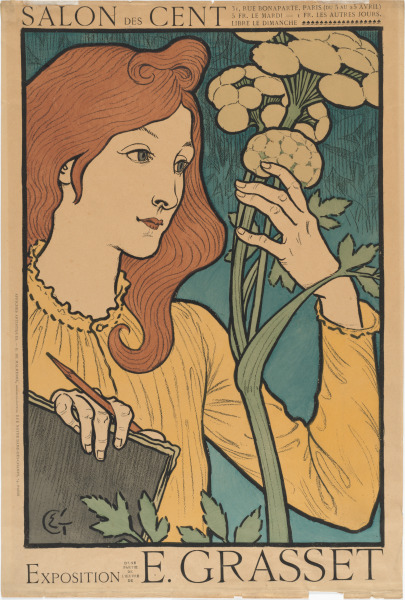
Eugène Samuel Grasset, Affiches Artistique de La Plume, Paris, and others
Exhibition Poster for “Salon des Cent”
1893
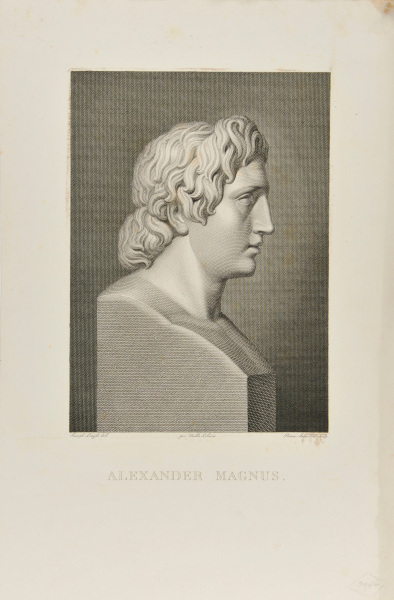
Pietro Anderloni and Giuseppe Longhi
Bust of Alexander the Great
1804–1848
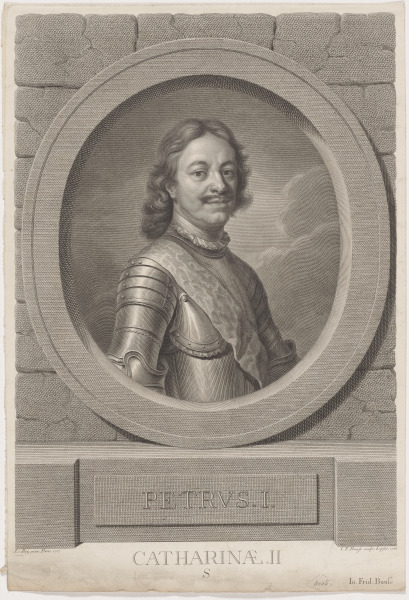
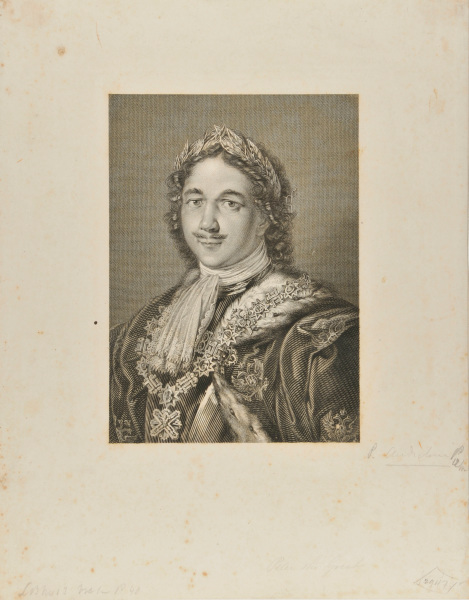
Johann Friedrich Bause and Le Roy
Portrait of Peter the Great
1785
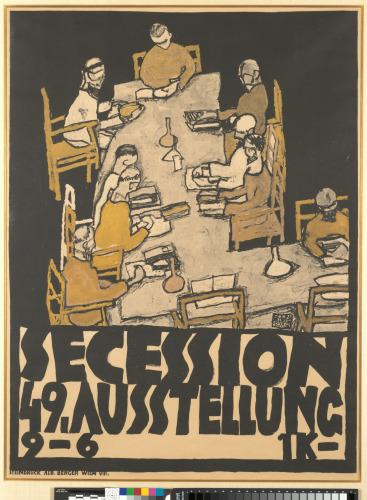
Egon Schiele, Vereinigung bildender Künstler Österreichs, and others
Poster for the 49th Exhibition of the Vienna Secession
1917
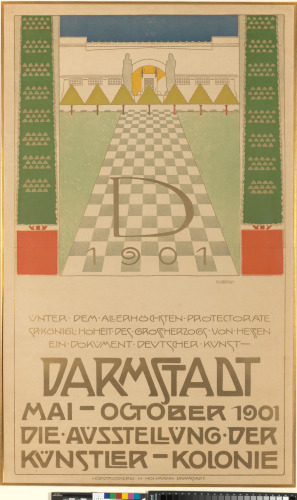
Joseph Maria Olbrich and Hofdruckerei H. Hohmann
Poster for the First Exhibition of the Darmstadt Artists' Colony
1900
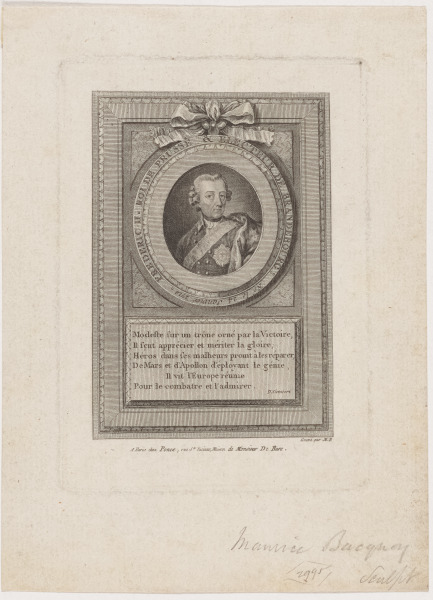
Maurice Baquoy
Portrait of Frederick the Great
1699–1746
Pietro Anderloni
Portrait of Peter the Great
1799–1848
Pietro Anderloni
Portrait of Peter the Great
1799–1848
Leonard Baskin
Announcement for the Exhibition "Sculpture and Drawings by Leonard Baskin" at the Grace Borgenicht Gallery in New York (May 8 - May 26, 1962)
1961