Piet Mondrian
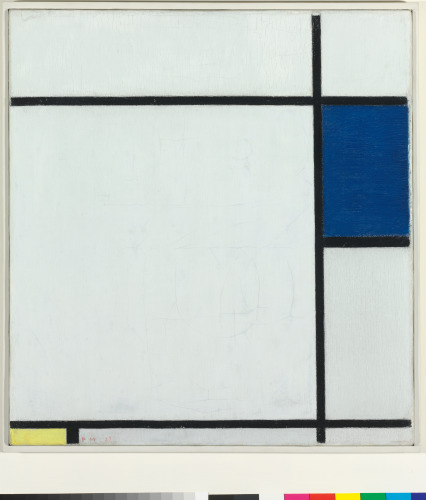
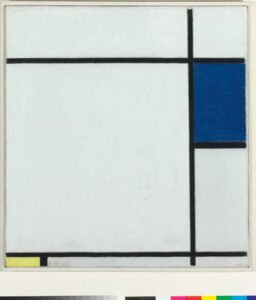
Compositie No. 1
1926
Scroll
Piet Mondrian
Compositie No. 1
1926
Physical Qualities
Oil on canvas, 15 1/8 x 14 in. (38.4 x 35.6 cm.)
Credit Line
Bequest of Saidie A. May
Object Number
1951.343
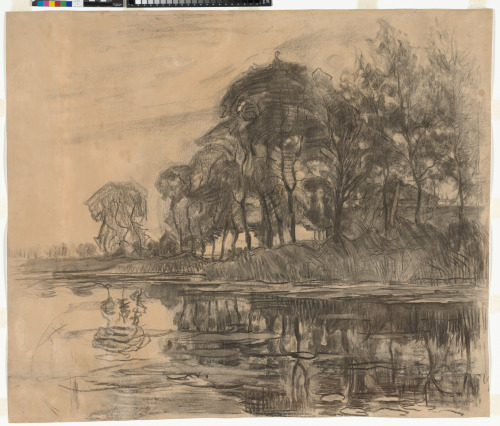
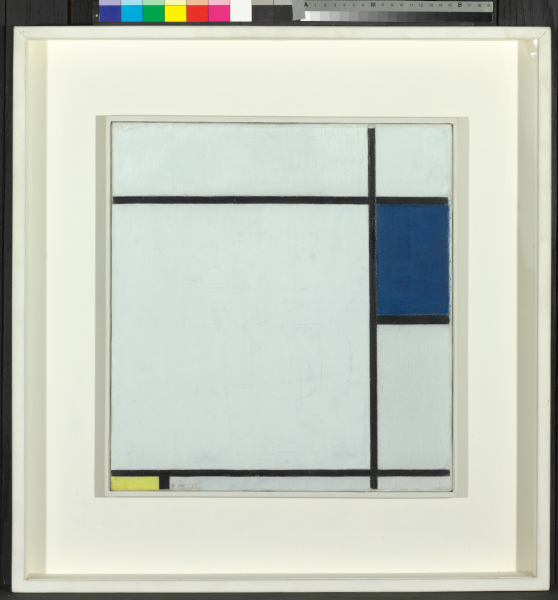
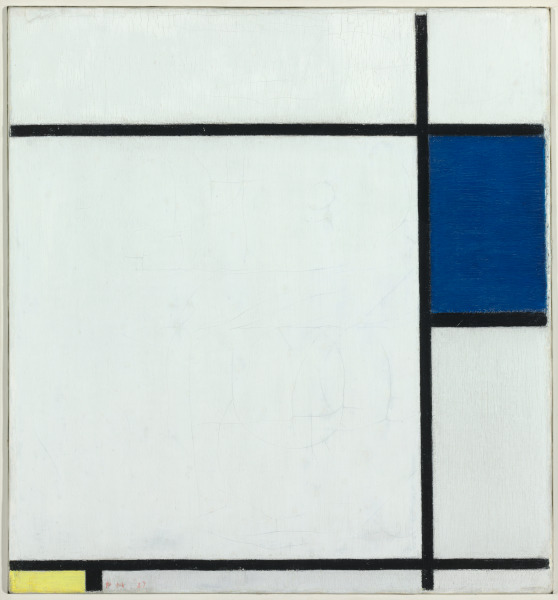
Piet Mondrian began his career as a landscape painter, but abandoned naturalism after being exposed to Cubism. "Composition V" is an example of the austere style he perfected in the 1920s. Restricting compositional elements to the bare essentials, Mondrian allowed himself to use only vertical and horizontal lines, right angles, and the three primary colors, plus black and white. Together with fellow artists of the "De Stijl" (The Style) art movement, Mondrian sought to purify art by purging all that was extraneous. The group's goal was to achieve ideal harmony while suppressing individualism, viewed as the underlying cause of World War I.
The Baltimore Museum of Art, by bequest, 1951; Saidie A. May, 1946; Dolly and Pierre Chareau, Paris/New York; from the artist 1928.
Mondrian in Paris
Mondrian. The Birth of Abstraction
Cercle et Cerré and the International Spirit of Abstract Art
The Renoir Returns
Blue Black
Mondrian and DeStijl
Northwest Cone Rotations 2021
Northwest Cone Rotations 2022
Northwest Cone Rotations 2023
Cone Wing Rotations 2024
Calder (working title)
The Baltimore Museum of Art News, “Catalogue of the Saidie A. May Collection of Modern Paintings and Sculpture,” March, 1950, cat. 86, p. 20.
Peter C. Sutton, "A Guide to Dutch Art in America," Grand Rapids, MI: Wm. B. Eerdmans, 1986, p. 6.
Joop M. Joosten, "Catalogue Raisonné of the Work of 1911-1944," Vol. II, New York: Harry Abrams, 1998, no. B192, p. 335.
Brigitte Leal, "Mondrian," Paris: Centre Pompidou, 2010, p. 238, color ill.
Meyer, Esther da Costa. Pierre Chareau: Modern Architecture and Design. New York: The Jewish Museum; New Haven: Yale University Press, 2016.
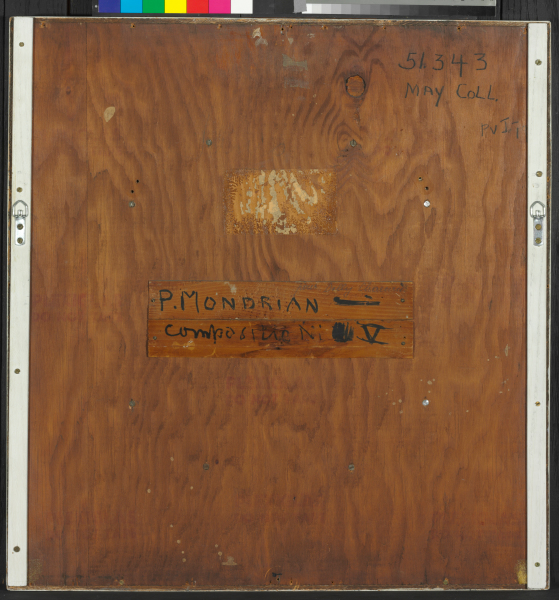
Inscribed: Initialed lower left: “P. M. ‘27”