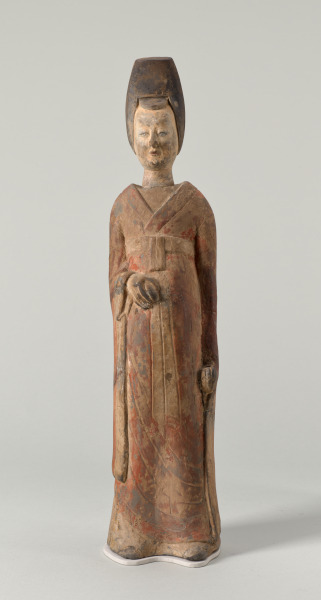

Court Attendant
2001
Scroll

Court Attendant
2001
Physical Qualities
Earthenware with transparent glaze over white slip, traces of red and black pigment, 19.4 cm. OH
Credit Line
Gift of George and Julianne Alderman, Baltimore
Object Number
1998.618.29
The practice of burying goods with the deceased had an ancient origin in China, evident as early as the middle Neolithic period (c. 4,000 B.C.) and continuing into the Qing dynasty (1644-1911). This mortuary retinue is remarkable for containing so many pieces, including 22 foot soldiers of distinct ethnic types, foreign traders, court attendants, civil and military officials, and a protective guardian. Few such groups have survived intact to accurately represent the large numbers of figures, animals, vessels, and other less permanent articles that were commonly buried for a proper and public display of finial piety, as well as for the comfort of the deceased in the afterlife.
This group dates to the early Tang dynasty, but some of its features suggest an earlier period. Ranks of foot soldiers as well as the type of armor worn by the military official are not characteristic of the Tang. However, they style of the civil official's hat and the figures of the robed attendants and court lades are representative. The tomb of Zhang Shigui, dated 657, in Shaanxi Province contained figures similar to some of these.
The Baltimore Museum of Art by gift, 1998; George and Julianne Alderman, Baltimore; Michael Teller, Williamsburg, Virginia (acquired by dealer after 1990)
Asian Reinstallation: Home, Temple, Tomb
Asian Gallery Rotations 2021
Asian Gallery Rotations 2022
Asian Gallery Rotations 2023
Annette L. Juliano, Bronze, Clay and Stone Chinese Art in the C. C. Wang Family Collection, published by Hsi An T'ang, 1988, unpaginated, nos. 41-48; note comparative excavated examples in the appendix for nos. 42, 46, 48 from the tomb of Zhang Shigui dated 657 in Liquan county, Shaanxi province.
Inscribed: Back bears faint remnant of Chinese inscription written in black ink(?).