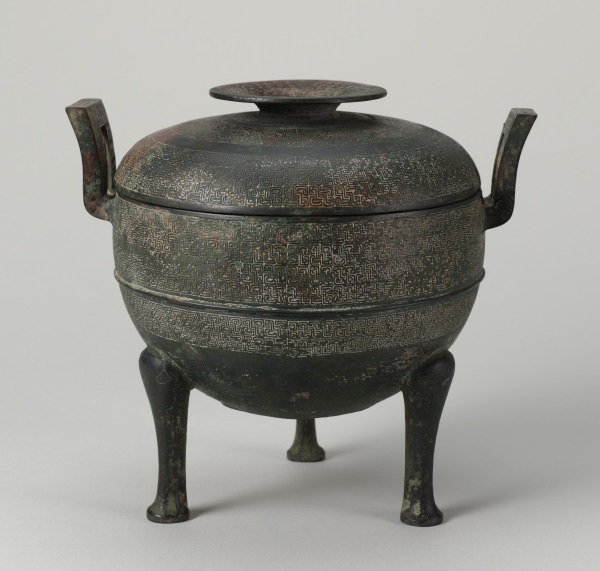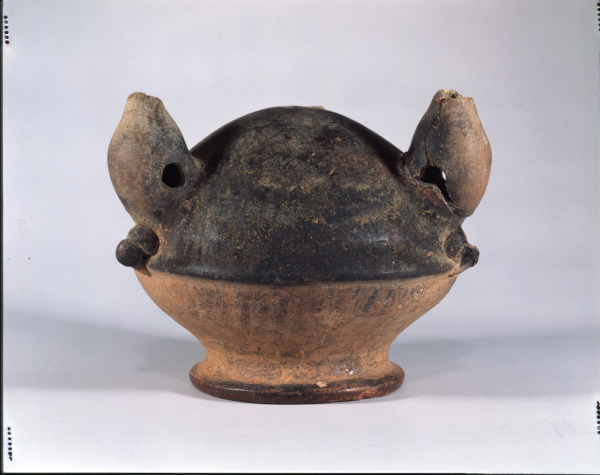
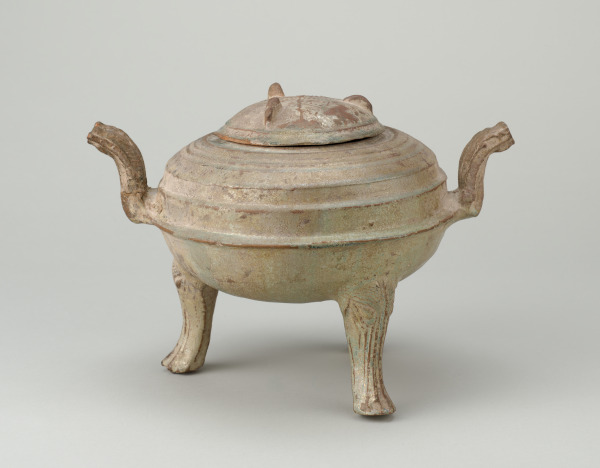
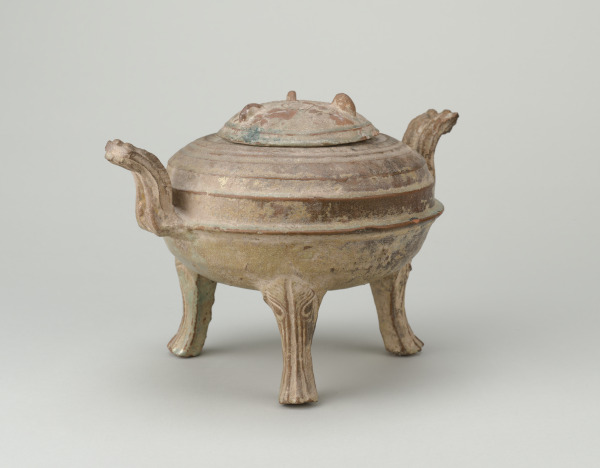
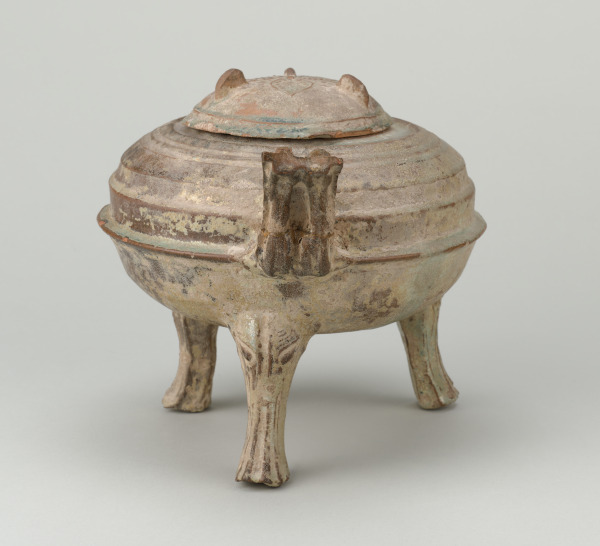
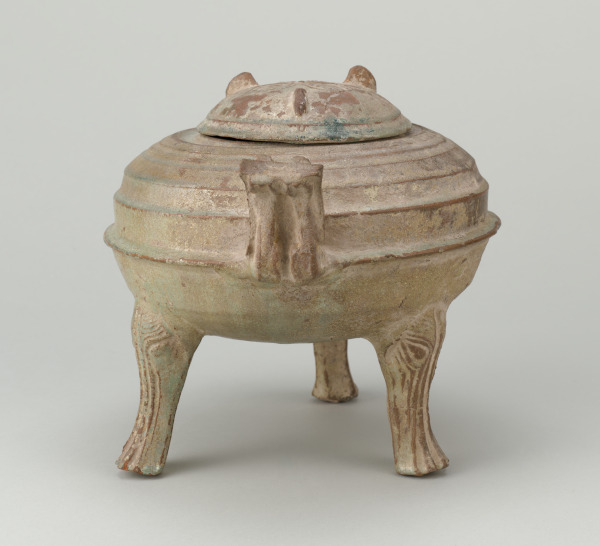
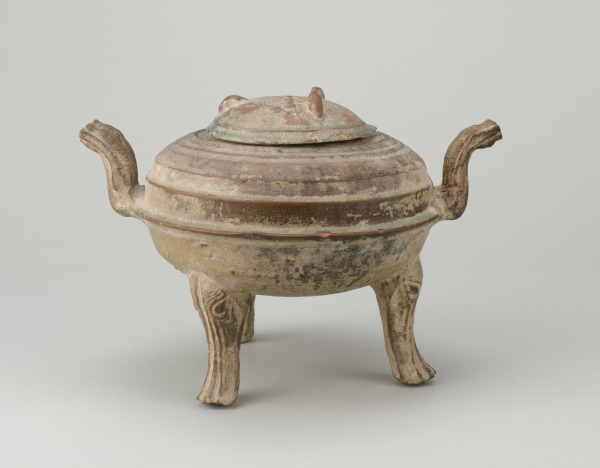
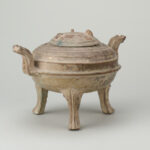
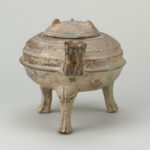
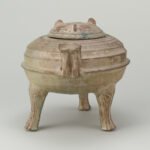
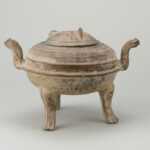
Covered Tripod (ding) with Elephant-Head legs
2001-100
Scroll
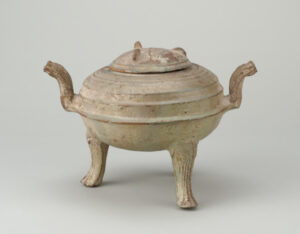
Covered Tripod (ding) with Elephant-Head legs
2001-100
Physical Qualities
Earthenware with deteriorated green lead glaze, 6 3/4 x 11 x 8 in. (17.1 x 27.9 x 20.3 cm.)
Credit Line
Julius Levy Memorial Fund
Object Number
1939.239
This covered food dish rests on three long legs, which take the form
of elephant heads. The elephants’ eyes and trunks are clearly visible.
The elephant motif was particularly appropriate for a ritual food vessel
during the Eastern Han period, when elephant meat was eaten and
the trunk was considered a special delicacy. Native elephants lived in
central and southern China before the 14th century bce, and Indian
elephants continued to inhabit Guangdong, Guangxi, and Hunan provinces
at least into the 13th century. Today, a few surviving elephants live
on preserves in Yunnan province.
The Baltimore Museum of Art by purchase, 1939; Parke-Bernet Galleries, Whitridge Collection, Sale #142, Nov. 16-18, 1939; William H. Whitridge, Baltimore
Asian Reinstallation: Home, Temple, Tomb
Asian Gallery Rotations 2021
Asian Gallery Rotations 2022
Asian Gallery Rotations 2023
International Studio Magazine, Feb. 1927.
"The Whitridge Collection of Chinese Pottery and Porcelain," Baltimore: The Baltimore Museum of Art, 1930, no. 632, p. 120, ill.
Whitridge Collection, NY: Parke-Bernet, 1939, no.247.
Frances Klapthor, "Chinese Ceramics," Baltimore: The Baltimore Museum of Art, 1993, no. 45, p. 52.