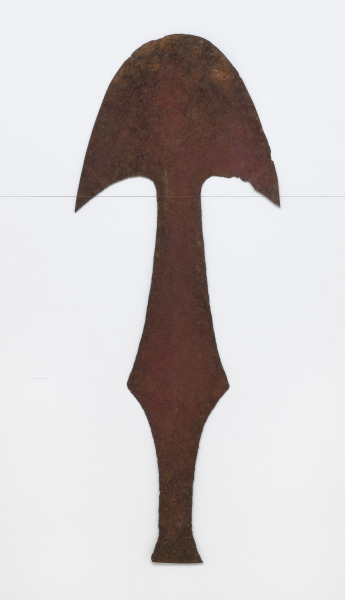
Currency Piece (Zong)

Kwele

Currency Piece (Zong)

Kwele (Western), 1700-1899

Scroll
Kwele

Currency Piece (Zong)

Kwele (Western), 1700-1899

Physical Qualities Iron, camwood, 51.3 H x 20 W cm.
Credit Line Purchased in Honor of Burton 'Buddy' Rosen with funds contributed by his Friends
Object Number 1999.174
Large, forged iron shapes resembling blades were used throughout Central Africa up to the early twentieth century as a medium of exchange, as we use money today. Other objects, such as shells or bolts of cloth were also used. The iron currency pieces were often paid as tribute by the family of the groom to the family of the bride in marriage. Red camwood rubbed on the iron surface indicates some ritual use.
The Baltimore Museum of Art by purchase, 1999; purchased from Mona Gavigan, Gallery Affrica, Washington, D.C., in 1999.
Frederick John Lamp, "See the Music Hear the Dance: Rethinking African Art at the Baltimore Museum of Art." New York: Prestel, 2003, p.231, ill.
Culture

Kwele

2000–2000

Meet Kwele →

Explore the Collection Further

Kwele
Male Figure
1933–1966
Unknown
Currency Piece
1700–1899
Kwele
Currency Piece
1900–1999
Kapsiki
Currency Piece
1800–1899
Anthony Caro
Table Piece CCCLXXXIII (Oven)
1976
Théodore Chassériau
Frontispiece for the "Othello" Illustrations
1843
Eugène Samuel Grasset
Frontispiece from the book "Jules Massenet, Esclarmonde: opéra romanesque (Paris: G. Hartmann, 1889)"
1888
Maxime Lalanne
Jardin avec statue ay bord d'une pièce d'eau
1846–1885
Maxime Lalanne
Frontispiece designed for the book "Alexandre Piedagnel, Un Bouquiniste Parisien (Paris: Édouard Rouveyre, 1878)"
1877
Maxime Lalanne
Frontispiece designed for the book "Alexandre Piedagnel, Un Bouquiniste Parisien (Paris: Édouard Rouveyre, 1878)"
1877
Maxime Lalanne
Frontispiece designed for the book "Alexandre Piedagnel, Un Bouquiniste Parisien (Paris: Édouard Rouveyre, 1878)"
1877
Antoine Béranger and Charles-Louis Constans
La Piece Curieuse
1824