
David Smith
Dida Gondola
1963
Scroll
David Smith
Dida Gondola
1963
Physical Qualities
Painted steel, 68 x 58 x 17 7/8 in. (172.7 x 147.3 x 45.4 cm.)
Credit Line
Purchase with exchange funds from Bequest of Saidie A. May
Object Number
1990.9
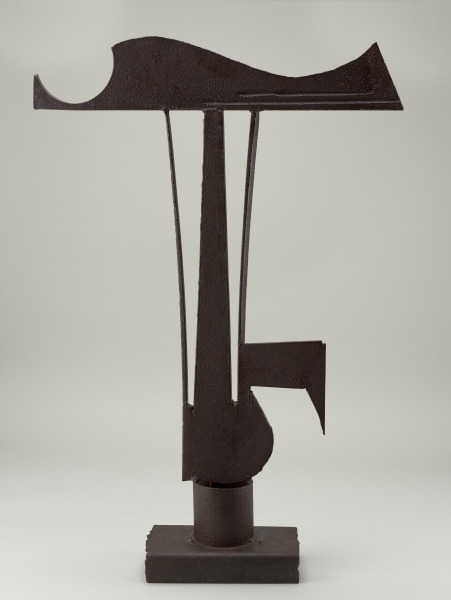
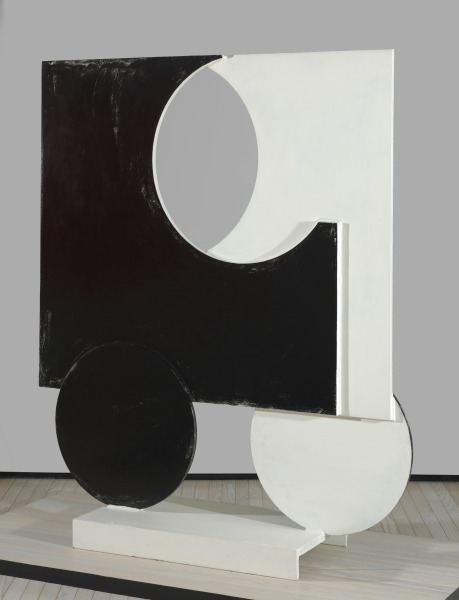
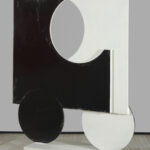
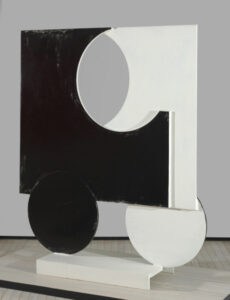
Dida Gondola is the first of a series of four “mural wagons” by David Smith. Here, two circular shapes at the bottom of the sculpture suggest wheels, while the rectangular form completing the work could be seen as a painting-like field. The work’s title further evokes a sense of motion by incorporating the Spanish word for “wagon” (gondola), along with a nickname for the artist’s daughter Candida.
The sculpture is Smith’s three-dimensional response to a series of bold, abstract paintings called Elegies to the Spanish Republic by his friend Robert Motherwell. Like Motherwell, Smith is considered part of the Abstract Expressionist movement. As a sculptor, however, Smith stands apart from most of the Abstract Expressionist artists who expressed emotional and psychological states through non-representational painting. In order to pay for art school, Smith held a job as a welder, influencing the industrial look that characterizes his investigation of three-dimensional form.
The Baltimore Museum of Art by purchase, 1990; Greenberg Gallery, St. Louis, Missouri, by purchase 1989; from government bankruptcy sale; Mansion House Center, St. Louis; Marlborough Gallery, NY; from the artist
Contemporary Wing Reinstallation
Rosalind E. Krauss, "The Sculpture of David Smith: A Catalogue Raisonné," New York & London: Garland Publishings, Inc., 1977, p. 93, cat. 513, ill.
E. A. Carmean, Jr., "David Smith," Washington: National Gallery of Art, 1982, p. 179, ill. [work shown on dolly in Smith's painting studio at Bolton Landing].
Bett Schumacher's written synopsis of the BMA/JHU Gallery Lecture on "Dida Gondola," presented in the public galleries at The Baltimore Museum of Art, May 15 and May 22, 1999.
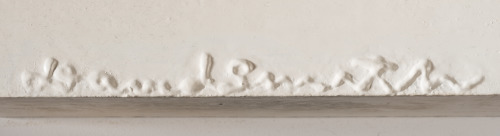
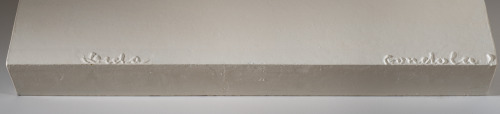
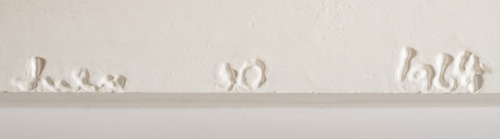
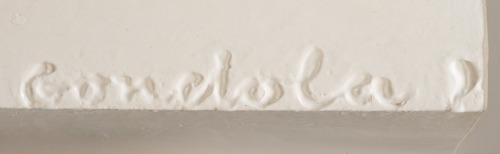
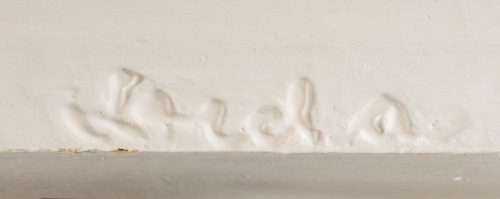
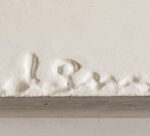
Inscribed: Base: LL, "Dida" in script; LR, "Gondola" VERSO: LL "David Smith" in script; LR "July 30 1964"