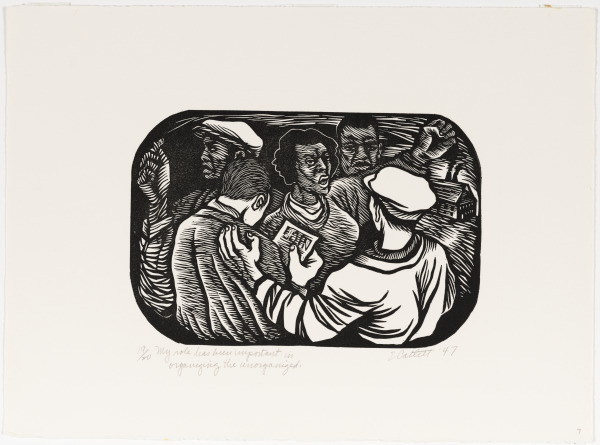
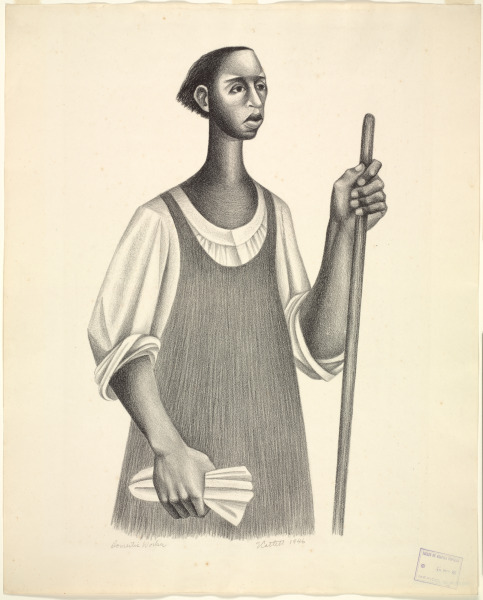
Elizabeth Catlett and Taller de Gráfica Popular
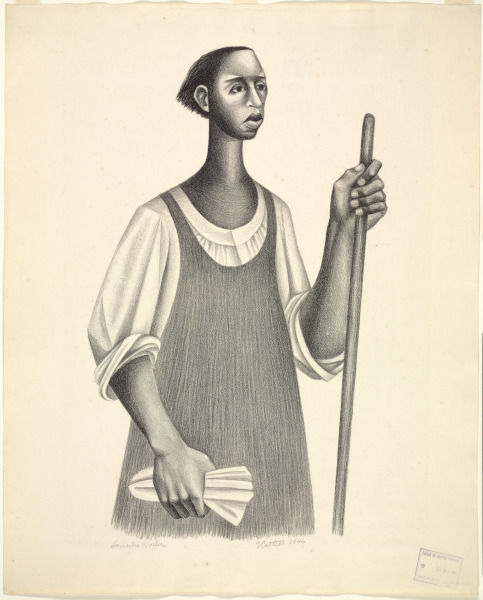
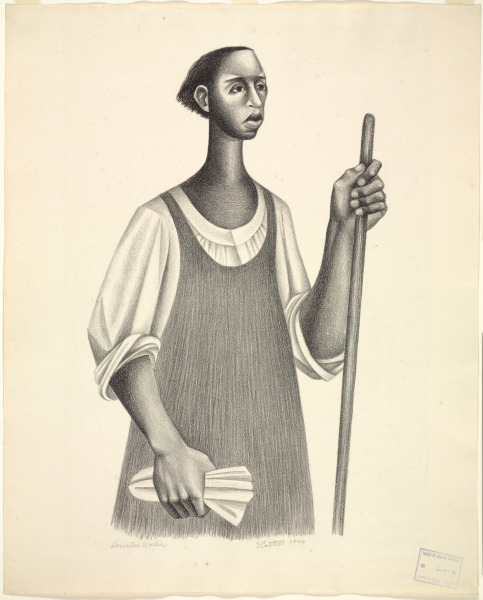
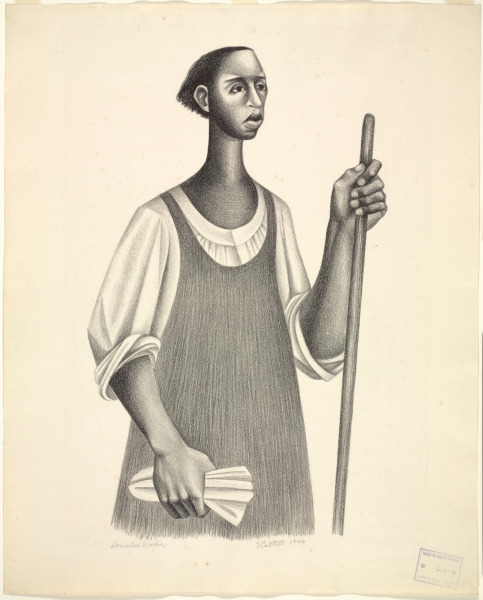
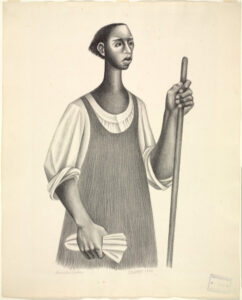
Domestic Worker
1945
Scroll
Physical Qualities
Crayon lithograph with scraping, Sheet: 619 x 499 mm. (24 3/8 x 19 5/8 in.)
Image: 520 x 320 mm. (20 1/2 x 12 5/8 in.)
Credit Line
Purchased as the gift of Lorraine and Mark Schapiro, Baltimore
Object Number
1997.20
Born in Washington, D.C., Elizabeth Catlett received her undergraduate degree from Howard University and graduate degree from the University of Iowa. She continued her art studies in sculpture and printmaking in Chicago and then New York City, where she also taught at the George Washington Carver School in Harlem. In 1946, Catlett received a prestigious Julius Rosenwald Fellowship that enabled her to live and work in Mexico City in 1946–1947. There Catlett frequented the Taller de Gráfica Popular (People’s Graphic Art Workshop), where she found a community of like-minded artists committed to engaging with issues of social justice through printmaking. Although Catlett briefly traveled to the United States in 1947, she returned to Mexico City that same year to continue her work and establish permanent residency in Mexico before ultimately becoming a Mexican citizen.
In "Domestic Worker" and "For Colored Only", Catlett took up two causes that she would pursue in her 15-print Negro Woman series. "Domestic Worker" heroizes working-class African-Americans through the simple and dignified depiction of a standing woman who holds her cleaning implements with large, powerful hands. "For Colored Only' (at right) shows a despondent woman holding her head in her hands as she is confronted with signs that enforce racial segregation in the southern United States.
The Baltimore Museum of Art by purchase, 1997; Ed Ogul, Paramour Fine Arts, Franklin, MI
Henry Ossawa Tanner and his Influence in America
Crossing Borders: Mexican Modernist Prints
By Their Creative Force: American Women Modernists
Persevere and Resist: The Strong Black Women of Elizabeth Catlett
Elizabeth Catlett: A Revolutionary Artist and All That It Implies
Pinheiro, Bruno. "Thinking Blackness in Pan-American Artistic Networks: The Case of the Bienal de São Paolo," in Afterall, 54. pp. 92-101., ill. p. 100.
Alone in a Crowd: Prints of the 1930s and 1940s by African American Artists from the Collection of Reba and Dave Williams, New York, American Federation of Art, 1993. Exh. cat. BMA, Jan. 4-Feb. 26, 1995.
Elizabeth Catlett, Samella Lewis and Richard J. Powell. Elizabeth Catlett: Works on Paper, 1944-1992. Exh. cat. Hampton, Virginia: Hampton University Museum, 1993.
Elizabeth Catlett, Samella Lewis and Richard J. Powell. Elizabeth Catlett: Works on Paper, 1944-1992. Exh. cat. Hampton, Virginia: Hampton University Museum, 1993.
Inscribed: lower left in graphite: "Domestic Worker"; lower right in graphite: "ECatlett 1946"; lower right stamped in purple ink: "Taller de Grafica Popular, Mexico / 13 1952 / MEXICO D.F."
Artist
Elizabeth Catlett
1914–2011
born Washington D.C. 1915; died Cuernavaca, Mexico 2012
Meet Elizabeth →
Explore the Collection Further