
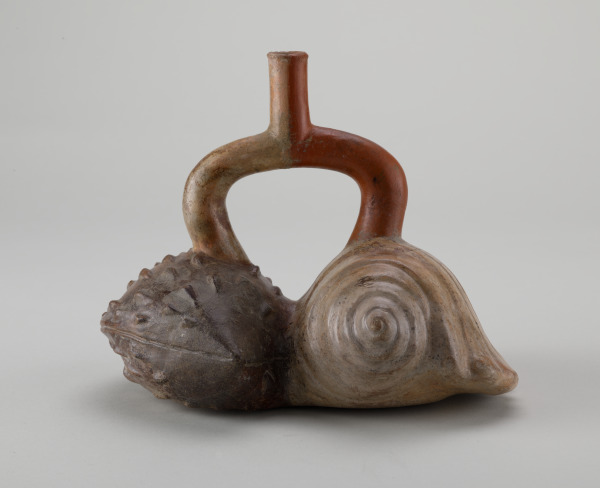
Moche
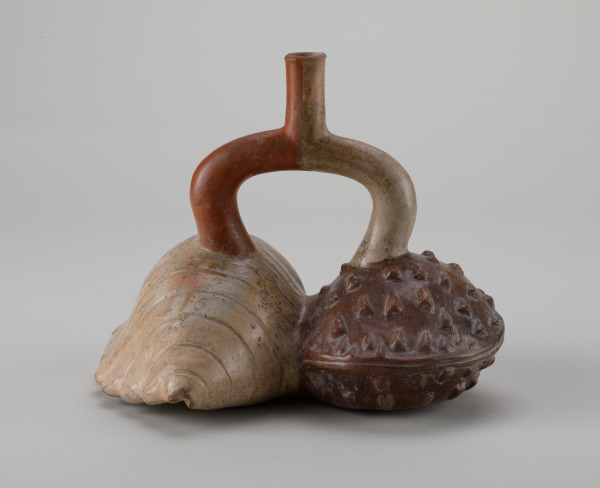
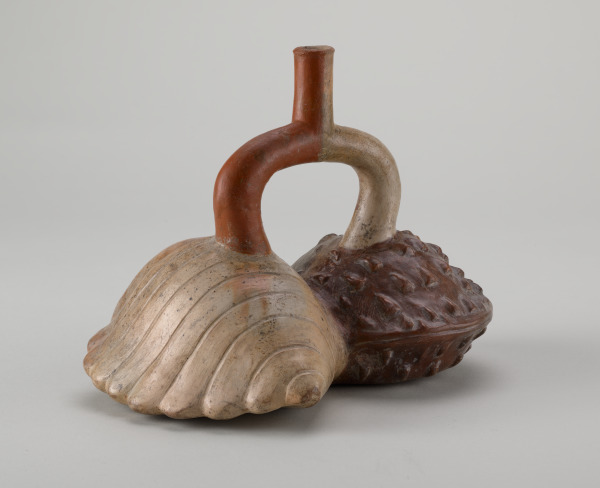
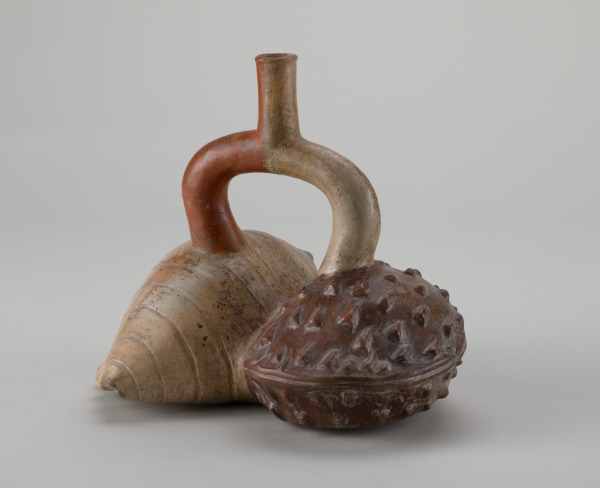
Double chambered bottle
Moche, 2001-650
Scroll
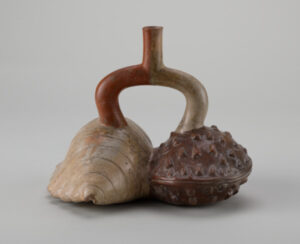
Moche
Double chambered bottle
Moche, 2001-650
Physical Qualities
Earthenware, slip, 6 11/16 × 6 1/8 × 8 1/16 in. (17 × 15.5 × 20.5 cm.)
Credit Line
Gift of the Austen-Stokes Ancient Americas Foundation, Upper Nyack, New York
Object Number
2005.31
All of the ceramic vessels seen above are “stirrup spout” bottles, named for their resemblance to horse stirrups. They were made by Moche people, prolific ceramicists who thrived on the northern coast of Peru from around 100–900 CE.
Moche ceramic production constantly evolved, as you can see from left to right. The decoration of the earliest vessel here reveals lizards executed with thicker lines. In later periods, painted decorations became more refined with thinner and crisper geometric lines, like the painting on the portrait head bottle. Look for differences in the vessel’s form, color, decoration, and spout shape.
Stirrup spout vessels were produced by other cultures living in the Andes from the second millennium BCE until the early colonial period. The Moche people revived the form pioneered by cultures that preceded them by centuries, including the Chavín and Cupisnique people. While the exact purpose of this shape in Moche culture is unknown, it may have served as a handle for carrying, prevented the evaporation of liquids held within, or had some symbolic significance that is lost to us.
Group label for 2003.177, 1996.147, and 1989.57.
The Baltimore Museum of Art by gift, 2005; Austen-Stokes Ancient Americas Foundation; Formerly part of a "private Pacific collection." Purchased from Howard Rose Galleries, NY, November 2004 by the donor.
Ancient Americas Gallery Rotations 2021
Ancient Americas Gallery Rotations 2022
Ancient Americas Gallery Rotations 2023
Ancient Americas Rotations 2024
Alva, Walter, and Christopher B. Donnan
1993. Royal Tombs of Sipán. Fowler Museum of Culture History, University of California, Los Angeles.
Anawalt, Patricia Rieff
1998. Ancient West Mexican - Ecuadorian Contacts. In Ancient West Mexico: Art and Archaeology of the Unknown Past, edited by R. F. Townsend, pp. 232-249. Thames and Hudson, New York.
Berdan, Frances F., and Anawalt, Patricia Rieff
1997. The Essential Codex Mendoza. University of California Press, Berkeley.
Berrin, Kathleen, and Esther Pasztory
1993. Teotihuacan: Art from the City of the Gods. The Fine Arts Museums of San Francisco and Thames and Hudson, New York and London.
Berrin, Kathleen, ed.
1998 The Spirit if Ancient Peru. The Fine Arts Museums of San Francisco and Thames and Hudson, New York and London. Cat 41
Donnan, Christopher B.
1978. Moche Art of Peru. UCLA Museum of Cultural History, Los Angeles. Figure 100.
Donnan, Christopher B., and Donna McClelland
1999. Moche Fineline Painting: Its Evolution and Its Artists. UCLA Museum of Cultural History, Los Angeles. Figure 4.77
Lapiner, Alan
1976. Precolumbian Art of South America. Harry N. Abrams, New York. Fig. 101
Miller, Mary Ellen, and Simon Martin
2004. Courtly Art of the Ancient Maya. Fine Arts Museums of San Francisco.
Paulsen, Allison
1974. The Thorny Oyster and the Voice of God: Spondylus and Strombus in Andean Prehistory. American Antiquity 39 (4):597-607.
Pillsbury, Joanne
1996. The Thorny Oyster and the Origins of Empire: Implications of Recently Uncovered Spondylus Imagery from Chan Chan, Peru. Latin American Antiquity 7(4):313-340.
Schmidt, Peter, Mercedes de la Garza, and Enrique Nalda
1998. Maya. Rizzoli, New York.
Solís, Felipe, ed.
2004. The Aztec Empire, Catalogue of the Exhibition. The Solomon R. Guggenheim Foundation, New York.
1993. Royal Tombs of Sipán. Fowler Museum of Culture History, University of California, Los Angeles.
Anawalt, Patricia Rieff
1998. Ancient West Mexican - Ecuadorian Contacts. In Ancient West Mexico: Art and Archaeology of the Unknown Past, edited by R. F. Townsend, pp. 232-249. Thames and Hudson, New York.
Berdan, Frances F., and Anawalt, Patricia Rieff
1997. The Essential Codex Mendoza. University of California Press, Berkeley.
Berrin, Kathleen, and Esther Pasztory
1993. Teotihuacan: Art from the City of the Gods. The Fine Arts Museums of San Francisco and Thames and Hudson, New York and London.
Berrin, Kathleen, ed.
1998 The Spirit if Ancient Peru. The Fine Arts Museums of San Francisco and Thames and Hudson, New York and London. Cat 41
Donnan, Christopher B.
1978. Moche Art of Peru. UCLA Museum of Cultural History, Los Angeles. Figure 100.
Donnan, Christopher B., and Donna McClelland
1999. Moche Fineline Painting: Its Evolution and Its Artists. UCLA Museum of Cultural History, Los Angeles. Figure 4.77
Lapiner, Alan
1976. Precolumbian Art of South America. Harry N. Abrams, New York. Fig. 101
Miller, Mary Ellen, and Simon Martin
2004. Courtly Art of the Ancient Maya. Fine Arts Museums of San Francisco.
Paulsen, Allison
1974. The Thorny Oyster and the Voice of God: Spondylus and Strombus in Andean Prehistory. American Antiquity 39 (4):597-607.
Pillsbury, Joanne
1996. The Thorny Oyster and the Origins of Empire: Implications of Recently Uncovered Spondylus Imagery from Chan Chan, Peru. Latin American Antiquity 7(4):313-340.
Schmidt, Peter, Mercedes de la Garza, and Enrique Nalda
1998. Maya. Rizzoli, New York.
Solís, Felipe, ed.
2004. The Aztec Empire, Catalogue of the Exhibition. The Solomon R. Guggenheim Foundation, New York.