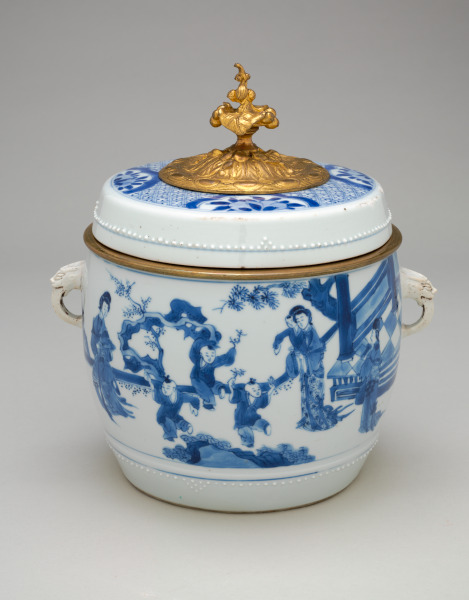
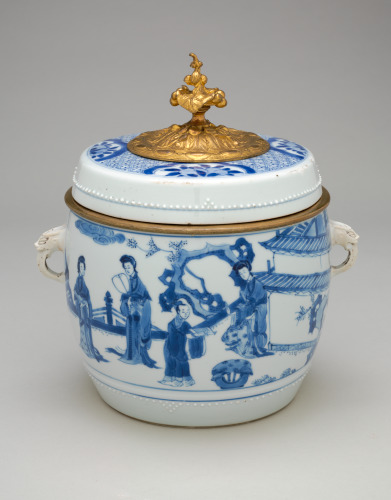
Jingdezhen kilns
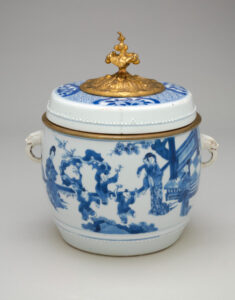
Drum-shaped Covered Jar with Decorative Mounts
1661-1682
Scroll
Jingdezhen kilns
Drum-shaped Covered Jar with Decorative Mounts
1661-1682
Physical Qualities
Porcelain, underglaze cobalt decoration, gilt copper alloy finial, copper alloy rim, 9 1/8 x 8 1/2 x 7 in. (23.2 x 21.6 x 17.8 cm.)
Credit Line
The George A. Lucas Collection, purchased with funds from the State of Maryland, Laurence and Stella Bendann Fund, and contributions from individuals, foundations, and corporations throughout the Baltimore community
Object Number
1996.47.25
In the 1500s and 1600s, Chinese, Japanese, and Korean porcelain was coveted by maritime merchants who transported examples to European courts, where porcelain conveyed global knowledge and status. Only Asian workshops knew the recipe for porcelain prior the 18th century. To own works of “true porcelain,” Europeans ordered objects and dinner services, adorned with coats of arms or depictions of Europeans, that had been decorated by women and men in Asian studios. However, even after
Europeans deciphered the formula in the early 1700s, porcelain from Asia was an essential possession for aristocrats who, by this time, were reaping the wealth of global conquest.
The Baltimore Museum of Art by purchase, 1996 (on loan 1966-1996); Maryland Institute College of Art, by 1911; Henry Walters, by bequest, 1909; George A. Lucas, Paris
A View Toward Paris: The Lucas Collection of 19th-Century French Art
Asian Reinstallation: Home, Temple, Tomb
Recasting Colonialism: Michelle Erickson Ceramics
"Exhibition of Paintings, Bronzes and Porcelains from the George A. Lucas Art Collection," The Maryland Institute, Baltimore, 1911, no. 674, p. 107 [identified as Jiaqing with 18th century brass mounts]
Council Tour & Reception, BMA Today, Issue 171, Summer 2023, p. 26
Christiaan J. A. Jörg, "Chinese Ceramics in the Collection of the Rijksmuseum, Amsterdam, The Ming and Qing Dynasties," London: Philip Wilson Publishers Limited, 1997, no. 106, p. 110; related but smaller covered jar, c. 1700, 8.6 cm. H, decorated with figural scene but with lion-form finial rather than the French ormolu final on the BMA jar.
Markings: 6-character copy of Ming mark, "Da Ming Jiajing nian zhi"