
R.J. Horner and Co.
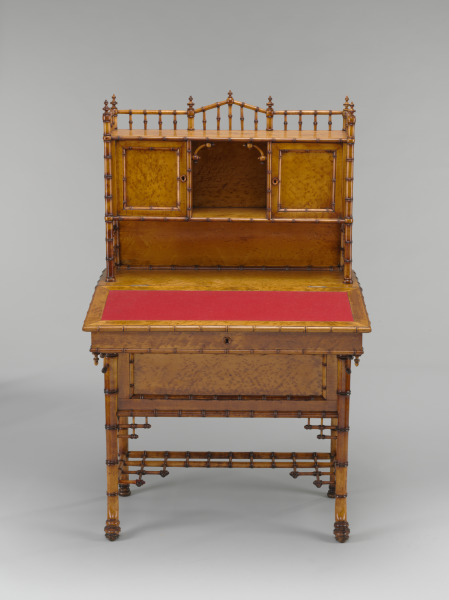
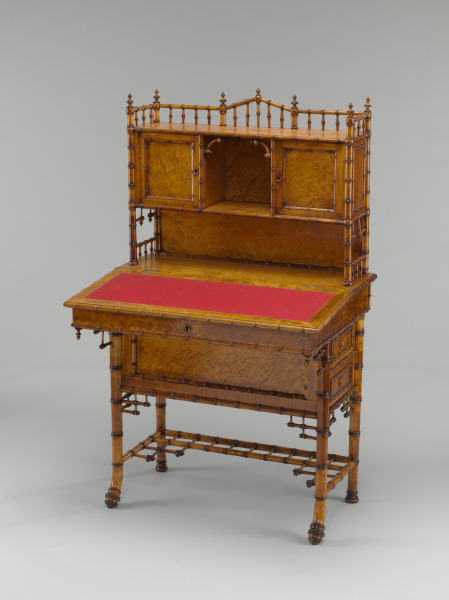
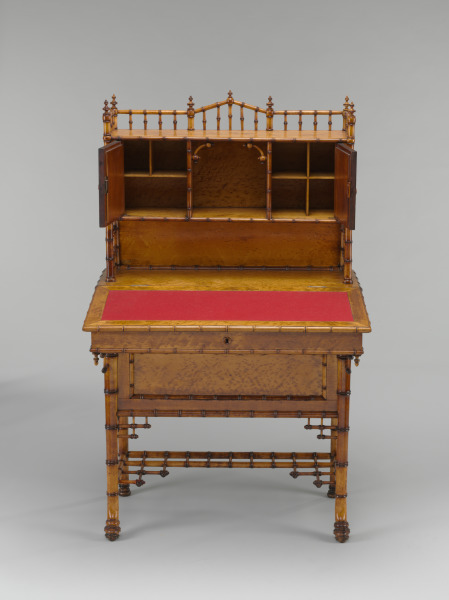
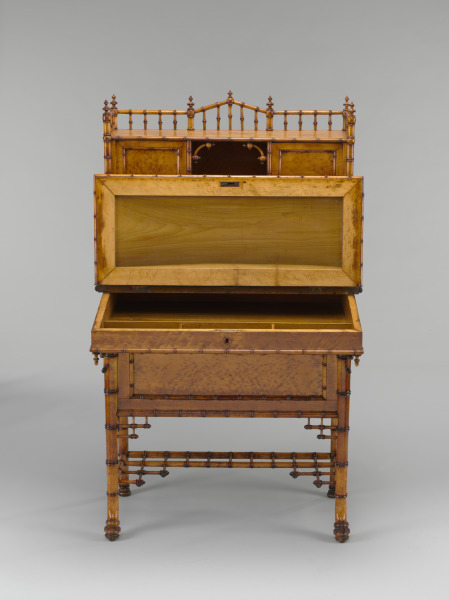
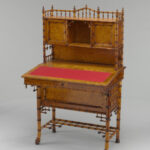
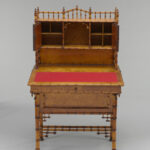
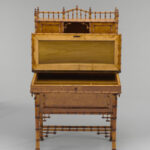
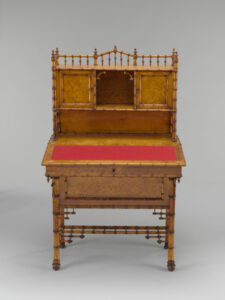
Faux Bamboo Desk
1889-1898
Scroll
R.J. Horner and Co.
Faux Bamboo Desk
1889-1898
Physical Qualities
Birds-eye maple, hard maple, brass, replaced writing surface, 53 1/4 x 23 1/8 in. (135.3 x 58.7 cm.)
Credit Line
Friends of the American Wing Fund
Object Number
2005.155
Why would R.J. Horner and Company, an American furniture maker, scorch and shape maple wood to look like Asian bamboo? In the mid-19th century, America's desire to control Pacific trade networks extended beyond California's statehood in 1850 to previously closed Japanese ports. An American military-enforced trade agreement between America and Japan in 1850s introduced Japanese art and objects to North American artists, who liberally adopted Asian aesthetics in their designs. The soaring popularity of the Japanese Pavilion at the 1876 Centennial Exposition in Philadelphia confirmed consumer interest for desks like this, and American magazines of the time declared bamboo the perfect material to furnish a summer home.
The Baltimore Museum of Art by purchase, 2005; Margot Johnson, Inc., New York
AMW Reinstallation 2014
American Wing Rotations 2020
American Wing Rotations 2021
American Wing Rotations 2022
American Wing Rotations 2023
American Wing Rotations 2024
American Wing Rotations 2025
D'Ambrosio, ed., "Masterpieces of American Furniture from the Munson-Williams-Proctor Institute," Syracuse, NY: Syracuse University Press, 1999, pp. 140-141
 On View at the BMA