
Tabwa
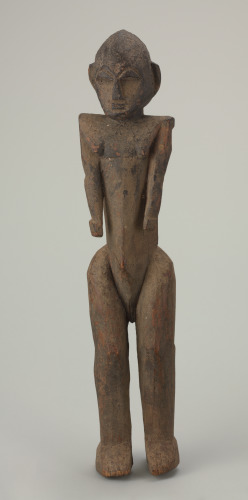
Female Ancestor Figure (Mipasi)
Tabwa, 1900-1932
Scroll

Tabwa
Female Ancestor Figure (Mipasi)
Tabwa, 1900-1932
Physical Qualities
Wood, 18 1/4 × 5 1/2 × 3 3/4 in. (46.4 × 14 × 9.6 cm.)
Credit Line
Gift of Robert Elkin, Mitchellville, Maryland
Object Number
1996.196
Among Tabwa, markings on the body act as tactile codes by which key information about the cosmos, social values, and political identity is conveyed. The simplest line or pattern may refer to complex systems of thought. In fact, Tabwa use the same verb to describe drawing, writing, and marking the body, for each of these acts conveys meaning in visual terms. The interpretation of a given pattern may change according to its location on the body. In general however, the presence of two lines joined and pointing skyward symbolizes the moon, while two connected lines facing downward refer to the earth. Pairing these patterns of lines suggests family, heritage, and fertility. Subtle linear incisions adorn the torso of this female figure, whose solid volumes and knobby, cap-like coiffure are all characteristic of Tabwa arts.
Acquired by donor 1980; ex coll Marc L. Felix
Meditations on African Art: Pattern
Felix, '100 Peoples of Zaire,' 1987, pp. 8-9, fig. 171-2. Roberts and Mauer, 'Tabwa,' 1986, pp. 246-7.