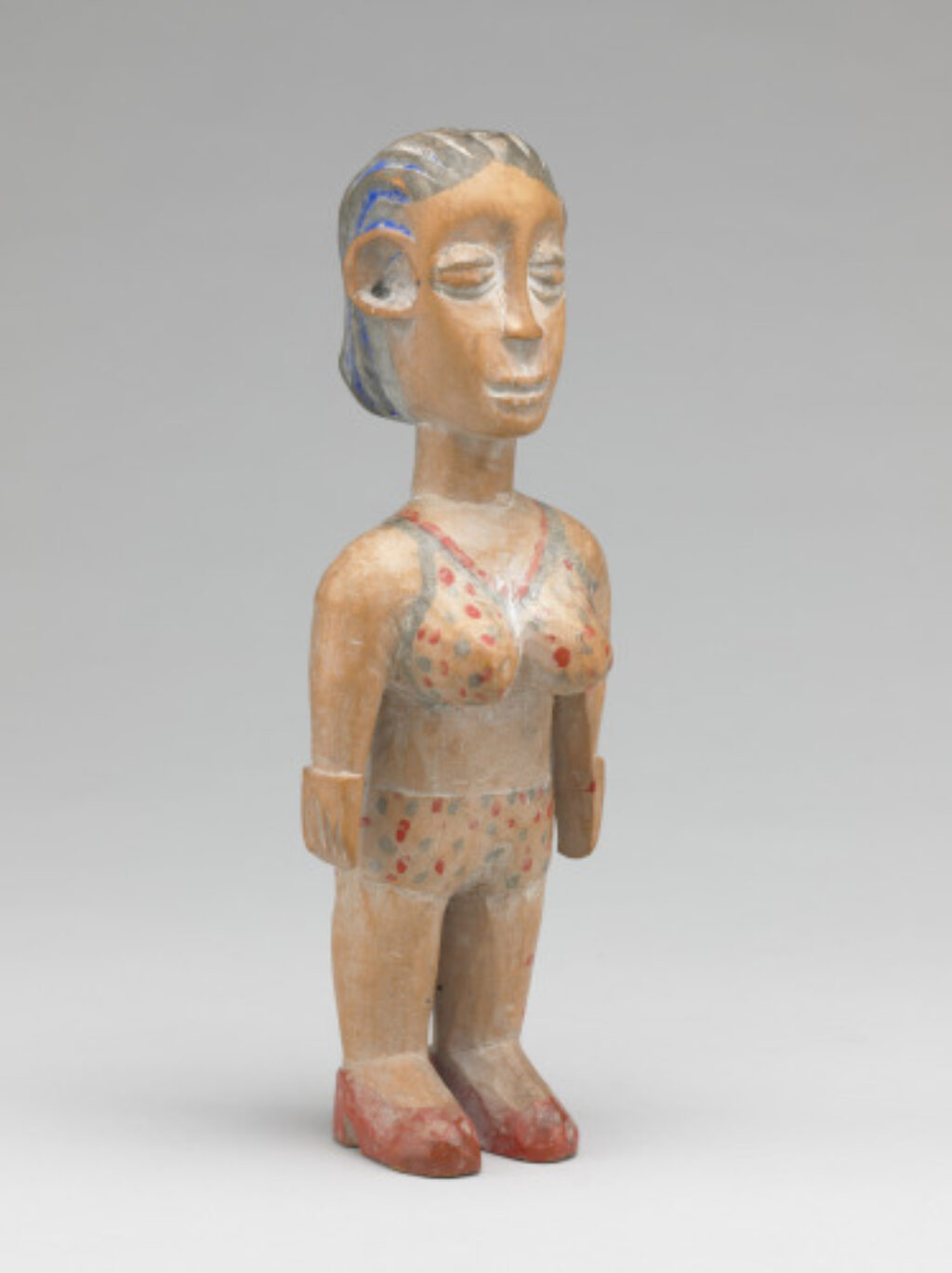
Ewe
Female Figure (possibly Ibeji)
Ewe, 2000
Scroll
Ewe
Female Figure (possibly Ibeji)
Ewe, 2000
Physical Qualities
Wood, pigment, 11 1/4 x 3 15/16 x 3 3/8 in. (28.5 x 10 x 8.5 cm.)
Credit Line
Gift of Geneviève McMillan in Memory of Reba Stewart
Object Number
2008.158
Wooden representations of women abound throughout much of the sub-Saharan continent. These two West African examples were made for very different purposes. The form and dimensions of the Ewe female suggest that she may once have been paired with a twin, or ibeji. As part of a longstanding art practice, ibeji are installed on domestic shrines to honor twins who died at birth. This figure appears modern in her high-heeled shoes.
The Mende minsereh was a divination article associated with healing. It enabled a priestess of the Yassi Society to consult with deceased women in search of a cure for illness or injury. Like her counterpart nearby, this "woman of the past," also wears modern dress. Such artistic experimentation indicates that historic art forms like these are not impervious to change. Rather, opportunity for adoption and adaption is readily seized.
The Baltimore Museum of Art by gift, 2008; Geneviève McMillan by purchase, 1982.
Rena Hoisington, The Baltimore Museum of Art, "New Arrivals: Gifts of Art for a New Century," February 7-May 8, 2016.
Baltimore Museum of Art. "The Baltimore Museum of Art: Celebrating a Museum." Baltimore: The Baltimore Museum of Art, 2014.
Inscribed: Under right foot, in black ink and white paint: "E4".