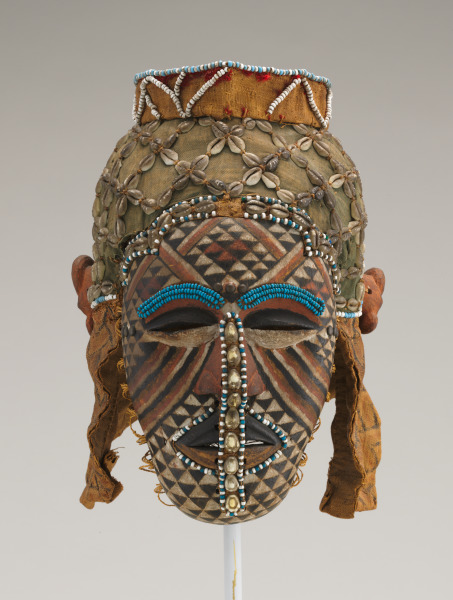

Turkana
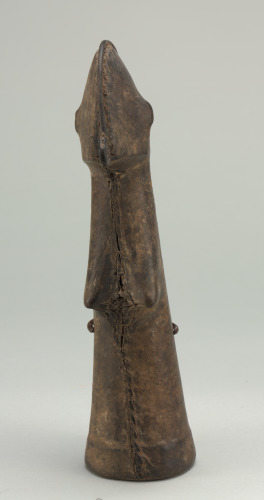
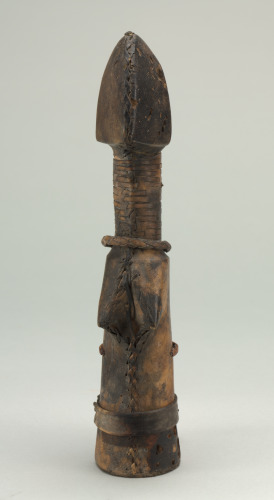
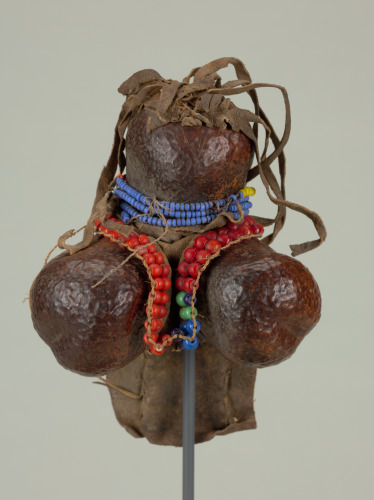
Fertility Doll
Turkana, 1933-1966
Scroll

Turkana
Fertility Doll
Turkana, 1933-1966
Physical Qualities
Wood, hide, glass and plastic beads, fiber, 15 3/4 x 3 1/8 x 3 1/8 in. (40 x 8 x 8 cm.)
Credit Line
Gift of Sandra R. Leichtman, Baltimore
Object Number
1999.172
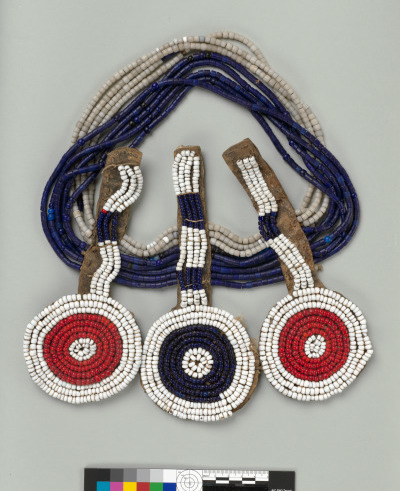
Absent from the artistic work of east African pastoralists is almost any representation of humans or animals. Most artwork from the region is abstract and geometric, characterized either by detailed two-dimensional design in vibrant color or by stark monochromatic forms. The exceptions to this rule are objects made by or associated with children. Indeed, this array of non-naturalistic Turkana dolls represents the extent of the region’s figural representation.
Fertility dolls, such as those displayed on your right, would have been carried by young women as a way to stimulate fertility and prompt conception while the contemporary clay dolls on your left represent a long-standing tradition of children’s artistic creativity. Taken together, these figures speak to the abstract impulse that characterizes art from this region. While scholars are still seeking to tease out the connections between abstraction and mobility, it is worth noting that children, who in their young lives have moved far fewer times than their elders, were more likely to create artworks that approach naturalistic figuration.
The Baltimore Museum of Art by gift, 1999; Sandra R. Leichtman; purchased in 1973 in San Francisco. Originally purchased in Africa by a Peace Corps volunteer.
Design for Mobile Living: Art from Eastern Africa
Emley, E. D. “The Turkana of Kolosia District.” The Journal of the Royal Anthropological Institute of Great Britain and Ireland vol. 57 (Jan. – Jun. 1927): pp. 157-201.
Riggins, Linda. “African Ritual Dolls.” African Arts vol. 7, no. 4 (Summer 1974): p. 74.
Fedders, Andrew and Cynthia Salvadori. Turkana Pastoral Craftsmen. Nairobi, Kenya: Transafrica Book Distributors in association with East African Literature Bureau, 1977.
Donovan, Alan. “Turkana Functional Art.” African Arts vol. 21, no. 3 (May 1988): pp. 44-47. http://www.jstor.org/stable/3336442.
Robbins, Warren M. and Nancy Ingram Nooter. African Art in American Collections: Survey 1989. Washington D.C.: Smithsonian Institution Press, 1989, pp. 568-569, pl. 1595.
Cameron, Elisabeth L. “In Search of Children: Dolls and Agency in Africa.” African Arts vol. 30, no. 2 (Spring 1997): pp. 18-33, 93. http://www.jstor.org/stable/3337419.
Conner, Randy P. ”Sexuality and Gender in African Spiritual Traditions.” In Sexuality and the World’s Religions, edited by David W. Machacek and Melissa M. Wilcox, pp. 3-30. Santa Barbara (CA): ABC-CLIO, 2003.
Labelle, Marie-Louise. “Beads of Life: Eastern and Southern African Adornments.” African Arts vol. 38, no. 1 (Spring 2005): pp. 12-35. http://www.jstor.org/stable/3338065.
Bofinger, Brigitte and Wolfgang Bofinger. Puppen aus Afrika: Ritus und Spiel. Stuttgart, Germany: Steinheim, 2006, p. 79.
Visonà, Monica Blackmun, Robin Poynor, and Herbert M. Cole. A History of Art in Africa (Second Edition). Upper Saddle River (NJ): Pearson and Prentice Hall, 2008, p. 461.
Riggins, Linda. “African Ritual Dolls.” African Arts vol. 7, no. 4 (Summer 1974): p. 74.
Fedders, Andrew and Cynthia Salvadori. Turkana Pastoral Craftsmen. Nairobi, Kenya: Transafrica Book Distributors in association with East African Literature Bureau, 1977.
Donovan, Alan. “Turkana Functional Art.” African Arts vol. 21, no. 3 (May 1988): pp. 44-47. http://www.jstor.org/stable/3336442.
Robbins, Warren M. and Nancy Ingram Nooter. African Art in American Collections: Survey 1989. Washington D.C.: Smithsonian Institution Press, 1989, pp. 568-569, pl. 1595.
Cameron, Elisabeth L. “In Search of Children: Dolls and Agency in Africa.” African Arts vol. 30, no. 2 (Spring 1997): pp. 18-33, 93. http://www.jstor.org/stable/3337419.
Conner, Randy P. ”Sexuality and Gender in African Spiritual Traditions.” In Sexuality and the World’s Religions, edited by David W. Machacek and Melissa M. Wilcox, pp. 3-30. Santa Barbara (CA): ABC-CLIO, 2003.
Labelle, Marie-Louise. “Beads of Life: Eastern and Southern African Adornments.” African Arts vol. 38, no. 1 (Spring 2005): pp. 12-35. http://www.jstor.org/stable/3338065.
Bofinger, Brigitte and Wolfgang Bofinger. Puppen aus Afrika: Ritus und Spiel. Stuttgart, Germany: Steinheim, 2006, p. 79.
Visonà, Monica Blackmun, Robin Poynor, and Herbert M. Cole. A History of Art in Africa (Second Edition). Upper Saddle River (NJ): Pearson and Prentice Hall, 2008, p. 461.