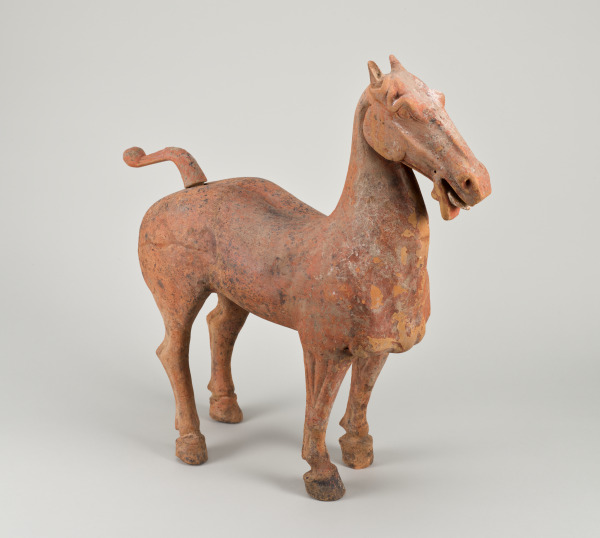
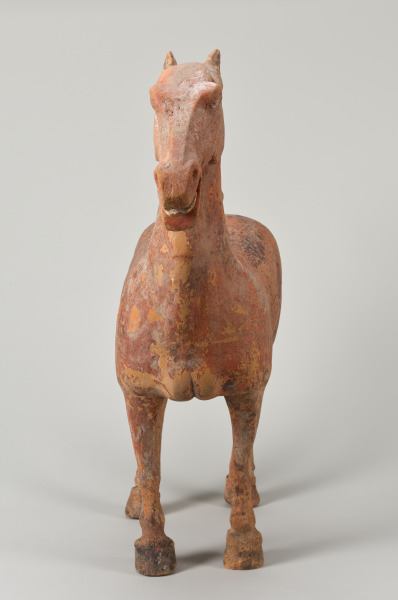
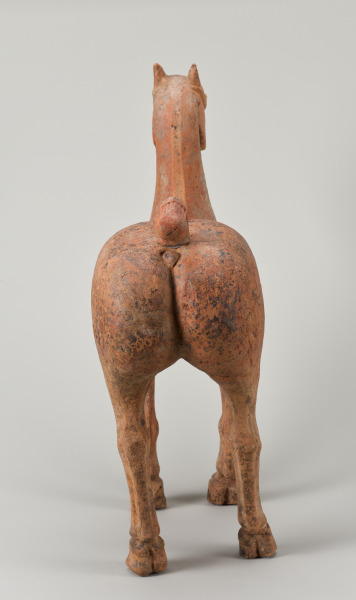
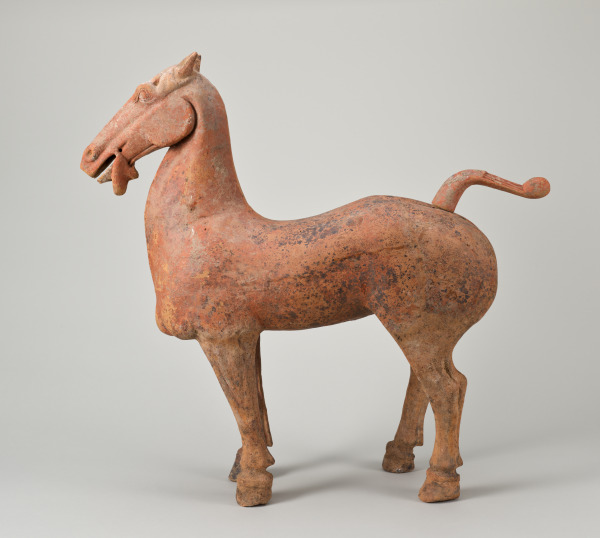
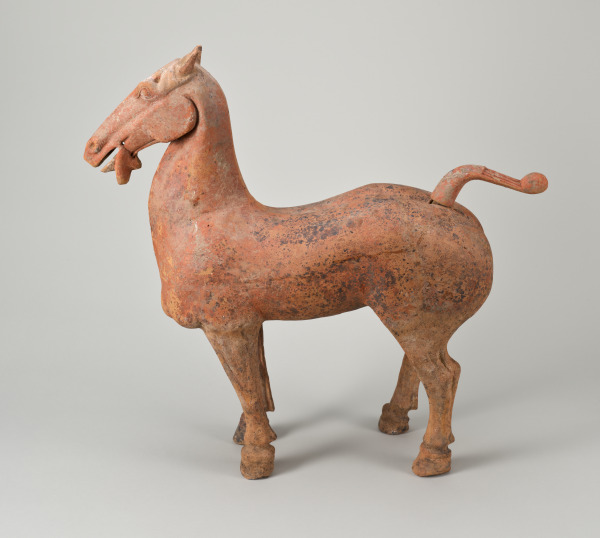
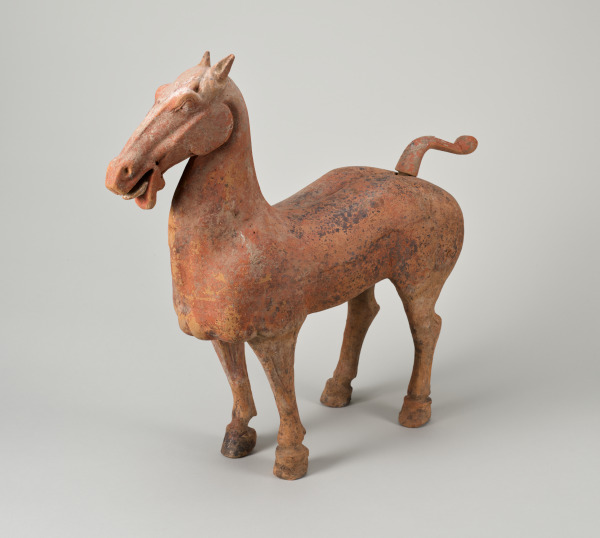
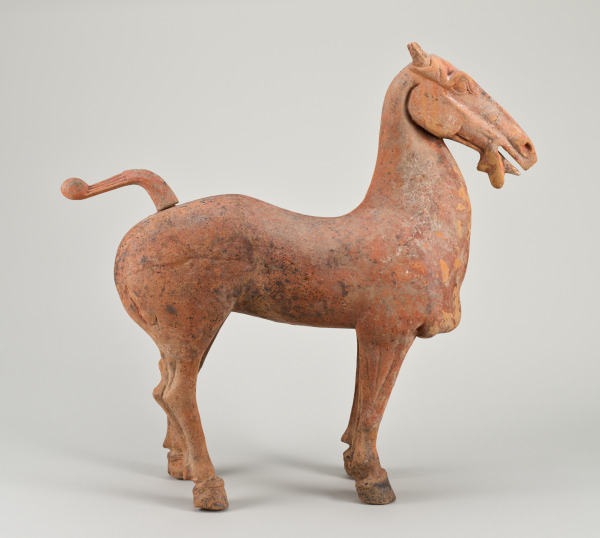
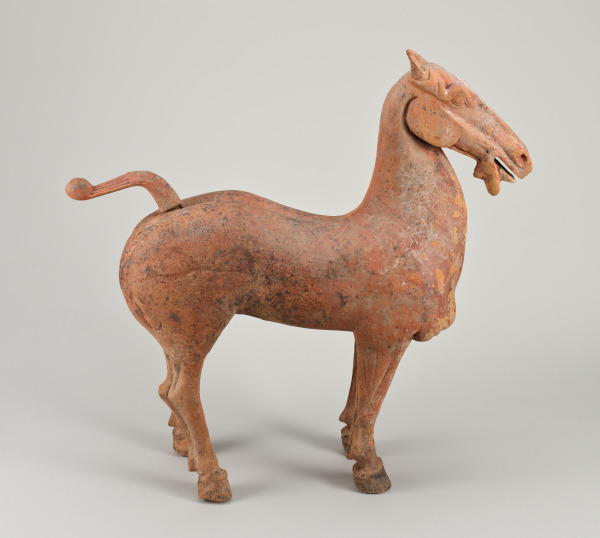
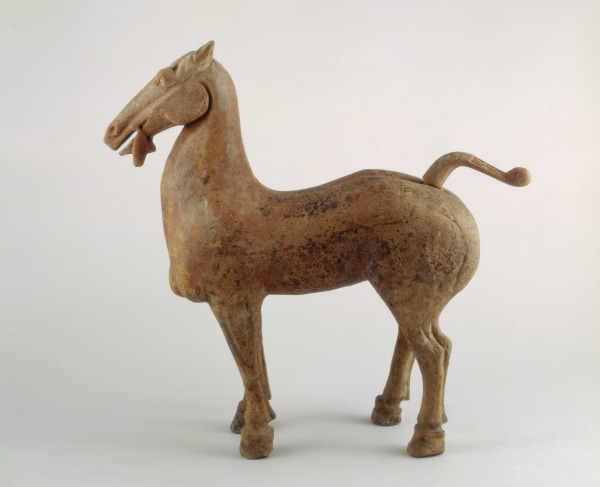
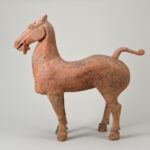
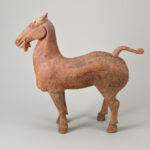
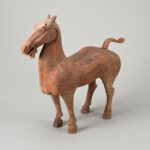
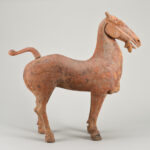
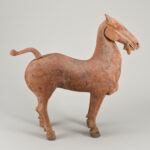
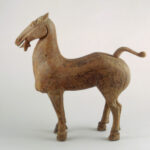
Figure of a Standing Horse
133-101
Scroll
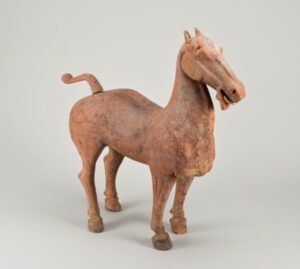
Figure of a Standing Horse
133-101
Physical Qualities
Earthenware with pigment over red slip, 23 1/16 × 23 5/8 × 7 1/16 in. (58.6 × 60 × 17.9 cm.)
Credit Line
Julius Levy Memorial Fund
Object Number
1987.1
Ceramic horses such as this one were included in royal tombs of the Western Han period (206 BCE–9 CE). Horses were vital to the success of military campaigns that stabilized and enriched the country, especially its elite.
During the Western Han period, the Xiongnu, horse-riding nomads, encroached on China’s northern border. Western Han foot soldiers, surrounded by chariots, fell to these mounted warriors. In 138 BCE, Han Emperor Wudi (140–87 BCE) sent a general named Zhang Qian (195-c. 114 BCE) westward to secure allies in the fight against the Xiongnu forces. He failed.
However, in Dayuan, an eastern outpost of Alexander the Great’s empire in Central Asia, Zhang Qian learned of hardy horses with great endurance and brought them to China. Astride these Central Asian horses, China’s military reestablished itself, repelled the Xiongnu, took control of Dayuan, and expanded trade. Chinese silk went westward, while goods and new ideas went eastward to China.
The Baltimore Museum of Art by purchase, 1987; J.J. Lally & Co., New York (acquired in Hong Kong after 1985)
Asian Reinstallation: Home, Temple, Tomb
Asian Gallery Rotations 2021
[Asian Refresh]
Asian Gallery Rotations 2022
Asian Gallery Rotations 2023
Asian Rotations 2024
Asian Rotations 2025
Donna K. Strahan and Ann Boulton, 'Chinese Ceramic Quadrupeds: Construction and Restoration,' The Conservation of Far Eastern Art, London: The International Institute of Historic and Artistic Works, 1988, pp. 150-152, ill. figs. 3, 4, 9, 11. Frances Klapthor, Chinese Ceramics, Baltimore: BMA, 1993, no. 1, p. 10, ill. p. 11.
'Fine Chinese Ceramics and Works of Art,' Christie's, 9/16/1988, no. 297: 4-legged horse with painted pigment with reference to Yangjiawan, Xianyang (Shaanxi province), c. 179-140 BC).
 On View at the BMA