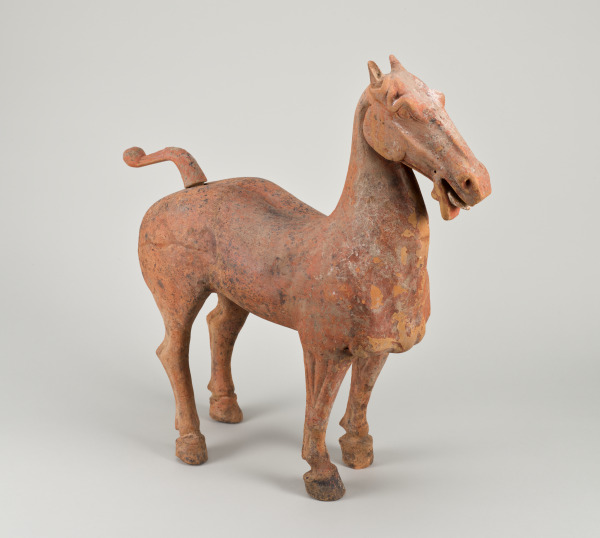
Figure of a Striding Horse
200
Scroll
Figure of a Striding Horse
200
Physical Qualities
Red earthenware with brown lead glaze, 88.4 x 105.7 x 20.9 cm.
Credit Line
Gift of George and Julianne Alderman, Baltimore
Object Number
1999.761
Sichuan province was located at some distance from China's imperial capital, Luoyang in Henan province, at the end of the Han dynasty. Lacking the refinements of the court, Sichuan nevertheless was a wealthy and populated area in the 2nd century. Toms from this region suggest its prosperity, which was derived from salt and iron mines as well as agriculture. Sichuan mortuary figures are distinguished by thier exagerated features and large size, both traits evident in this figure. Especially rare for being glazed, the horse displays several features of the native Sichuan breed, including the long body, large head and ears, and high tail.
The Baltimore Museum of Art by gift, 2000; George and Julianne Alderman, Baltimore; Michael Teller, Williamsburg, Virginia (acquired after 1990)
F. Klapthor, 'On View: Third-Century Chinese Horse,' BMA Today, October 2001, p. 9, ill.
Susan N. Erickson, 'Delicate and Lovely, Unique and Strange: Art of Sichuan Province, Second Century BCE to Third Century,' 'Orientations', Sept. 1997, vol. 28, no. 8, pp. 78-84.
Inscribed: None