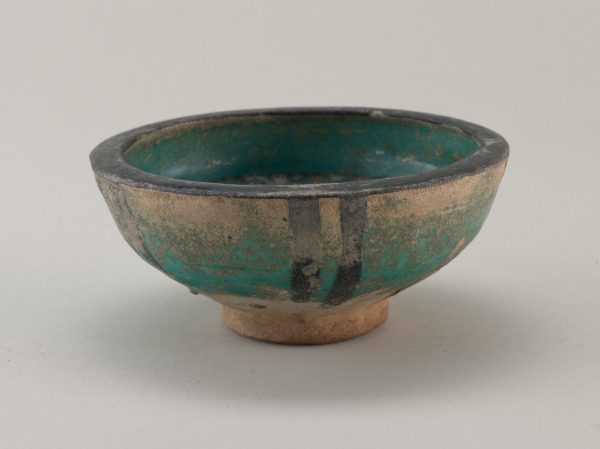
Footed Bowl with Script Decoration
1100-1199
Scroll
Footed Bowl with Script Decoration
1100-1199
Physical Qualities
Fritware with black slip and turquoise glaze, 4 1/2 H x 7 Diam. in. (11.4 x 17.8 cm.)
Credit Line
Gift of Richard and Elizabeth S. Ettinghausen in Memory of Adelyn D. Breeskin
Object Number
2013.203
According to written accounts confirmed by archaeological finds, imported Chinese ceramics were widely available throughout the Abbasid period (749–1055). Potters in Iraq and Iran imitated Chinese white stoneware by covering their 9th–10th century buff or red earthenware with white slip. During the 12th–14th century, potters in Iran rediscovered
or revived an ancient Egyptian process of making a ceramic body predominantly of silica-rich quartz rather than clay as used in China. This material, called fritware or stonepaste, produced a harder and more durable ceramic body compared to the earthenwares. Slip continued to be used as a ground which was decorated with underglaze painted motifs—usually blue or black. Arabic inscriptions remained popular choices for ornament. Patterns imitating script (13) also persisted. As Dr. Richard Ettinghausen noted, “...inscriptions ...more often observed and admired than read... [had] a symbolic function, asserting the power and rectitude of Islam simply by their presence.”
The Baltimore Museum of Art by gift, 2013 (on extended loan from 1957); Elizabeth Ettinghausen, Princeton, NJ; Richard S. Ettinghausen
Extended Loans IN
Art Across Asia: West Asian Connections
"Epigraphy iii. Arabic inscriptions in Persia," "Encyclopaedia Iranica," 7/10/2017 [http://www.iranicaonline.org/articles/epigraphy-iii]