Georges Braque, Eugene Delâtre, and others
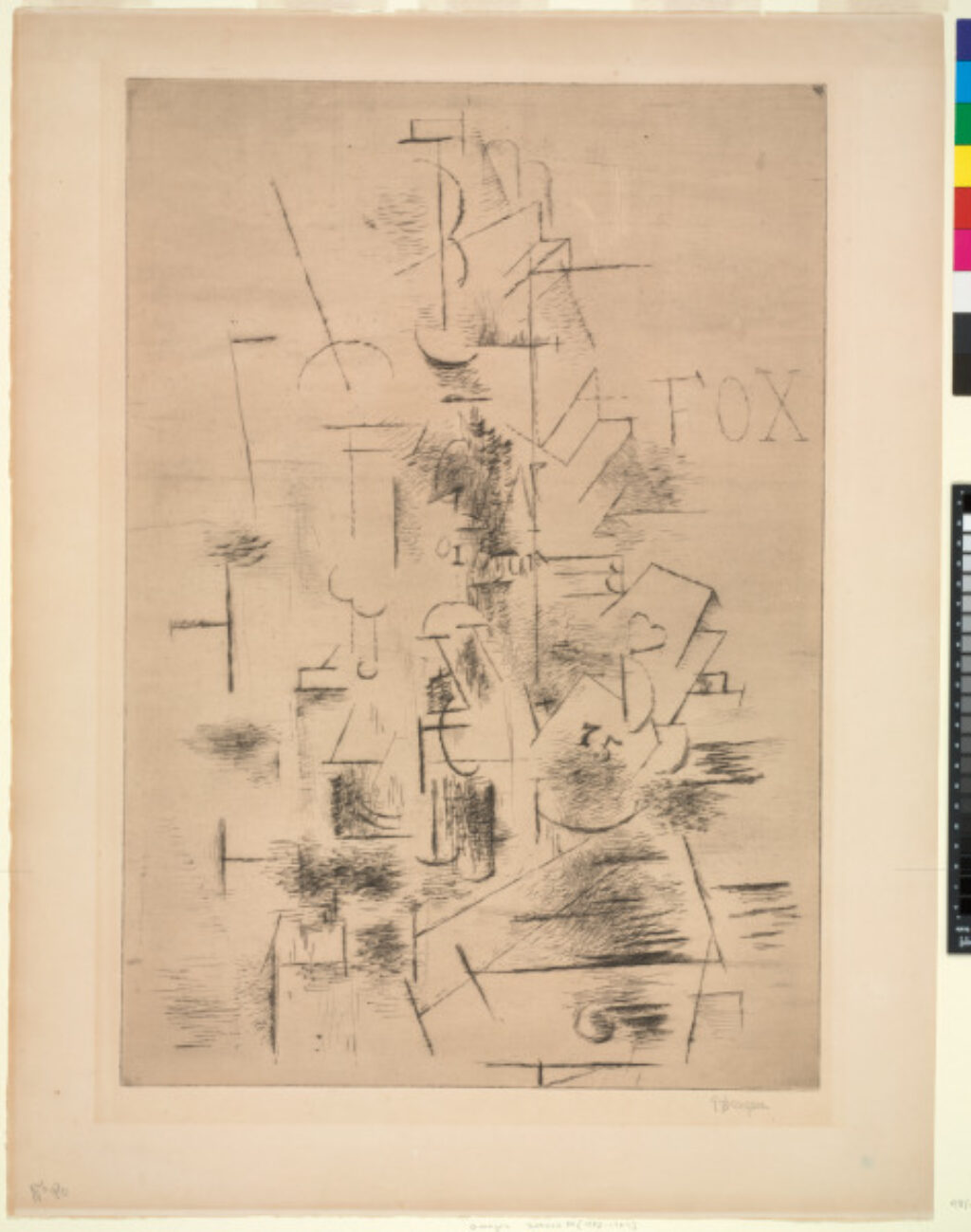
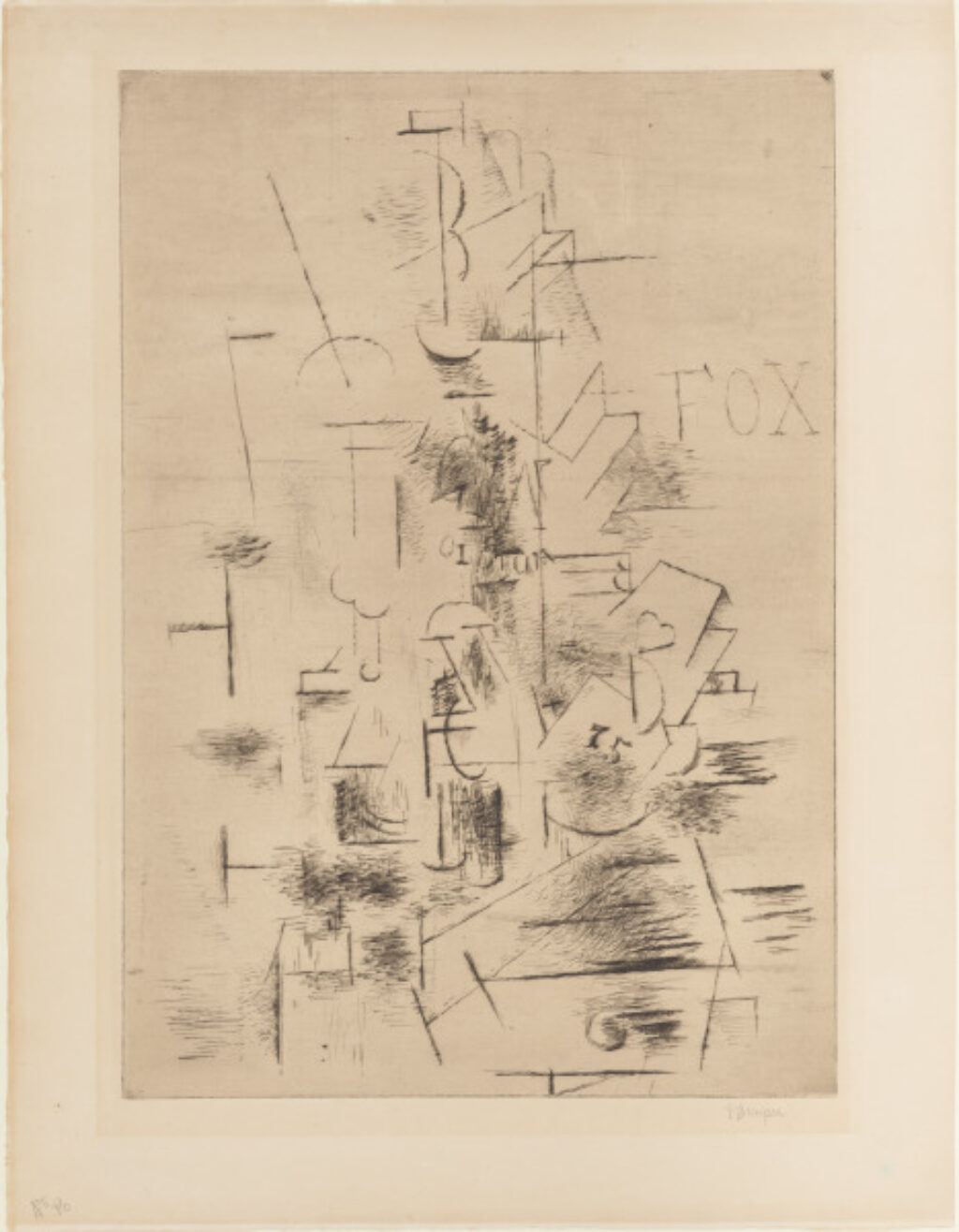
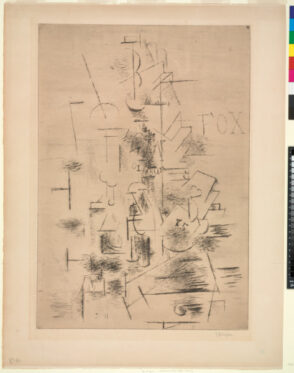
Fox
1911
Scroll
Physical Qualities
Drypoint, Sheet: 654 x 53 mm. (25 3/4 x 2 1/16 in.)
Plate: 545 x 380 mm. (21 7/16 x 14 15/16 in.)
Credit Line
Purchase Fund
Object Number
1958.120
Between 1909 and 1914, Pablo Picasso and Georges Braque shared
an intense visual dialogue that would transform the work of both artists and bring about the birth of Cubism. In 1911, their progressive art dealer, Daniel-Henry Kahnweiler, provided the opportunity for this breakthrough by commissioning prints from both artists.
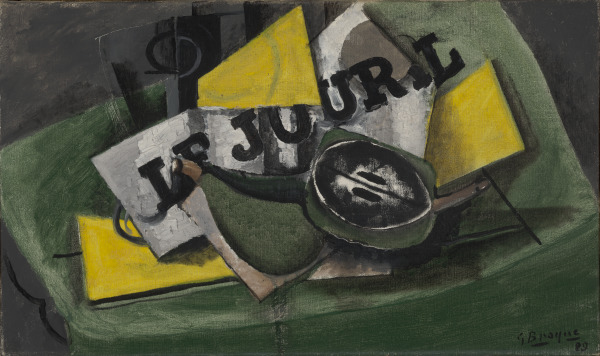
For his commission, Braque created a suite of large-format drypoints, including the abstract composition "Fox", which takes its name from
a sign hanging on the wall of a café.
Picasso, for his part, made etchings for "St. Matorel" (1911), a book of poems by his friend Symbolist poet Max Jacob (1876–1944). The illustrations seen here are two versions of Jacob’s character, Mademoiselle Léonie. Unlike Braque’s "Fox", in which the dry printing emphasizes the linear character of the design, the richly printed impression of Picasso’s etching "Mademoiselle Léonie on a Chaise Longue" draws one’s attention to a more modulated, volumetric approach to Cubism. The two impressions on view were issued in a supplementary edition separate from the publication
of Jacob’s book.
The Baltimore Museum of Art by purchase, 1958; Robert M. Light; Philadelphia Museum of Art; Fiske Kimball
Victor Carlson (organized and circulated by the BMA), "19th and 20th Century Prints and Drawings from The Baltimore Museum of Art." E.B. Crocker Art Gallery, Sacramento, November 3 - December 2, 1973; Honolulu Academy of Art, Honolulu, January 18 - February 17, 1974; The William Hayes Ackland Memorial Art Center, University of North Carolina, Chapel Hill, April 2 - April 21, 1974, no. 4.
BMA, "Master Prints II: Daumier to Picasso," 25 October, 1983 - 15 January, 1984.
BMA, "The Cubist Generation: Prints, Drawings, and Photographs from the Museum Collection," 18 October 1995 - 21 January 1996.
Sona Johnston, BMA organized, "The Art of Still Life from The Baltimore Museum of Art;" circulated to The Academy Art Museum, Easton, August 3 - October 6, 2007; and Mitchell Gallery, St. John's College, Annapolis, August 25, 2010 - October 10, 2010.
Rena Hoisington, The Baltimore Museum of Art, "New Arrivals: Gifts of Art for a New Century," February 7-May 8, 2016.
BMA, "Master Prints II: Daumier to Picasso," 25 October, 1983 - 15 January, 1984.
BMA, "The Cubist Generation: Prints, Drawings, and Photographs from the Museum Collection," 18 October 1995 - 21 January 1996.
Sona Johnston, BMA organized, "The Art of Still Life from The Baltimore Museum of Art;" circulated to The Academy Art Museum, Easton, August 3 - October 6, 2007; and Mitchell Gallery, St. John's College, Annapolis, August 25, 2010 - October 10, 2010.
Rena Hoisington, The Baltimore Museum of Art, "New Arrivals: Gifts of Art for a New Century," February 7-May 8, 2016.
Inscribed: lower right in graphite: "G. Braque"


![LEAVES COLOR LIGHT [FEUILLES COULEUR LUMIÈRE]](https://artbmadevsite.org/wp-content/uploads/2026/02/34917_28189044.jpg)