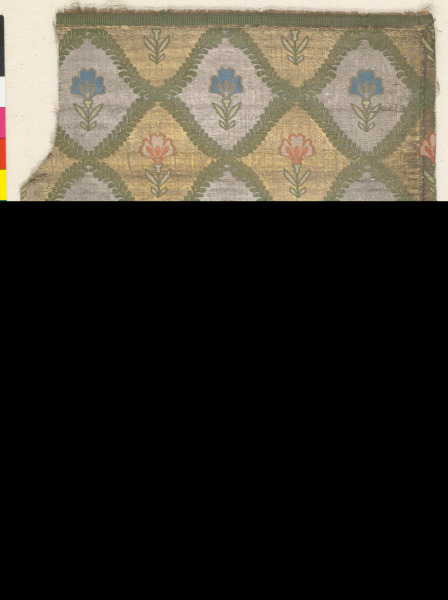
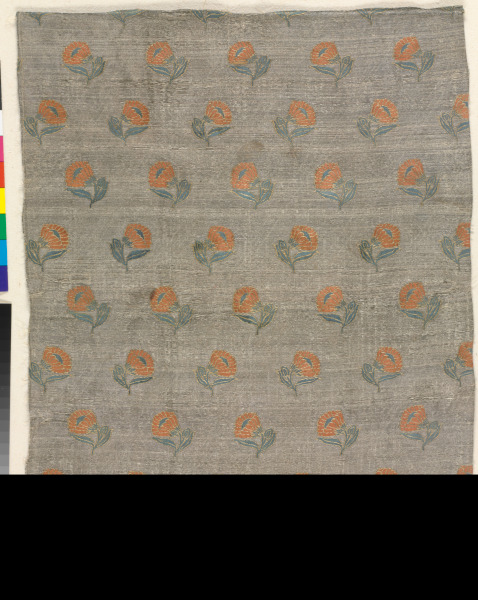
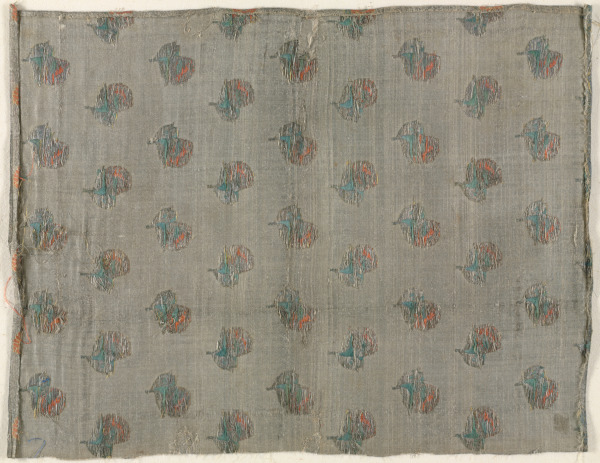
Fragment of Brocaded and Stamped Metallic Ground Fabric
1600-1699
Scroll
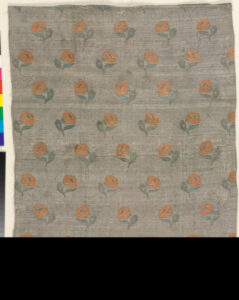
Fragment of Brocaded and Stamped Metallic Ground Fabric
1600-1699
Physical Qualities
Silk, metallic-wrapped wefts, 20 × 15 1/2 in. (50.8 × 39.4 cm.)
Credit Line
Gift of Blanche Adler
Object Number
1929.17.10j
LABEL COPY FOR:
"Floral Designs in Textiles"
The Baltimore Museum of Art
July 25-Nov. 12, 1989
Curator: Anita Jones
Fragment of Metal-ground Fabric
India
(17th century)
Silk, metallic-wrapped wefts
The Baltimore Museum of Art
Gift of Saidie May and Blanche Adler
BMA 1929.17.10J
Flower designs in Persian textiles tend to follow two conventional patterns. Either they are somewhat stiff and symmetrical, or they are asymmetrical, the flowers bending in a graceful curve, leaning to the left in one row and to the right in the next. During the reign of the Mughal emperors from the second half of the 16th century, Indian textiles exhibited Persian influence; therfore it is not always possible to distinguish between textiles from these two cultures. Shiny metal-ground textiles with similar patterns are found in both Mughal and Safavid (Persian) paintings of the 17th century. According to recent studies, the different weave structures seen in these metal-ground textiles may eventually be used to distinguish their origin.
The Baltimore Museum of Art by gift, 1929; Blanche Adler.
Adele Coulin Weibel, Two Thousand Years of Textiles: The Figured Textiles of Europe and the Near East, New York: Hacker Books, 1972, pl. 122 showed a similar brocaded and stamped textile, which is identified, perhaps erroneously, as Persian.
Carol Bier (ed.), Woven from the Soul, Spun from the Heart: Textile Arts of Safavid and Qajaq Iran 16th-19th Centuries, Washington, D.C.: The Textile Museum, 1987, pp. 236-237, illus. cat. #52 and #53, also see pp. 168-169, cat. #16, illus. of Persian example.
Cyril G. E. Bunt, Persian Fabrics, Leigh-on-Sea: F. Lewis Publishers, Ltd., 1963, fig. 32
Weaves in Hand-Loom Fabrics. VI. Brocading
Author(s): Nancy Andrews Reath
Source: Bulletin of the Pennsylvania Museum, Vol. 22, No. 113 (May, 1927), pp. 382-389
Published by: Philadelphia Museum of Art
Stable URL: http://www.jstor.org/stable/3794356
Accessed: 10-11-2017 21:41 UTC.
Carol Bier (ed.), Woven from the Soul, Spun from the Heart: Textile Arts of Safavid and Qajaq Iran 16th-19th Centuries, Washington, D.C.: The Textile Museum, 1987, pp. 236-237, illus. cat. #52 and #53, also see pp. 168-169, cat. #16, illus. of Persian example.
Cyril G. E. Bunt, Persian Fabrics, Leigh-on-Sea: F. Lewis Publishers, Ltd., 1963, fig. 32
Weaves in Hand-Loom Fabrics. VI. Brocading
Author(s): Nancy Andrews Reath
Source: Bulletin of the Pennsylvania Museum, Vol. 22, No. 113 (May, 1927), pp. 382-389
Published by: Philadelphia Museum of Art
Stable URL: http://www.jstor.org/stable/3794356
Accessed: 10-11-2017 21:41 UTC.
Inscribed: None.