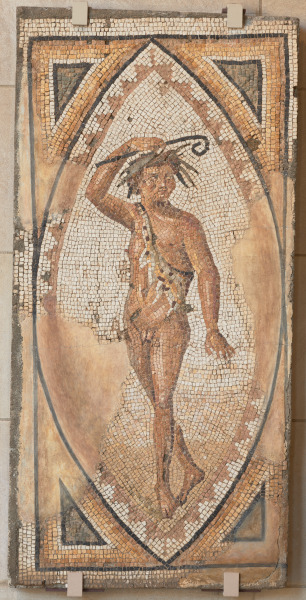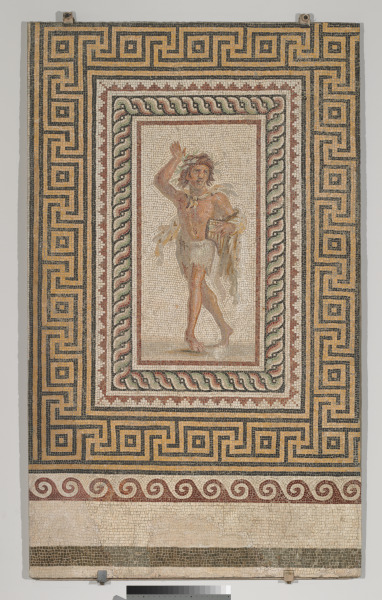

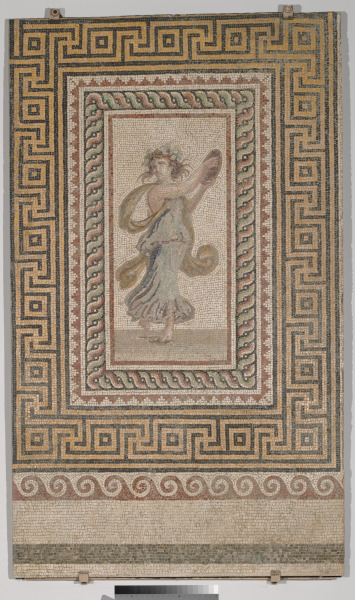
Fragment of floor mosaic depicting a dancing maenad
100-133
Scroll
Fragment of floor mosaic depicting a dancing maenad
100-133
Physical Qualities
Stone, glass, lime mortar, 74 1/2 x 44 1/2 x 3 in. (189.2 x 113 x 7.6 cm.)
Credit Line
Antioch Subscription Fund
Object Number
1933.52.1
Garments and hair whirling from their frenzied dancing, the half-man, half-goat satyr and the maenad—a female devotee of the Greek god of wine, Dionysos—mirror each other’s movements. Dance played an important role in Dionysiac rites, and these figures originally flanked a mosaic panel showing Dionysos’ triumph over the demi-god Herakles in a drinking contest. Depictions of satyrs and maenads often decorated spaces and objects involved in the symposium, a ritualized drinking event practiced by both Greeks and Romans in which participants showed off their sophistication and culture.
Kevin Tervala, Antioch Interpretation Refresh, September 1, 2022
George W. Elderkin, ed., "Antioch-on-the-Orontes I: The Excavations of 1932," Princeton: The Princeton University Press, 1934, p. 42ff and pl. VI.
C.R. Morey, "The Mosaics of Antioch," Longmans, Green & Co., 1938, pp. 27-28, pl. III
Doro Levi, "Antioch Mosaic Pavements," Princeton: Princeton University Press, 1947, vol. I, pp. 21-23 & 519; vol. II, pl. CXLVII-b.
R. Stead, 'Pavements from a Fabled City,' "Pharos," Museum of Fine Arts, St. Petersburg, Florida, Fall/Winter 1964, pp. 5-8.
Sheila Campbell, ed., "The Mosaics of Antioch," Toronto, 1988, pp. 21-22, pl. 74.
Kondoleon, Christine, ed. Antioch: The Lost Ancient City. Princeton, NJ: Princeton University Press in association with the Worcester Art Museum, 2000. pp 170-171, ill.
Scott Redford, Editor, "Antioch on the Orontes: Early Explorations in the City of Mosaics," Istanbul, Turkey: Universitesi Yayinlari, 2014, p. 167-168, ill.
 On View at the BMA