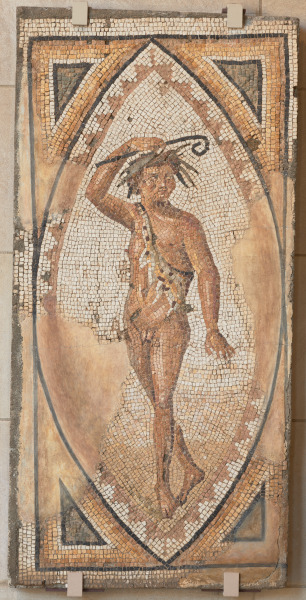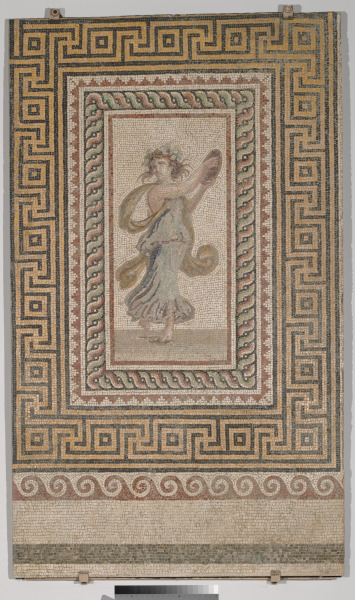

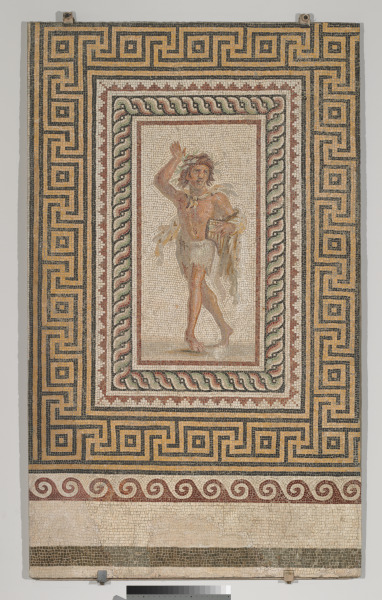
Fragment of floor mosaic depicting a dancing satyr
100-133
Scroll
Fragment of floor mosaic depicting a dancing satyr
100-133
Physical Qualities
Stone, glass, and lime mortar, 73 5/8 x 44 1/2 x 2 7/8 in. (187 x 113 x 7.3 cm.)
Credit Line
Antioch Subscription Fund
Object Number
1933.52.2
Garments and hair whirling from their frenzied dancing, the half-man, half-goat satyr and the maenad—a female devotee of the Greek god of wine, Dionysos—mirror each other’s movements. Dance played an important role in Dionysiac rites, and these figures originally flanked a mosaic panel showing Dionysos’ triumph over the demi-god Herakles in a drinking contest. Depictions of satyrs and maenads often decorated spaces and objects involved in the symposium, a ritualized drinking event practiced by both Greeks and Romans in which participants showed off their sophistication and culture.
George W. Elderkin, ed., "Antioch-on-the-Orontes I: The Excavations of 1932," Princeton: The Princeton University Press, 1934, p. 42ff and pl. VI.
C.R. Morey, "The Mosaics of Antioch," Longmans, Green & Co., 1938, pp. 27-28.
Scott Redford, Editor, "Antioch on the Orontes: Early Explorations in the City of Mosaics," Istanbul, Turkey: Universitesi Yayinlari, 2014, pp. 222-223, fig. 47, ill.
Doro Levi, "Antioch Mosaic Pavements," Princeton: Princeton University Press, 1947, vol. I, p. 21-23 & 519, vol. II, pl. CXLVII-a.
"A Picture Book," Baltimore: Baltimore Museum of Art, 1955, ill. p. 11.
R. Stead, "Pavements from a Fabled City," "Pharos," Museum of Fine Arts, St. Petersburg, Florida, Fall/Winter 1964, pp. 5-8.
Sheila Campbell, ed., "The Mosaics of Antioch," Toronto, 1988, pp. 21-22, pl. 74.
Kondoleon, Christine, ed. Antioch: The Lost Ancient City. Princeton, NJ: Princeton University Press in association with the Worcester Art Museum, 2000, p. 172, ill.
Scott Redford, Editor, "Antioch on the Orontes: Early Explorations in the City of Mosaics," Istanbul, Turkey: Universitesi Yayinlari, 2014, p. 167-168, ill.
 On View at the BMA