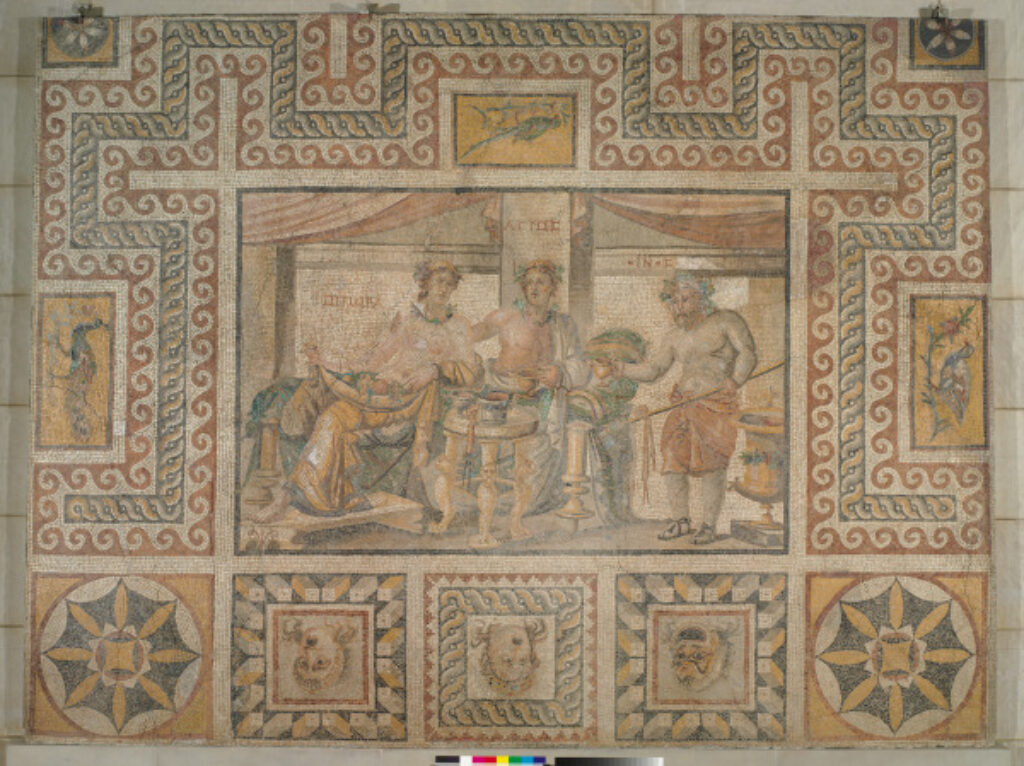
Fragment of floor mosaic depicting a Opora, Agros, and Oinos at dinner
201-300
Scroll
Fragment of floor mosaic depicting a Opora, Agros, and Oinos at dinner
201-300
Physical Qualities
Stone, glass, and lime mortar, 94 1/2 x 124 1/2 x 2 1/2 in. (240 x 316.2 x 6.4 cm.)
Credit Line
Antioch Subscription Fund
Object Number
1937.127
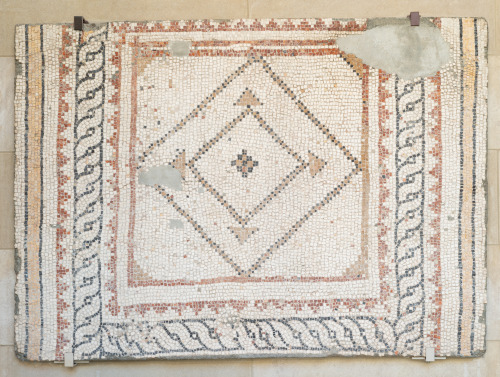
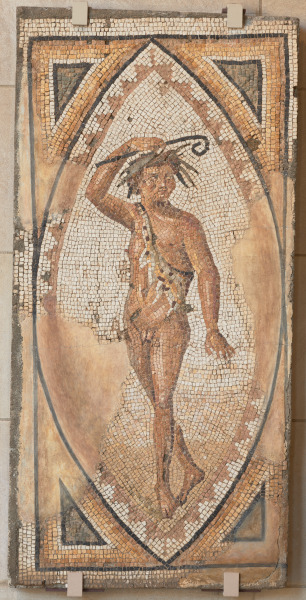
Red labels identify these figures as personifications of Opora (Harvest) at left, Agros (Field) at center, and Oinos (Wine) at right. The ancient cities of Antioch and Daphne were located in an agriculturally rich valley called the Amuq Plain, and wealthy citizens of this region frequently gathered for feasts and wine parties. Just as in this image, these banqueters reclined on couches arranged around three sides of a central, and oftentimes figurative, mosaic. This fragment came from one of at least four dining spaces in a structure known as the “House of the Boat of Psyches.”
C. R. Morey, Museum Quarterly II, BMA, 1937-1938, no. 4, p. 4.
"Antioch-on-the Orontes, II, The Excavations, 1932-1936," Princeton: Princeton University Press, 1938, no. 53, pp. 185-6, pl. 40.
C.R. Morey, "The Mosaics of Antioch," Longmans, Green & Co., 1938, pp. 33-34, pl. IX.
Doro Levi, "Antioch Mosaic Pavements," Princeton: Princeton University Press, 1947, vol. I, p. 168, fig. 64, pp. 186-187, vol. II, pl. XLIIa-b.
"A Picture Book," Baltimore: Baltimore Museum of Art, ill. p. 10.
R. Stead, "Pavements from a Fabled City," "Pharos," Museum of Fine Arts, St. Petersburg, Florida, Fall/Winter 1964, pp. 5-8.
Christine Kondoleon, "Antioch The Lost Ancient City," Princeton, 2000, figs. 5 & 7, pp. 59-61 and 70-73.
Baltimore Museum of Art. The Baltimore Museum of Art: Celebrating a Museum. Baltimore: The Baltimore Museum of Art, 2014.
Rogers, Dylan K. and Claire J. Wiess, eds. A Quaint & Curious Volume: Essays in Honor of John J. Dobbins. Oxford: Archaeopress Publishing Ltd, 2021
Inscribed: Greek inscription on face
 On View at the BMA