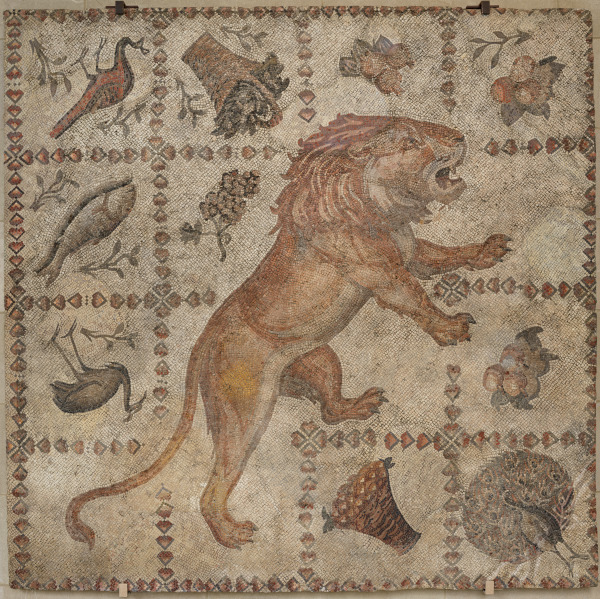
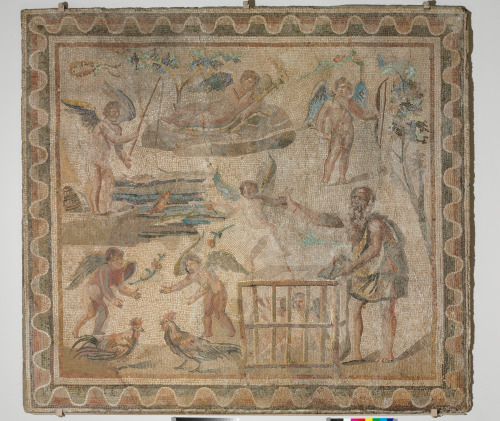
Fragment of floor mosaic depicting a peddler of Erotes
201-300
Scroll
Fragment of floor mosaic depicting a peddler of Erotes
201-300
Physical Qualities
Stone, glass, and lime mortar, 87 x 97 1/2 x 2 in. (221 x 247.7 x 5.1 cm.)
Credit Line
Antioch Subscription Fund
Object Number
1937.128
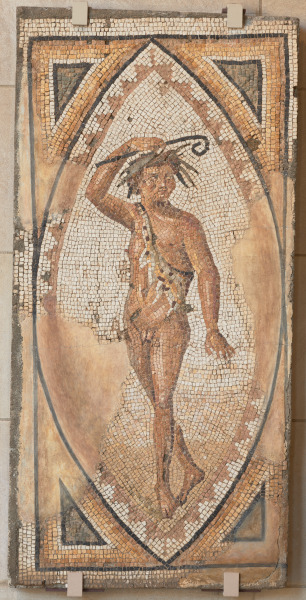
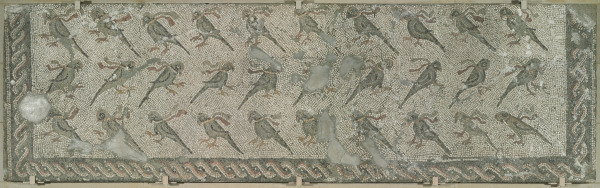
Water shimmers and wings glint thanks to the vibrant blue and iridescent green glass embedded in this floor mosaic. The use of these reflective, colored tesserae makes the
natural world inhabited by winged gods, known as the Erotes, seem lush and idyllic. In contrast, the peddler— the man capturing and caging these frolicking Erotes—is
depicted in duller, more muted limestone.
Stone, the most common element in these mosaics, was quarried locally, perhaps no more than a few miles from the city. Making glass, however, required mineral compounds
shipped from as far away as Egypt.
Love Gods, in the Company of Aphrodite
C. R. Morey, Museum Quarterly II, BMA, 1937-1938, no. 4, p. 4.
"Antioch-on-the Orontes, II, The Excavations, 1932-1936," Princeton: Princeton University Press, 1938, no. 64, pp. 189-190, pl. 48.
C.R. Morey, "The Mosaics of Antioch," Longmans, Green & Co., 1938, p. 32, pl. VII.
Doro Levi, "Antioch Mosaic Pavements," Princeton: Princeton University Press, 1947, vol. I, pp. 191-193, fig. 71, vol. II, pl. XLIII-a.
R. Stead, "Pavements from a Fabled City," "Pharos," Museum of Fine Arts, St. Petersburg, Florida, Fall/Winter 1964, pp. 5-8.
Panosky, Erwin. Essais d'iconologie: Themes humanistes dans l'art de la Renaissance. Paris: Éditions Gallimard, 2021
Valladares, Hérica. (Translated from English by Philippe Hunt). "Comment peindre une ekphrasis? L'offrand à Vénus de Titien et les limites de la description." La Part de l'Oeil 37 (2023): 82-109. ill. p. 90.
 On View at the BMA