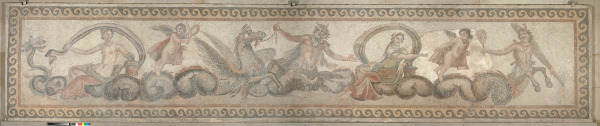
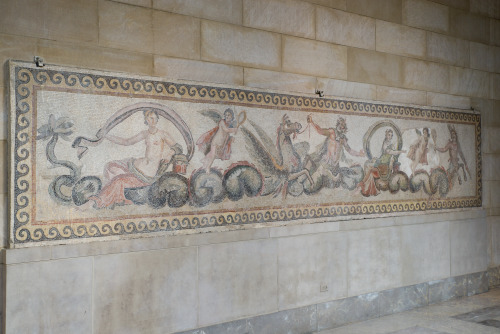
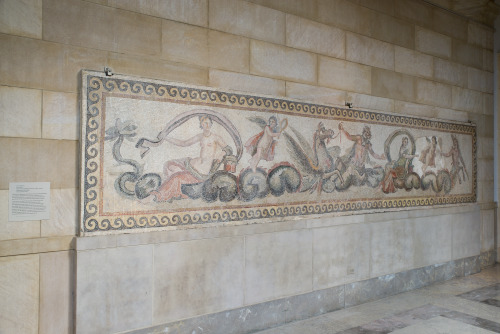
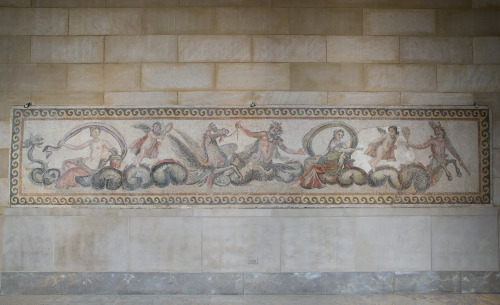
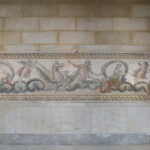
Fragment of floor mosaic depicting a procession of sea gods and creatures
101-200
Scroll
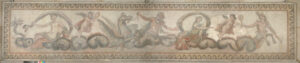
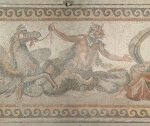
Fragment of floor mosaic depicting a procession of sea gods and creatures
101-200
Physical Qualities
Stone and lime mortar, 241 x 51 in. (612.4 x 129.6 cm.); 4271.25 lbs.
Credit Line
Antioch Subscription Fund
Object Number
1937.123
Look closely at this energetic procession of sea gods and creatures and you will see figures, such as the winged god on the right, depicted in paint rather than stone or glass. These details were added during the mid-20th century in an attempt to recreate missing tesserae (cubes). Today, conservators use different strategies for dealing with areas of loss in mosaics to both repair the works and to clarify what material is original. Although we cannot know that the winged god on the right was present in the original mosaic, the bearded ichthyocentaur with the head and torso of a man and the fins of a fish, the hippocamp (winged horse), and nereid (sea nymph) were created by 2nd-century mosaicists.
C. R. Morey, Museum Quarterly, BMA, 1937-38, no. 4, p. 4.
"Antioch-on-the-Orontes, II, The Excavations, 1932-1936," Princeton: Princeton University PRess, 1938, no. 44, p. 182, pl. 31.
C.R. Morey, "The Mosaics of Antioch," Longmans, Green & Co., 1938, p. 42.
Doro Levi, "Antioch Mosaic Pavements," Princeton: Princeton University Press, 1947, vol. I, p. 317, vol. II, pl. LXXII-d.
 On View at the BMA