
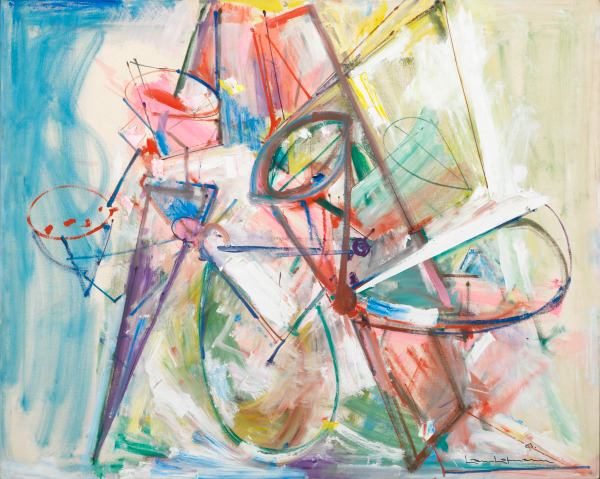
Hans Hofmann
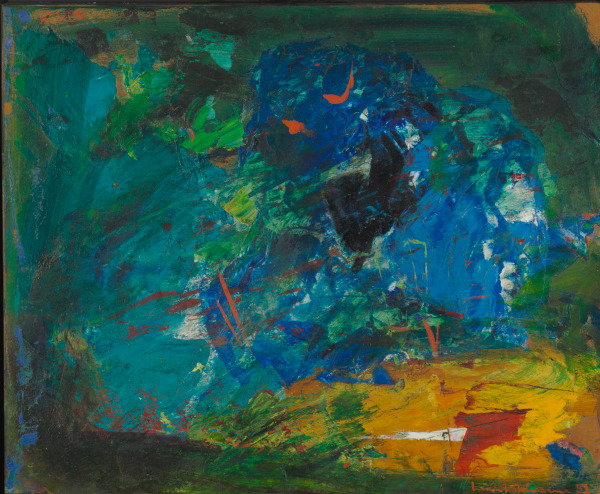
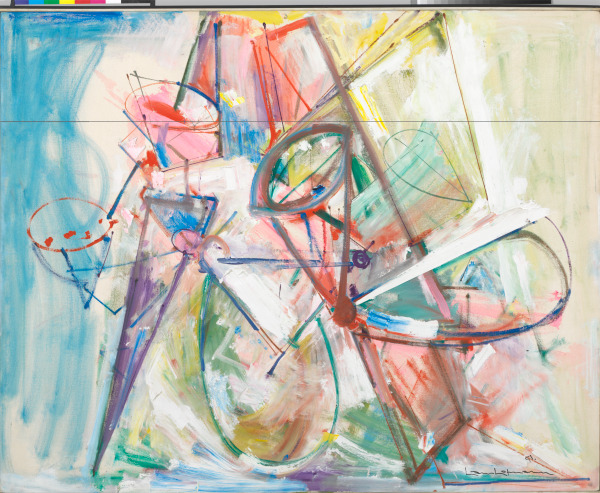
Germania
1950
Scroll
Hans Hofmann
Germania
1950
Physical Qualities
Oil on canvas, Unframed: 48 × 60 in. (121.9 × 152.4 cm.)
Credit Line
Frederic W. Cone Fund
Object Number
1954.253
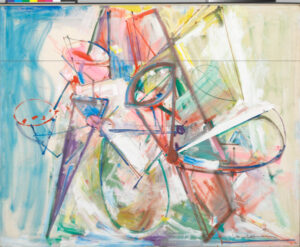
German-born Hans Hofmann helped import European sophistication to New York when he moved there in 1932. Gifted in science, math, music, and art, he left behind an enormous legacy, both as an artist and a teacher. Hoffman was a member of the cosmopolitan avant-garde who saw the artist as “an agent in whose mind nature is transformed into a new creation.” His works of the 1940s and early 1950s parallel abstract expressionist works by Americans such as Jackson Pollock, whose Water Birds is on view nearby. Pollock encouraged Hoffmann to stage his first New York one-artist show at Peggy Guggenheim’s gallery, Art of This Century. The title, Germania, pays homage to twin streams in Hoffmann’s work. Heavy impasto and thin, rapidly brushed negative areas acknowledge the subjective emotional intensity of German Expressionism. Hoffman’s tensely poised prismatic forms assembled into a well contained composition derive from teachings at the Bauhaus (1919-1933). The name of this radical German art school translates literally as “house of construction;” its approach to design combined crafts with fine art. The minimalist strip frame is original to the picture.
The Baltimore Museum of Art by purchase, 1954; from the artist
AMW Reinstallation 2014
Adelyn Breeskin: Curating a Legacy
"Baltimore Museum of Art News," February 1955, pp. 9-12, ill. p. 11.
"A Picture Book," Baltimore: The Baltimore Museum of Art, 1955, p. 84.
Dore Ashton, 'Summer Night's Bliss, A new Painting by Hans Hofmann,' "Baltimore Museum of Art News Quarterly," 25:3, Spring 1962, pp. 4-8, ill. p. 8.
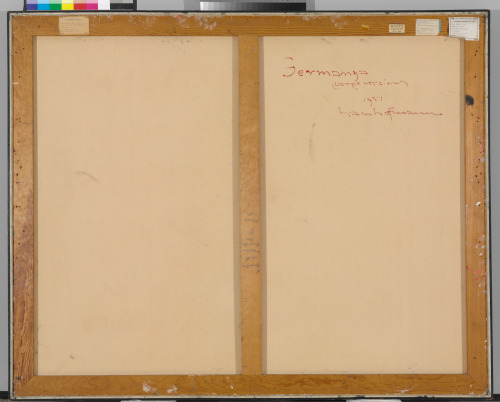
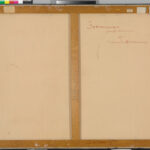
Inscribed: Recto, LR: "51 Hans Hofmann" Verso: "Germanya (large version) 1951 Hans Hofmann"