Akan
Gold-Dust Weight (Abrammuo)
Akan, 1699-1899
Scroll
Akan
Gold-Dust Weight (Abrammuo)
Akan, 1699-1899
Physical Qualities
Brass, 3.9 H x 2.0 W cm.
Credit Line
Gift of Helen 'Muffie' Lippincott McElhiney, Bethesda, Maryland
Object Number
1988.1131
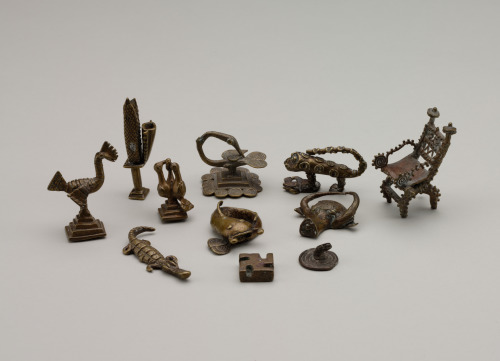
Large gold mines in Ghana formed one of the principle bases for the rise of the Asante kingdom that saw its zenith in the 18th and 19th centuries. Early trade was conducted through ancient Mali to North Africa and then to Europe. By the 15th century, brass gold-dust weights had been developed by the Asante, based on ancient Islamic weight standards. Geometric weights took on designs derived from old Asante motifs. Other weights were made in naturalistic forms, many of these referring to Asante proverbs. For example, a group of birds pecking palm-nuts from a palm tree relates to a proverb, "When the palm-nuts ripen, all birds partake of them"; i.e., when opportunity comes, take advantage of it.
Most gold-dust weights were made by the lost-wax method. First the object was formed in wax. This was encased in clay and then heated. After the melted wax was poured out, brass was poured in and cooled to a solid. Other objects were made by the "lost-beetle method"; a natural object such as a beetle or a peanut shell was used in the cast itself to form an exact replica.
Gold-dust weights were often put to ritual and cultural use as well as to the practical use of weighing gold. By the end of the 19th century, with the fall of the Asante kingdom, gold-dust weights fell out of use, although reproductions continued to be made for sale through the present century.
Baltimore Museum of Art by gift, 1988; Helen McElhiney (1920-2014) by purchase in Ghana 1968-1971
African Reinstallation
Frederick John Lamp, "See the Music Hear the Dance: Rethinking African Art at the Baltimore Museum of Art." New York: Prestel, 2003, p,125, ill.