Kwere
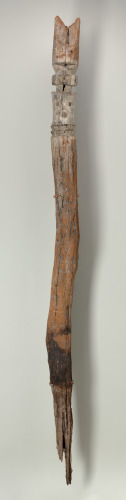
Grave Witness (Shahidi wa Kaburi)
1900-1932
Scroll
Kwere
Grave Witness (Shahidi wa Kaburi)
1900-1932
Physical Qualities
Wood, pigment, 80 × 4 × 3 in. (203.2 × 10.2 × 7.6 cm.)
Credit Line
Purchased as the gift of the Friends of the Arts of Africa, the Pacific and the Americas
Object Number
2018.34
On the northeast coast of Tanzania, monumental posts mark the final resting spot of important individuals from the Kwere and Zaramo ethnic groups. Upon the death of a community leader, carvers would work with family members to design the look of each memorial. As a result, every post is a unique work of art. Some were sculpted to resemble the deceased. Others reference motifs in the visual culture of the region. This particular work depicts Mwana Hiti, a male-female figure who represents ancestral presence and authority. The relatively unembellished form of the figure reflects the non-human status of the figure. However, while the body of the figure is relatively undefined, the carver masterfully convey dignity and deep intelligence with the intersecting planes of the face and forehead. Although sometime stolen from their place of origin, this grave witness was sold by in 1939 by Tabora Kahusha, an indigenous trader in the country then called Tanganyika.
The raw emotion sculpted onto the faces of these figures resonates with the human experience of pain, loss, and suffering. These artworks were created to memorialize the dead and heal the sick, and their vivid, emotional realism allows them to speak across time and space. Although their bodies may appear crude or unrefined, their emotions are all too real.
The Baltimore Museum of Art by purchase, 2018; David Ackley, Baltimore, 2017; Kassner Collection, New York, 1939-2017; Tabora Kahusha, Kipili, Tanzania, unknown to 1939
Subverting Beauty: African Anti-Aesthetics