William Morris and Morris & Company
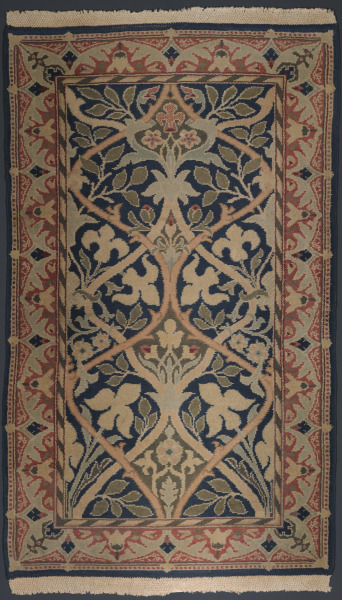
Hammersmith Carpet
1879-1909
Scroll
Physical Qualities
Wool pile, cotton warp, wool binding weft, 101 1/2 x 57 in. (257.8 x 144.8 cm.)
Credit Line
Gift of Jean and Sidney Silber, Lutherville, Maryland
Object Number
2010.59
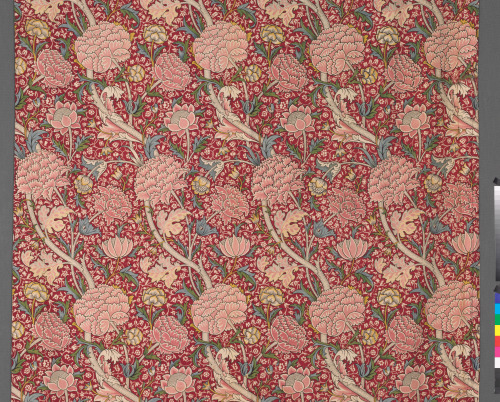
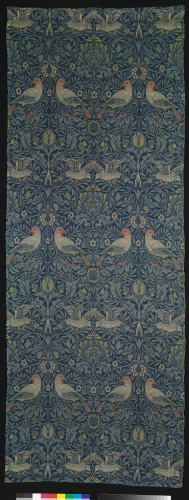
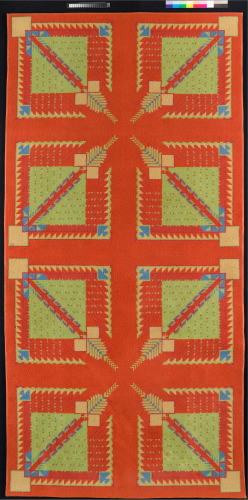
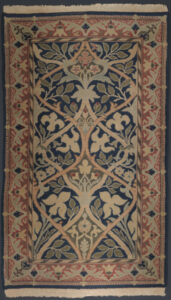
As the foremost textile and decorative arts designer of the late 19th century and the father of the Arts and Crafts movement in England, William Morris was an advocate for social and aesthetic reform. In his carpets, as in his tapestries, embroideries, printed and woven textiles, Morris sought to raise standards by reviving hand production and reinstituting the use of vegetable rather than synthetic dyes. In 1877, Morris began making carpets at Kelmscott House, his home overlooking the Thames near the town of Hammersmith. There and later at his factories at Merton Abbey, carpets such as this one were knotted by hand following Morris's designs. The two-dimensional graphic quality, interlacing ogee grid, multiple borders, Western floral motifs, and soft vegetable dye coloring favored by Morris are apparent in this example. More unusual, is the rug's single orientation, indicating that it may have been intended to hang on the wall. Morris was known to display oriental carpets on the wall in his own home in appreciation of their artistry.
Baltimore Museum of Art by gift, 2010; Jean and Sidney Silber, Lutherville, MD, by purchase, 1987; David Black Oriental Carpets, London
Curator's Choice Rotation
New Arrivals: Gifts of Art for a New Century
Haslam Malcom, Arts & Crafts Carpets, London: David Black, 1991, pp. 71-72, illus. p. 72.
Clive Edwards, Encyclopedia of Furnishing Textiles, Floorcoverings and Home Furnishing Practices, 1200 -1950, pp. 119-120, illus. p. 119, similar Hammersmith carpet, c. 1880.
Ray Watkinson, William Morris as designer, New York: Van Nostrand Reinhold Company, 1983, 1st ed. paperback,
pp. 54-57, figs. 54-55, fig. 55 designed in 1889 for Sanderson house "Bullerswood" in Kent. Handknotted. Wool on cotton warp, V&A.
Linda Parry, William Morris Textiles, New York: The Viking Press: A Studio Book, 1983, pp. 74-99.
Linda Parry, William Morris, London: Victoria and Albert Museum, pp. 278-284.
Anthea Callen, "Sexual Division of labor In the Arts and Crafts Movement," Woman's Art Journal, Vol. 5, No. 2 (Autumn, 1984-Winter, 1985), pp. 1-6.
Ray Watkinson, William Morris as designer, New York: Van Nostrand Reinhold Company, 1983, 1st ed. paperback,
pp. 54-57, figs. 54-55, fig. 55 designed in 1889 for Sanderson house "Bullerswood" in Kent. Handknotted. Wool on cotton warp, V&A.
Linda Parry, William Morris Textiles, New York: The Viking Press: A Studio Book, 1983, pp. 74-99.
Linda Parry, William Morris, London: Victoria and Albert Museum, pp. 278-284.
Anthea Callen, "Sexual Division of labor In the Arts and Crafts Movement," Woman's Art Journal, Vol. 5, No. 2 (Autumn, 1984-Winter, 1985), pp. 1-6.
Manufacturer
Morris & Company
1874–1939
1875-1940; working at Kelmscott House, Hammersmith, 1877-1881, or Merton Abbey, 1881-1940
Meet Morris →