
Yup'ik
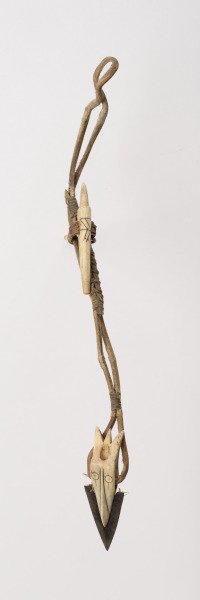
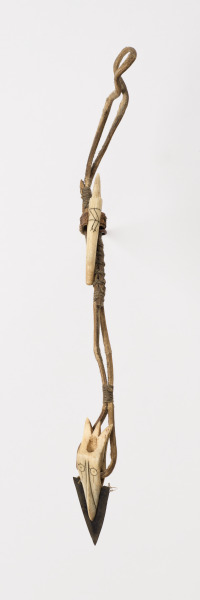
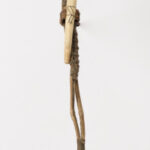
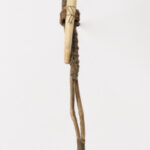
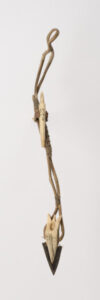
Harpoon Head (Toggling) and Foreshaft
Inuit, 1800-1899
Scroll
Yup'ik
Harpoon Head (Toggling) and Foreshaft
Inuit, 1800-1899
Physical Qualities
Rawhide, bone, copper alloy, 10 13/16 in. (approx.) (27.5 cm.)
Credit Line
John Erikson Collection
Object Number
1955.167.63a-b
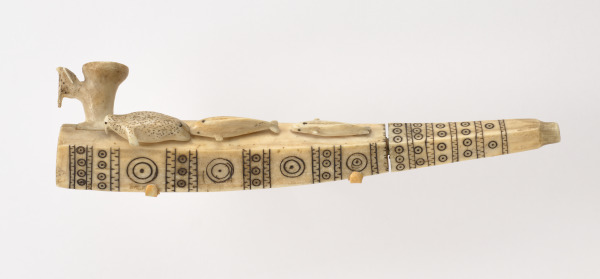
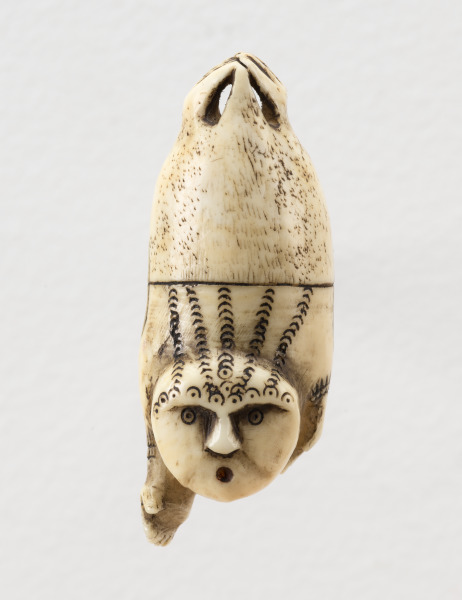
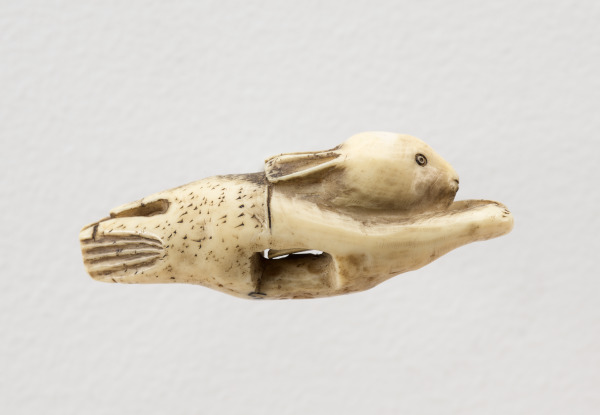
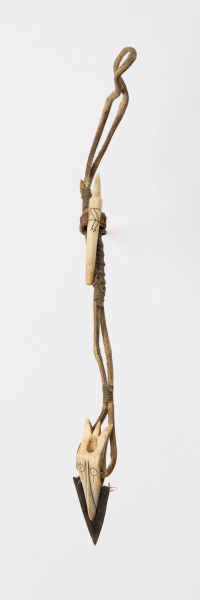
Like their ancestors, Iñupiaq and Yup’ik artists of the 19th century adorned utilitarian objects with carvings. Hunters used implements like the harpoon point with a circle-and-dot pattern and the throwing board to hunt sea mammals. This throwing board effectively lengthened the hunter’s arm, so that the harpoon or dart resting in the groove was launched with greater power, speed, and distance. The animals carved in ivory here reveal the deep relationship between the hunter and the hunted and reflect the hunter’s respect.
Purchased by John Erikson in Alaska ca. 1900
Arctic Artistry
"Native Arts of the Pacific Northwest," Portland Art Museum, California, 1949, ill. 138-140.
"INUA: Spirit World of the Bering Sea Eskimo," 1982, pp. 81, 83, and 242, ill. 61, 64, 291.
Wm Strutevant, ed., "Handbook of North American Indians," vol. 5: "Arctic," (D. Damas, volume ed.), Washington: Smithsonian Institution, 1984, pp. 43, 328.
"INUA: Spirit World of the Bering Sea Eskimo," 1982, pp. 81, 83, and 242, ill. 61, 64, 291.
Wm Strutevant, ed., "Handbook of North American Indians," vol. 5: "Arctic," (D. Damas, volume ed.), Washington: Smithsonian Institution, 1984, pp. 43, 328.
Inscribed: none