Hugh Newell
Harvest Scene
1873
Scroll
Hugh Newell
Harvest Scene
1873
Physical Qualities
Oil on canvas, Sight: 21 1/8 x 35 1/4 in. (53.7 x 89.5 cm) Framed: 32 1/2 x 45 3/4 x 6 1/8 in. (82.6 x 116.2 x 15.6 cm)
Credit Line
Bequest of William Bose Marye, Baltimore
Object Number
1980.105
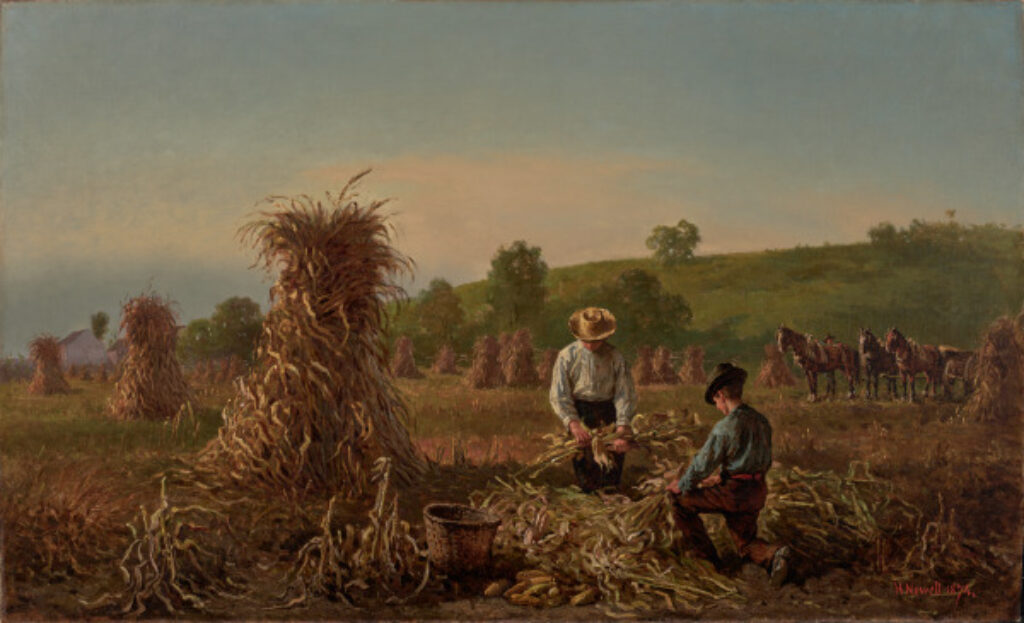
Winslow Homer and Hugh Newell focused on the theme of agricultural labor
in these two paintings. In Homer’s Waiting an Answer, the young farmer pauses
his work to gaze steadily at the young woman before him. Newell’s Harvest Scene
depicts two figures harvesting corn in the bright sunshine. Placing their subjects
in rural settings, both Homer and Newell drew on the affinity of wealthy, white,
urban collectors for idealized scenes set in nature. Works such as these offered
an escape from the economic upheavals and social changes in the years following
the American Civil War (1861–1865). Yet the youthful demeanor of the figures
in both paintings allude to a missing generation of older farmers who did not
return from battle.
William Bose Marye, Baltimore
Possibly, NAD, New York, 1882, vol. 2, p. 682, no. 467 (as Husking Corn in the Field)
Sona K. Johnston, "American Painting 1750-1900 from the Collection of The Baltimore Museum of Art," 1983, pp. 111-112, ill. p. 112.
Inscribed: l.r. in red, H. Newell. 1874


 On View at the BMA